Another milestone today: I weighed in at 91.4kg this morning, 51.2kg lighter than where I started. There’s now just 1.4kg to lose to hit my primary target. My newest exercise shorts are size S — six sizes smaller than what I was wearing in January. In fact, I can easily fit into one leg of those old shorts now.
I weigh less than at any point in my adult life. I have records stretching back to the last 10 years worth of battling with my weight, but I’ve never come this far. And as for before that? I don’t have records, but I know that I weighed 15 stone (95kg) by the time I was 16. I think I can safely claim that I am now leaner, faster, fitter, and stronger than ever. I am in the best physical condition that I have been in my life. Something else that’s been entirely new to me has been picking out a new wardrobe, and for the first time in my life, actually enjoying the clothes I’m wearing. This has been such a paradigm-shift for me that I’ll blog about it separately soon. My world has changed.
The rate of loss over the last few months has been maddeningly slow compared to the weight that was just falling off me at the beginning; and I feel myself losing patience and momentum. So, to ensure I’m maintaining a meaningful calorie deficit, I’ve upped my morning cardio routine to include a 5km run on the treadmill every day (which is also no doubt helping my ParkRun and fun run times). I’m also trying to do some longer bike rides on the weekends: I’ve now done a couple in the 30-km range and plan to extend these.
So, in another few weeks, I hope to be reaching for a new target — I still have my sights set on 82kg.
Saturday, 5 September 2015

Wednesday, 12 August 2015
Review: Reid Vintage Ladies 7-Speed Classic
Not having acquired the skill in childhood, I recently learned to ride a bike as an adult. I’ve written about that journey elsewhere, so I mention the fact here only because it obviously affects my perspective on the bike I’m about to review. It’s effectively my first bike, and my only basis for comparison are the public-hire CityCycles available in my city. So I’m evaluating this bike purely on its own merits.
Just to recap what I was looking for in my first bike though:
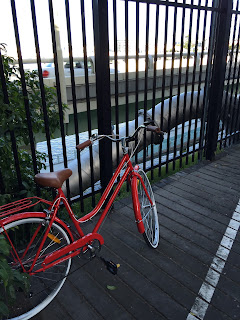
So, on to the review. Well, for a start, I find this to be an insanely good-looking bike. See for yourself!

As pictured, the bike is exactly stock. Note the white bracket at the top of the head tube to which a basket available as an option mounts. I love the little finishing touch of the whitewall tyres too — they’re standard, as are the fenders and rear carry-rack. The finish overall is really nice: shiny, bright, and very cheerful.
I was looking for a comfortable ride, and Reid provided one. At 184 cm (6 ft) tall, I’m right at the top limit Reid recommends for this, the Large-size frame (for people 165 cm to 183 cm tall; the bike is also available in a Small frame, recommended for people between 151 cm and 165 cm tall). Still, even with the seat and handlebars close to their lowest positions, as in the photograph, I could ride comfortably upright, with my arms relaxed and easily able to reach the grips. With the bike properly adjusted (more on this later), it’s even more comfortable.
I found that I got used to the thumb shifter very quickly, so the decision to compromise on my preferred gearing solution turned out OK. The only (slight) downside is that while I was still getting used to commuting by bike, I was gripping the handlebars very firmly and with my right hand very close to the shifter, meaning that I quickly developed a callous on the knuckle of my right index finger that’s only now starting to go down. But I don’t consider this a flaw in the bike itself.
The gears seem ample for my commuting use-case. If anything, I would probably be just as happy with half the number of gears, but I guess it’s nice to have the finer grain there if I ever need it.
The saddle is comfortable, but not nearly as nicely sprung as the CityCycles I learned on, and I will probably replace it sometime soon. The “leatherette” vinyl of the saddle and grips looks attractive, but feels a bit cheap. That’s not something I’m going to complain about on a $200 bike, especially when these items are so easily upgraded at any time.
The only really poor feature on this bike is the chainguard. This is extremely flimsy and easily bent out of shape. Combined with the fact that its design is such that it’s snagged several times on clothing or footwear, I really wonder how long it will last. I’ve already got my eyes open for an after-market replacement (suggestions welcome!)
But overall, I’m extremely happy with this bike. Indeed, although I purchased it with the intention of it being a proof-of-concept bike from which I’d upgrade when I knew I’d continue commuting by cycle, I now can’t see what a dearer bike in a similar style would offer me that I can’t get by just accessorising this one. (But let me know if you think there’s something I’m overlooking. This is my first bike, remember).
I’ll just finish this review with a few thoughts about the experience of buying this bike. Unfortunately, it did leave quite a lot to be desired. When I went into Reid’s Fortitude Valley store on a Saturday, they didn’t have the size and colour combination I wanted right there, but told me they would order it in for me and text me when the bike was ready to pick up, expected to be by Tuesday. They never contacted me, and when I phoned on Thursday to find out what was happening, they confirmed that the bike had arrived and had been ready to pick up for days.
I picked it up on Friday afternoon and rode it home. A number of issues big and small soon set in.
On my way home from work on my fourth day of riding, the saddle suddenly and unexpectedly tipped back while I was in motion. Fortunately, this didn’t result in a fall, but I did need to walk my bike the rest of the way home. It turned out that the nuts securing the saddle to the top of the seat post could have used a lot of tightening. No big deal in daylight and with the right size spanner handy, but disappointing on a new bike and obviously not something you want to happen while actually riding it.
Not dangerous, but annoying, was all the noise that the bike made, especially from the front fender. I initially put it down to a design quirk until I discovered that the nut that secures the fender and front brake caliper to the fork also needed a lot of tightening, at which point the noise went away completely.
Finally, when comparing my bike to another Reid Vintage Ladies 7-Speed Classic that parks in my building, I noticed that the rear brakes were set up very differently, in that the brake pads on mine were very low (at the very bottom of their adjustment slots) so that only half the pad actually contacted the wheel rim. This was different from the front brakes on my bike and from the brakes on the other bike. I moved the brake pads so that all their surface area contacted the rim, and braking became a lot more effective.
If I had to take a guess at what happened, I think someone got most of the way through setting it up before being called away to do something else. Hence final adjustment and tightening never happened and I was never contacted to pick it up.
It would also have been nice for Reid to at least have offered to set the bike up for me when I came in to collect it. I had read about these adjustments during my basic bike research, but had no idea of how much difference it made until I adjusted it myself on the advice of a cycle coach. If I hadn't obtained that third-party opinion, chances are that I'd still be riding a bike today that wasn't even close to being right for me.
As for the customer experience, I have no way of knowing if this was typical for even this Reid store, let alone any other Reid store, and I like to give the benefit of the doubt. So, I'll just say to any other novices out there:
Just to recap what I was looking for in my first bike though:
- Upright riding position
- Platform pedals
- Step-through (“ladies”) frame
- Hub gears and twist shifter
- Pretty!
- Inexpensive
So, on to the review. Well, for a start, I find this to be an insanely good-looking bike. See for yourself!

As pictured, the bike is exactly stock. Note the white bracket at the top of the head tube to which a basket available as an option mounts. I love the little finishing touch of the whitewall tyres too — they’re standard, as are the fenders and rear carry-rack. The finish overall is really nice: shiny, bright, and very cheerful.
I was looking for a comfortable ride, and Reid provided one. At 184 cm (6 ft) tall, I’m right at the top limit Reid recommends for this, the Large-size frame (for people 165 cm to 183 cm tall; the bike is also available in a Small frame, recommended for people between 151 cm and 165 cm tall). Still, even with the seat and handlebars close to their lowest positions, as in the photograph, I could ride comfortably upright, with my arms relaxed and easily able to reach the grips. With the bike properly adjusted (more on this later), it’s even more comfortable.
I found that I got used to the thumb shifter very quickly, so the decision to compromise on my preferred gearing solution turned out OK. The only (slight) downside is that while I was still getting used to commuting by bike, I was gripping the handlebars very firmly and with my right hand very close to the shifter, meaning that I quickly developed a callous on the knuckle of my right index finger that’s only now starting to go down. But I don’t consider this a flaw in the bike itself.
The gears seem ample for my commuting use-case. If anything, I would probably be just as happy with half the number of gears, but I guess it’s nice to have the finer grain there if I ever need it.
The saddle is comfortable, but not nearly as nicely sprung as the CityCycles I learned on, and I will probably replace it sometime soon. The “leatherette” vinyl of the saddle and grips looks attractive, but feels a bit cheap. That’s not something I’m going to complain about on a $200 bike, especially when these items are so easily upgraded at any time.
The only really poor feature on this bike is the chainguard. This is extremely flimsy and easily bent out of shape. Combined with the fact that its design is such that it’s snagged several times on clothing or footwear, I really wonder how long it will last. I’ve already got my eyes open for an after-market replacement (suggestions welcome!)
But overall, I’m extremely happy with this bike. Indeed, although I purchased it with the intention of it being a proof-of-concept bike from which I’d upgrade when I knew I’d continue commuting by cycle, I now can’t see what a dearer bike in a similar style would offer me that I can’t get by just accessorising this one. (But let me know if you think there’s something I’m overlooking. This is my first bike, remember).
The purchasing experience
I’ll just finish this review with a few thoughts about the experience of buying this bike. Unfortunately, it did leave quite a lot to be desired. When I went into Reid’s Fortitude Valley store on a Saturday, they didn’t have the size and colour combination I wanted right there, but told me they would order it in for me and text me when the bike was ready to pick up, expected to be by Tuesday. They never contacted me, and when I phoned on Thursday to find out what was happening, they confirmed that the bike had arrived and had been ready to pick up for days.
I picked it up on Friday afternoon and rode it home. A number of issues big and small soon set in.
On my way home from work on my fourth day of riding, the saddle suddenly and unexpectedly tipped back while I was in motion. Fortunately, this didn’t result in a fall, but I did need to walk my bike the rest of the way home. It turned out that the nuts securing the saddle to the top of the seat post could have used a lot of tightening. No big deal in daylight and with the right size spanner handy, but disappointing on a new bike and obviously not something you want to happen while actually riding it.
Not dangerous, but annoying, was all the noise that the bike made, especially from the front fender. I initially put it down to a design quirk until I discovered that the nut that secures the fender and front brake caliper to the fork also needed a lot of tightening, at which point the noise went away completely.
Finally, when comparing my bike to another Reid Vintage Ladies 7-Speed Classic that parks in my building, I noticed that the rear brakes were set up very differently, in that the brake pads on mine were very low (at the very bottom of their adjustment slots) so that only half the pad actually contacted the wheel rim. This was different from the front brakes on my bike and from the brakes on the other bike. I moved the brake pads so that all their surface area contacted the rim, and braking became a lot more effective.
If I had to take a guess at what happened, I think someone got most of the way through setting it up before being called away to do something else. Hence final adjustment and tightening never happened and I was never contacted to pick it up.
It would also have been nice for Reid to at least have offered to set the bike up for me when I came in to collect it. I had read about these adjustments during my basic bike research, but had no idea of how much difference it made until I adjusted it myself on the advice of a cycle coach. If I hadn't obtained that third-party opinion, chances are that I'd still be riding a bike today that wasn't even close to being right for me.
Summary
I wholeheartedly recommend this bike for anyone who wants to commute with a bit of style.As for the customer experience, I have no way of knowing if this was typical for even this Reid store, let alone any other Reid store, and I like to give the benefit of the doubt. So, I'll just say to any other novices out there:
- if you don't know what you're doing, take an experienced cyclist with you on the day you buy your bike.
- bicycles should be next to silent. If yours is rattling and clanging along, something needs tightening
- bikes should be adjusted to your body. It makes a lot of difference.
- if you didn't have an experienced cyclist with you when you purchased the bike, have one check the bike's mechanicals as soon as possible afterwards: wheels, drivetrain, brakes.
Friday, 7 August 2015
Learning to cycle as an adult: from complete n00b to daily commuter
Here in Australia, it seems that most people acquired two skills in childhood that I never did. One of these is riding a bicycle. When I was about eight years old, my parents did actually buy me one, but being the indoor sort of child that I was, I never developed an interest in it and never learned to use it.
Fast-forward a few decades, and I’ve been looking for ways to boost my level of daily physical activity as part of a plan to lose weight and keep it off. I’ve always walked a lot, and at various points in the past have regularly walked the 5 kilometres each way to and from work. But walking as commuting takes the better part of two hours out of my day and I wondered if cycling would give me a similar energy burn but without taking up so much time. The first challenge, though, was to figure out whether I’d be able to ride a bike.
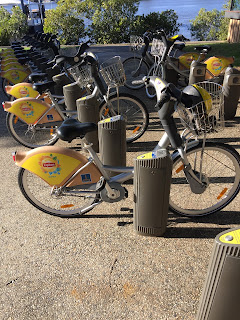 My first conundrum was that I was hesitant to go out and buy a bike when I didn’t know whether I’d be able to learn to ride it. But how to learn to ride a bike without a bike?
Fortunately I had access to a simple and obvious solution: my city (Brisbane) has a public bike-hire scheme (CityCycle). For a small subscription fee, you can access a fleet of bicycles available from racks stationed throughout the inner city. The success of the scheme overall is debatable, but it was a perfect fit for my purpose.
As for actually learning to ride, of course I turned to the Internet. Reading the experiences of other adult learners suggested separating out “riding a bike” into a set of discrete skills. The most fundamental of these was balancing on the bike while in motion. So, following the advice I gleaned online, I set myself the goal of balancing on a CityCycle while it rolled down a grassy slope in a park, using the bike’s brakes—and my feet—to stop it at the end of the slope. Advice I’d read also suggested removing the pedals from the bike while practicing this specific skill, but obviously that wasn’t an option for me!
I also considered lessons from a cycling coach. More on this later.

Early on, I had considered hiring a cycle coach to teach me to ride, but in practice, it proved hard to find a coach at short notice with a schedule that worked in with my already very full one. By the time I’d successfully engaged a coach, there was a two-week wait before my lesson. When I booked it, I assumed that I’d still be learning to balance by then, but instead, I’d already taught myself to ride from the Internet, had bought my own bike, and had even ridden it all the way to work and back!
Nevertheless, I did buy an hour’s coaching with one of the trainers from CycleAway, and it did prove useful. I’ll admit that I was nervous at first, wondering if I’d be judged for buying something other than a “serious” road bike, or for wanting nothing more from cycling than to commute to and from work. But this proved completely unfounded. What I liked straight away was that the trainer listened to my choices and my use case, and then worked with me to optimise for them.
Specific useful advice I took from the session included how to progressively adjust the bicycle to my height, better riding posture to maximise comfort and control for a cruiser-style bike like mine, and (much) better braking technique. These are things that I would have been unlikely to have discovered on my own, so the session was definitely worth it.
This is almost an anti-climax to this story. The next day, Monday, I rode to work instead of taking the train. And I did the same on Tuesday. And I’ve done the same practically every day since then. The only exceptions have been a couple of days that would have required a night ride home before I was comfortable doing that, and a couple of days where I needed to wear a suit and didn't want to cycle in that.
It hasn’t all been lovely, though. The absolute worst thing about learning to ride has been the behaviour of other cyclists. During the first few weeks of commuting, I was a lot slower than any other rider on the bike path, and when making my way up hills, a lot wobblier. During those weeks, I was verbally abused or physically menaced by other riders approximately one day in every two. Usually the menacing took the form of tailgating (do cyclists use that term?), cutting me off after overtaking me or on the inside of the curve while going around bends, or—in one incident—actually running me off the path. I wonder how many would-be cycle commuters have been turned off the idea forever after experiences like these?
Against that, there have been lovely cyclists, who offered words of encouragement and support after witnessing two of the worst such incidents, or who stopped and offered me assistance one day as I walked my bike home with a flat tyre. Those folks have been one of the best things about learning to ride.
But anyway, I’ve stayed with it, and I now do the ride to and from work in about half the time it took me at first.
The scope of my cycling has crept a little too! I bought this bike with the sole intention of riding it only to work and back. However, it wasn’t long before I started using it to replace the car for other trips of under 10km or so, where I would have been the only passenger and where I wasn’t to be carrying large or heavy cargo.
My total outlay to start cycling was about $440:
Against that, I save about $36 per week in public transport fares, so after two months, I’m getting close to recouping my initial outlay. I’ll be revenue-netural in a few more weeks!
Even now, I’m not sure that I’d say that I like cycling. That is, it’s not something I would choose to do for its own sake (“It's a lovely day! I think I’ll go for a ride!”) However, I do know that I like it more than I like catching buses or trains. And I like it more than driving a car under most circumstances. And it does deliver the physical activity I was looking for without taking any more time out of my day than my commute by train did.
I commute in the clothes I work in. My workplace actually has showers and change facilities for cyclists, but I’m not comfortable with the idea of using them. That seems to be OK right now in the winter, but it might force me back onto the trains once Brisbane summer hits and brings with it heat, humidity, and rain. If that’s the case, I hope I’ll be able to overcome inertia and switch back to cycling as temperatures drop again.
I originally saw the bike I chose as an entry-level option and a stepping stone to something else. But now, I’m not so sure: it seems such a perfect fit for my use case! Sure, I’ll buy a few accessories like better lights, better tyres, and a better saddle, but I get the feeling I’ll be keeping this bike for a while.
1 Actually, CityCycle makes shared helmets available with some hire bikes. But ewwwwww...
2 Bicycle Queensland is the state’s bicycle advocacy organisation. Membership includes public liability insurance for bodily injury and property damage. I think you’d be insane to ride in public without insurance of this kind.
Fast-forward a few decades, and I’ve been looking for ways to boost my level of daily physical activity as part of a plan to lose weight and keep it off. I’ve always walked a lot, and at various points in the past have regularly walked the 5 kilometres each way to and from work. But walking as commuting takes the better part of two hours out of my day and I wondered if cycling would give me a similar energy burn but without taking up so much time. The first challenge, though, was to figure out whether I’d be able to ride a bike.
 My first conundrum was that I was hesitant to go out and buy a bike when I didn’t know whether I’d be able to learn to ride it. But how to learn to ride a bike without a bike?
Fortunately I had access to a simple and obvious solution: my city (Brisbane) has a public bike-hire scheme (CityCycle). For a small subscription fee, you can access a fleet of bicycles available from racks stationed throughout the inner city. The success of the scheme overall is debatable, but it was a perfect fit for my purpose.
As for actually learning to ride, of course I turned to the Internet. Reading the experiences of other adult learners suggested separating out “riding a bike” into a set of discrete skills. The most fundamental of these was balancing on the bike while in motion. So, following the advice I gleaned online, I set myself the goal of balancing on a CityCycle while it rolled down a grassy slope in a park, using the bike’s brakes—and my feet—to stop it at the end of the slope. Advice I’d read also suggested removing the pedals from the bike while practicing this specific skill, but obviously that wasn’t an option for me!
I also considered lessons from a cycling coach. More on this later.
26 April — Lesson 1

So one Sunday afternoon, I spent an hour in a nearby park with a hired CityCycle. I adjusted its seat down as far as it would go, then I would walk the bike to the top of a slope, climb on, and just coast down the slope while attempting to remain upright. The first few attempts had me rolling only a few metres before I’d lose balance or confidence and put a foot down to prevent a fall. However, I was very surprised at how quickly I learned to balance on the bike. At the end of the hour (and some twenty or more coasts of about 50 metres), I was still scared, but had no trouble riding the whole way down the slope with both my feet off the ground. This was a major confidence boost for me. I don’t have a good sense of balance, and I had assumed that balancing was going to be the biggest obstacle I faced. With that concern out of the way, I felt much more certain that this whole riding-a-bicycle idea was actually feasible.
The other surprise for me was how the brakes operated. For some reason, I instinctively expected that if I pulled on the brake lever fitted to the left handlebar, the bike would veer left, and vice versa for the lever on the right handlebar. Of course, that’s not true and doesn’t reflect what I knew even then to be mechanically true of the bike, but it was an unconscious expectation nonetheless. To this day, three months and 600 kilometres later, I still have to fight this instinct occasionally. I wonder if this somehow distantly relates to my very earliest driving experiences being with a tracked vehicle with differential braking? (A Caterpillar D2, for the record).
Two weeks later, at a different park, I again hired a CityCycle with the intention of adding steering and propulsion to the mixture, still confining myself to areas thick with grass.
Pedalling turned out to be a non-issue; and in retrospect, I now know that apart from cushioning any potential falls, the thick grass also served the very useful purpose of preventing me from building up too much speed too quickly.
Steering was a little more difficult for me to get the hang of. Initially, I had a very strong tendency to over-steer. It took quite some trial-and-error to determine that most of the turn needed to come from shifting my balance to one side or the other, with only small, gentle inputs from the handlebars. Initially, I think I expected the bike to steer more like a car. I liked discovering that it steers more like an aeroplane.
This week, I also experimented with the gears (on CityCycles, a three-speed, hub-geared arrangement with a twist shifter) but found little value in them. Indeed, I could feel so little difference between the gears that I had to enquire via social media whether “1” was the low gear (as in a car) or whether it was the other way around! (Yes, “1” is low, for anyone else wondering) I also learned that, unlike a car, shifting down gears does not provide a braking force. Another instinct that I still occasionally fight.
I spent an hour that day pedalling along the grass, describing long, lazy figures-of-eight. By the end of it, I could essentially ride a bike, even if my directional control was not wonderful.
So, for any other adult novices reading this: that’s two hours from zero to basic competence.
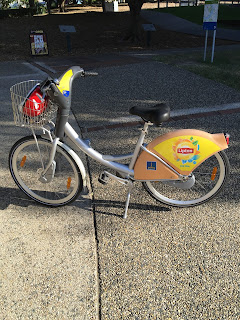
The following weekend, I decided to attempt a real ride along a bike path. There’s a 5-km round-trip stretch of path that I knew quite well from doing weekly fun-runs on it (ParkRun). I knew it to be flat, wide along most of its distance, and not too busy. And my familiarity meant that I could remove finding my way from the cognitive load. I set out, slowly and tentatively.
It wasn’t hard to complete the 5 km, but it was a pretty nerve-racking experience for me, especially when sharing the path with other cyclists and pedestrians. It was during this ride that I discovered that the phenomenon of target fixation applies to cycling: that worrying about an obstacle like a pole or bollard would tend to make me steer directly for it. I had to learn to disconnect my attention from such hazards and focus on where I wanted the bike to go rather than where I didn’t want it to go.
By the end of week three, I now knew that I was physically capable of staying on a bike and making a powered, controlled ride of approximately the distance I would need to cover to ride to or from work.
By now, I was already researching what kind of bike I might like to buy. The criteria I had come up with included:
As it happened, the day of my third test ride, an advertisement by Reid Cycles appeared in my Facebook feed, promoting a deep discount on a bicycle that matched my criteria very closely. The only way that the Reid Vintage Ladies 7-Speed Classic diverged from my wish list was in its gearing: it has a derailleur and a thumb shifter. Still, a discount of over $100 off the list price brought the bike down to $200. Trading off that one feature for such a good price seemed acceptable to me, so I went straight to the Reid store in Fortitude Valley to buy one. I’ll review the bike and purchase experience separately in another post (update: here it is), but for now, I’ll say that overall, I’m very, very happy with this bike.
This Sunday, I set out early in the morning to ride to my workplace and back, to confirm the route and my ability to ride it. I’m extremely fortunate to have a bike path that takes me from a few hundred metres away from my front door right to across the street from my office!
I have a terrible sense of direction, but Google Maps does a great job of indicating bike paths and other cycling infrastructure, so I found the way without too much trouble. I was also pleasantly surprised at how easy the ride was almost along its entire length. I only encountered two hills on the way to work and two (different) hills on the way home that required me to dismount and push the bike maybe a hundred metres or so each time.
I was set.
The other surprise for me was how the brakes operated. For some reason, I instinctively expected that if I pulled on the brake lever fitted to the left handlebar, the bike would veer left, and vice versa for the lever on the right handlebar. Of course, that’s not true and doesn’t reflect what I knew even then to be mechanically true of the bike, but it was an unconscious expectation nonetheless. To this day, three months and 600 kilometres later, I still have to fight this instinct occasionally. I wonder if this somehow distantly relates to my very earliest driving experiences being with a tracked vehicle with differential braking? (A Caterpillar D2, for the record).
9 May — Lesson 2
Two weeks later, at a different park, I again hired a CityCycle with the intention of adding steering and propulsion to the mixture, still confining myself to areas thick with grass.
Pedalling turned out to be a non-issue; and in retrospect, I now know that apart from cushioning any potential falls, the thick grass also served the very useful purpose of preventing me from building up too much speed too quickly.
Steering was a little more difficult for me to get the hang of. Initially, I had a very strong tendency to over-steer. It took quite some trial-and-error to determine that most of the turn needed to come from shifting my balance to one side or the other, with only small, gentle inputs from the handlebars. Initially, I think I expected the bike to steer more like a car. I liked discovering that it steers more like an aeroplane.
This week, I also experimented with the gears (on CityCycles, a three-speed, hub-geared arrangement with a twist shifter) but found little value in them. Indeed, I could feel so little difference between the gears that I had to enquire via social media whether “1” was the low gear (as in a car) or whether it was the other way around! (Yes, “1” is low, for anyone else wondering) I also learned that, unlike a car, shifting down gears does not provide a braking force. Another instinct that I still occasionally fight.
I spent an hour that day pedalling along the grass, describing long, lazy figures-of-eight. By the end of it, I could essentially ride a bike, even if my directional control was not wonderful.
So, for any other adult novices reading this: that’s two hours from zero to basic competence.
16 May — Lesson 3
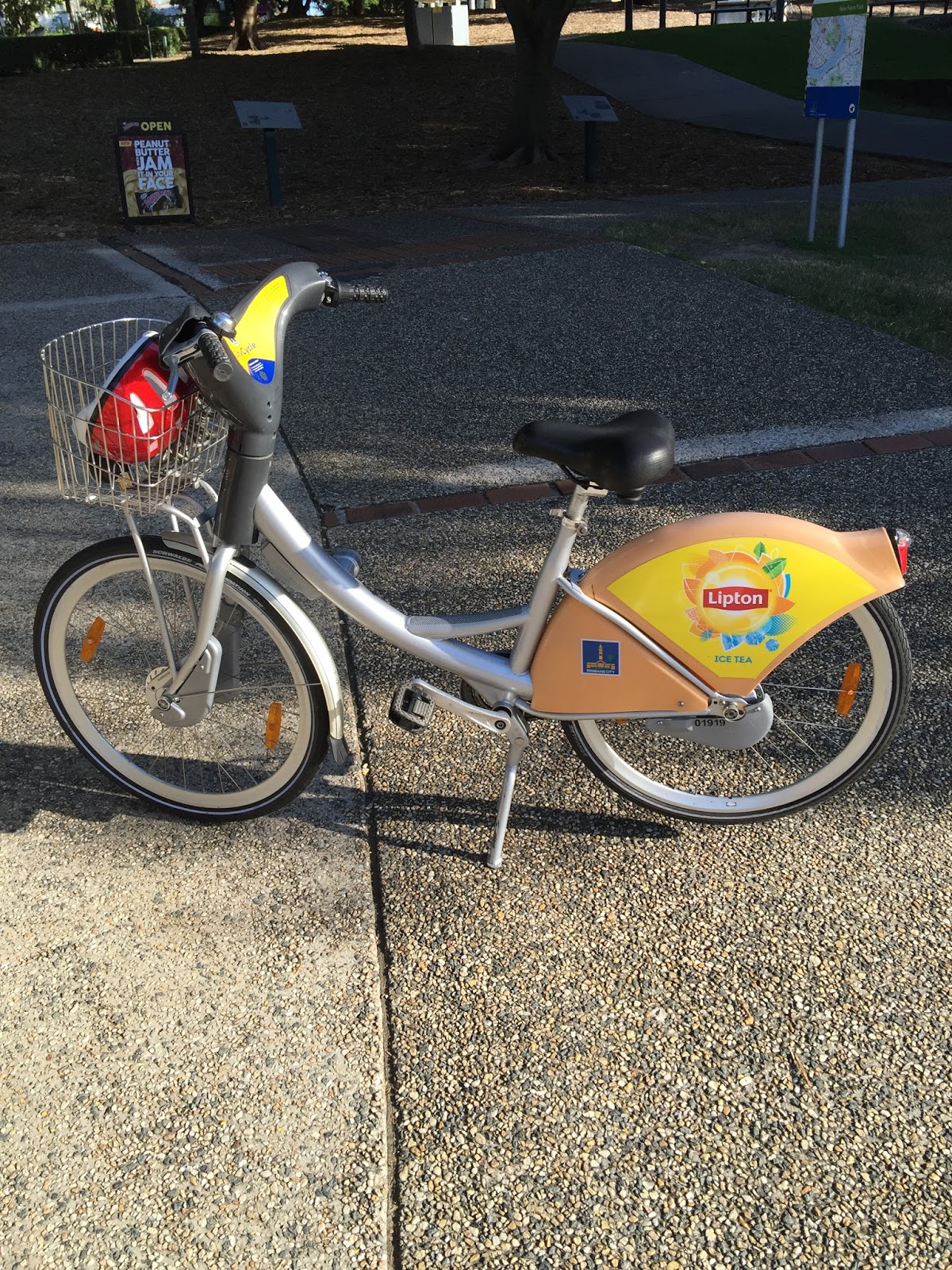
The following weekend, I decided to attempt a real ride along a bike path. There’s a 5-km round-trip stretch of path that I knew quite well from doing weekly fun-runs on it (ParkRun). I knew it to be flat, wide along most of its distance, and not too busy. And my familiarity meant that I could remove finding my way from the cognitive load. I set out, slowly and tentatively.
It wasn’t hard to complete the 5 km, but it was a pretty nerve-racking experience for me, especially when sharing the path with other cyclists and pedestrians. It was during this ride that I discovered that the phenomenon of target fixation applies to cycling: that worrying about an obstacle like a pole or bollard would tend to make me steer directly for it. I had to learn to disconnect my attention from such hazards and focus on where I wanted the bike to go rather than where I didn’t want it to go.
By the end of week three, I now knew that I was physically capable of staying on a bike and making a powered, controlled ride of approximately the distance I would need to cover to ride to or from work.
16 May — My first bike
By now, I was already researching what kind of bike I might like to buy. The criteria I had come up with included:
- Upright riding position: I wanted a bike that emphasised comfort over speed, and the upright position suggested greater comfort than being hunched over the handlebars, as well as better safety due to better visibility.
- Platform pedals: I wanted to be able to put a foot down quickly to avert a fall without having to disengage from any kind of retention mechanism.
- Step-through (“ladies”) frame: And if I were to fall, I wanted to minimise the chances of getting entangled in or injured by the frame.
- Hub gears and twist shifter: Hub gears seemed more robust and needing less maintenance than derailleurs. And the twist shifter seemed easier to use while keeping both hands firmly on the handlebars. Actually, I initially wondered if I’d need or want gears at all, but fortunately, friends convinced me that they were a must-have.
- Pretty! I wanted a bike that had some character and which reflected my own aesthetic sense. As I see it, too many bikes lack any kind of style, or are actually (and perhaps deliberately) ugly.
- Cheap: Despite the promising experiments, I didn’t want to spend a lot of money on what was still an unproven concept. I hoped I would be able to spend less than $300 or so.
As it happened, the day of my third test ride, an advertisement by Reid Cycles appeared in my Facebook feed, promoting a deep discount on a bicycle that matched my criteria very closely. The only way that the Reid Vintage Ladies 7-Speed Classic diverged from my wish list was in its gearing: it has a derailleur and a thumb shifter. Still, a discount of over $100 off the list price brought the bike down to $200. Trading off that one feature for such a good price seemed acceptable to me, so I went straight to the Reid store in Fortitude Valley to buy one. I’ll review the bike and purchase experience separately in another post (update: here it is), but for now, I’ll say that overall, I’m very, very happy with this bike.
24 May — Test ride
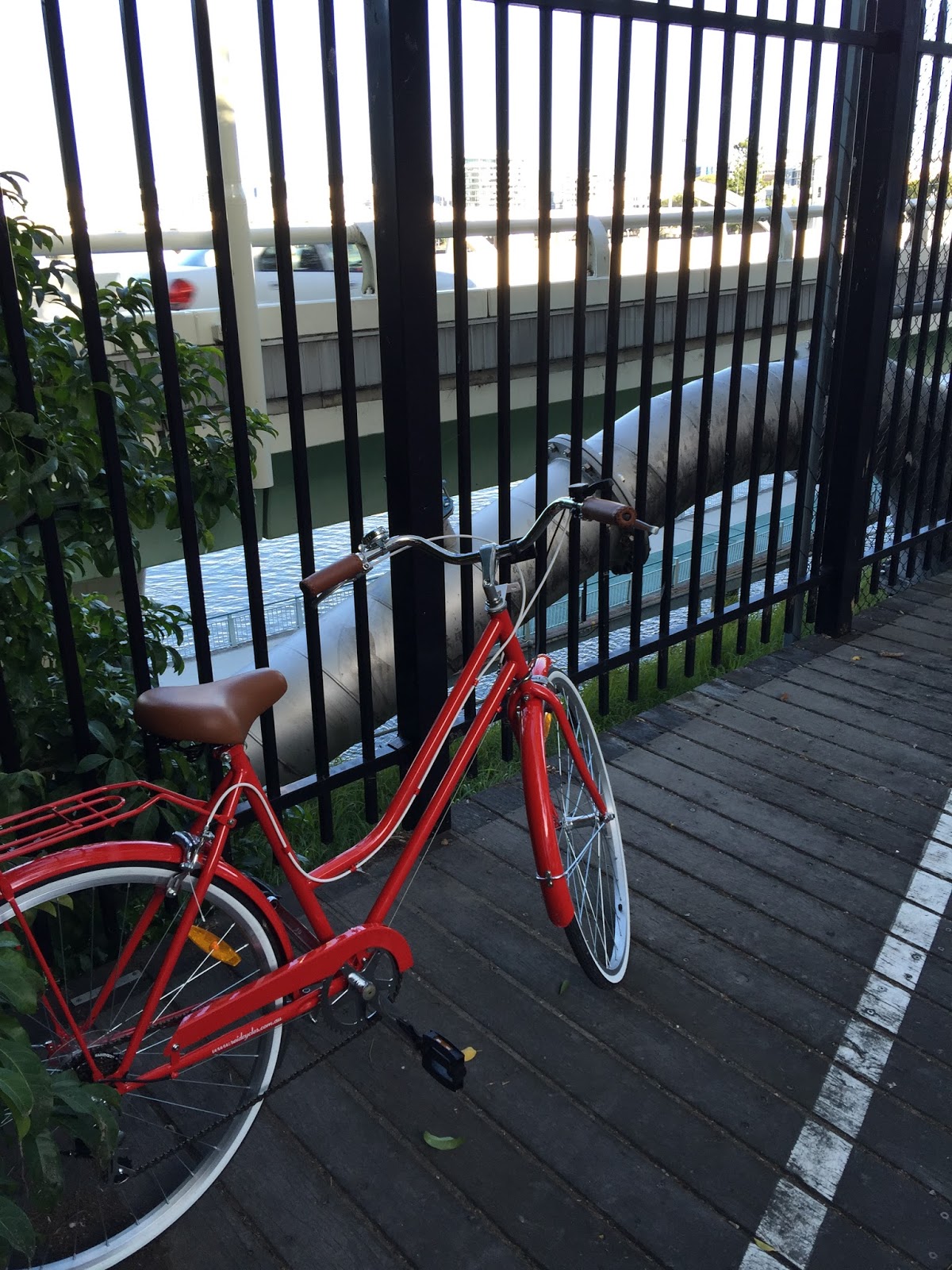
This Sunday, I set out early in the morning to ride to my workplace and back, to confirm the route and my ability to ride it. I’m extremely fortunate to have a bike path that takes me from a few hundred metres away from my front door right to across the street from my office!
I have a terrible sense of direction, but Google Maps does a great job of indicating bike paths and other cycling infrastructure, so I found the way without too much trouble. I was also pleasantly surprised at how easy the ride was almost along its entire length. I only encountered two hills on the way to work and two (different) hills on the way home that required me to dismount and push the bike maybe a hundred metres or so each time.
I was set.
24 May — Coaching
Early on, I had considered hiring a cycle coach to teach me to ride, but in practice, it proved hard to find a coach at short notice with a schedule that worked in with my already very full one. By the time I’d successfully engaged a coach, there was a two-week wait before my lesson. When I booked it, I assumed that I’d still be learning to balance by then, but instead, I’d already taught myself to ride from the Internet, had bought my own bike, and had even ridden it all the way to work and back!
Nevertheless, I did buy an hour’s coaching with one of the trainers from CycleAway, and it did prove useful. I’ll admit that I was nervous at first, wondering if I’d be judged for buying something other than a “serious” road bike, or for wanting nothing more from cycling than to commute to and from work. But this proved completely unfounded. What I liked straight away was that the trainer listened to my choices and my use case, and then worked with me to optimise for them.
Specific useful advice I took from the session included how to progressively adjust the bicycle to my height, better riding posture to maximise comfort and control for a cruiser-style bike like mine, and (much) better braking technique. These are things that I would have been unlikely to have discovered on my own, so the session was definitely worth it.
25 May to now — Commuting and more
This is almost an anti-climax to this story. The next day, Monday, I rode to work instead of taking the train. And I did the same on Tuesday. And I’ve done the same practically every day since then. The only exceptions have been a couple of days that would have required a night ride home before I was comfortable doing that, and a couple of days where I needed to wear a suit and didn't want to cycle in that.
It hasn’t all been lovely, though. The absolute worst thing about learning to ride has been the behaviour of other cyclists. During the first few weeks of commuting, I was a lot slower than any other rider on the bike path, and when making my way up hills, a lot wobblier. During those weeks, I was verbally abused or physically menaced by other riders approximately one day in every two. Usually the menacing took the form of tailgating (do cyclists use that term?), cutting me off after overtaking me or on the inside of the curve while going around bends, or—in one incident—actually running me off the path. I wonder how many would-be cycle commuters have been turned off the idea forever after experiences like these?
Against that, there have been lovely cyclists, who offered words of encouragement and support after witnessing two of the worst such incidents, or who stopped and offered me assistance one day as I walked my bike home with a flat tyre. Those folks have been one of the best things about learning to ride.
But anyway, I’ve stayed with it, and I now do the ride to and from work in about half the time it took me at first.
The scope of my cycling has crept a little too! I bought this bike with the sole intention of riding it only to work and back. However, it wasn’t long before I started using it to replace the car for other trips of under 10km or so, where I would have been the only passenger and where I wasn’t to be carrying large or heavy cargo.
My total outlay to start cycling was about $440:
| CityCycle membership for learning to ride | $30 |
| Helmet (compulsory in my state1) | $10 |
| Bicycle Queensland membership (for included insurance2) | $90 |
| Bicycle | $200 |
| Lights/lock/pump kit | $20 |
| Coaching session | $90 |
| Total: | $440 |
Against that, I save about $36 per week in public transport fares, so after two months, I’m getting close to recouping my initial outlay. I’ll be revenue-netural in a few more weeks!
The future
Even now, I’m not sure that I’d say that I like cycling. That is, it’s not something I would choose to do for its own sake (“It's a lovely day! I think I’ll go for a ride!”) However, I do know that I like it more than I like catching buses or trains. And I like it more than driving a car under most circumstances. And it does deliver the physical activity I was looking for without taking any more time out of my day than my commute by train did.
I commute in the clothes I work in. My workplace actually has showers and change facilities for cyclists, but I’m not comfortable with the idea of using them. That seems to be OK right now in the winter, but it might force me back onto the trains once Brisbane summer hits and brings with it heat, humidity, and rain. If that’s the case, I hope I’ll be able to overcome inertia and switch back to cycling as temperatures drop again.
I originally saw the bike I chose as an entry-level option and a stepping stone to something else. But now, I’m not so sure: it seems such a perfect fit for my use case! Sure, I’ll buy a few accessories like better lights, better tyres, and a better saddle, but I get the feeling I’ll be keeping this bike for a while.
1 Actually, CityCycle makes shared helmets available with some hire bikes. But ewwwwww...
2 Bicycle Queensland is the state’s bicycle advocacy organisation. Membership includes public liability insurance for bodily injury and property damage. I think you’d be insane to ride in public without insurance of this kind.
Sunday, 21 June 2015
Fedora 22
Fedora is my preferred operating system for my workstation at work and for my desktop computer at home. When a new version of Fedora comes out, I have a strong preference to upgrade my existing installations rather than re-installing them. I’ve been doing this consistently and successfully since Fedora 10, so when I upgraded to Fedora 22 a couple of weeks ago, it was the twelfth successive upgrade that these machines have had.
Unfortunately, it was a rough ride this time. Neither upgrade went smoothly and I had to do considerably manual clean-up afterwards. And there’s still stuff that either isn’t working or is somehow eccentric on both machines.
BUT on the upside, I’ve just discovered that two Windows applications that I’ve long really wanted to get working on WINE under Fedora are now working: namely Adobe Digital Editions, and iTunes! Up to now, I’ve been running these in a Windows virtual machine with VirtualBox. Now, each is working in its own WINE bottle. Here's how I set them up (installers previously downloaded to ~/Downloads):
The WINE version presently on my system is wine-1.7.44-1.fc22.x86_64.
Note that in both cases, I went for the 32-bit versions of the apps. I was also a bit conservative with iTunes and went for a slightly older version (the most recent one that anyone had anything nice to say about on the WINE database).
After that, it was just a case of authorising these instances just the same way as you would on Windows or OSX.
As far as I can tell, Adobe Digital Editions is working absolutely perfectly.
I haven’t tested all iTunes functionality, but I can confirm that the main reason I wanted it (to sync upwards and downwards with the iCloud and iTunes Match) is working: I’ve successfully synced music in both directions now. It also plays music fine; actually, it's working better than my usual music player (Amarok) is at the moment! To my great surprise, even video playback is working. So far, the only thing that’s not is the iTunes store. Clicking on that crashes iTunes immediately. This is no big deal for me, since I’ve been doing my music purchases on my phone for many years now (since it’s also my primary music playback device). Update: I also tested whether iTunes could sync to my phone via USB. It can’t. So if this functionality is important to you, you need more experimentation. When iTunes launches, it displays an error message saying that it can’t read CDs, but this isn’t true: it reads and rips CDs just fine.
It’s a great feeling to be rid of the two biggest reasons I needed a Windows virtual machine on my system!
Unfortunately, it was a rough ride this time. Neither upgrade went smoothly and I had to do considerably manual clean-up afterwards. And there’s still stuff that either isn’t working or is somehow eccentric on both machines.
BUT on the upside, I’ve just discovered that two Windows applications that I’ve long really wanted to get working on WINE under Fedora are now working: namely Adobe Digital Editions, and iTunes! Up to now, I’ve been running these in a Windows virtual machine with VirtualBox. Now, each is working in its own WINE bottle. Here's how I set them up (installers previously downloaded to ~/Downloads):
$ wget https://raw.githubusercontent.com/Winetricks/winetricks/master/src/winetricks
$ chmod +x winetricks
$
$ WINEPREFIX=~/.wine.ade WINEARCH='win32' wine 'wineboot'
$ export WINEPREFIX=~/.wine.ade
$ ./winetricks -q msxml3 corefonts dotnet20
$ ./winetricks -q dotnet40
$ wine ~/Downloads/ADE_4.0_Installer.exe
$
$ WINEPREFIX=~/.wine.itunes WINEARCH='win32' wine 'wineboot'
$ export WINEPREFIX=~/.wine.itunes
$ ./winetricks -q gdiplus
$ wine ~/Downloads/iTunesSetup_11_04_32-bit.exe
$ chmod +x winetricks
$
$ WINEPREFIX=~/.wine.ade WINEARCH='win32' wine 'wineboot'
$ export WINEPREFIX=~/.wine.ade
$ ./winetricks -q msxml3 corefonts dotnet20
$ ./winetricks -q dotnet40
$ wine ~/Downloads/ADE_4.0_Installer.exe
$
$ WINEPREFIX=~/.wine.itunes WINEARCH='win32' wine 'wineboot'
$ export WINEPREFIX=~/.wine.itunes
$ ./winetricks -q gdiplus
$ wine ~/Downloads/iTunesSetup_11_04_32-bit.exe
The WINE version presently on my system is wine-1.7.44-1.fc22.x86_64.
Note that in both cases, I went for the 32-bit versions of the apps. I was also a bit conservative with iTunes and went for a slightly older version (the most recent one that anyone had anything nice to say about on the WINE database).
After that, it was just a case of authorising these instances just the same way as you would on Windows or OSX.
As far as I can tell, Adobe Digital Editions is working absolutely perfectly.
I haven’t tested all iTunes functionality, but I can confirm that the main reason I wanted it (to sync upwards and downwards with the iCloud and iTunes Match) is working: I’ve successfully synced music in both directions now. It also plays music fine; actually, it's working better than my usual music player (Amarok) is at the moment! To my great surprise, even video playback is working. So far, the only thing that’s not is the iTunes store. Clicking on that crashes iTunes immediately. This is no big deal for me, since I’ve been doing my music purchases on my phone for many years now (since it’s also my primary music playback device). Update: I also tested whether iTunes could sync to my phone via USB. It can’t. So if this functionality is important to you, you need more experimentation. When iTunes launches, it displays an error message saying that it can’t read CDs, but this isn’t true: it reads and rips CDs just fine.
It’s a great feeling to be rid of the two biggest reasons I needed a Windows virtual machine on my system!
Saturday, 20 June 2015
Weight loss update 8
Today, I've passed another milestone: I've lost 45kg since the start of the year. At 97.7kg this morning, there's just a little under 8kg left to get to my original target.
The rate of loss is continuing to slow, but I also suspect that some of that is because I seem to be actually gaining muscle at the moment. In particular, in my upper legs, which I attribute to the running and cycling I've been doing. I'd been hoping that I'd be done with the big weight-loss phase of this project by early July, but I'd say it will be late July at best now.
I'm having some weird in-the-wrong body moments. For example, my arm might brush against my torso and I get the vivid and unnerving impression that I'm actually touching somebody else. It can be very strange! My body is definitely a very different shape from what it was: I've dropped two shirt sizes (XXL to L) and the shorts I bought to go to Zumba the other week are four sizes smaller (4XL to L)!
The rate of loss is continuing to slow, but I also suspect that some of that is because I seem to be actually gaining muscle at the moment. In particular, in my upper legs, which I attribute to the running and cycling I've been doing. I'd been hoping that I'd be done with the big weight-loss phase of this project by early July, but I'd say it will be late July at best now.
I'm having some weird in-the-wrong body moments. For example, my arm might brush against my torso and I get the vivid and unnerving impression that I'm actually touching somebody else. It can be very strange! My body is definitely a very different shape from what it was: I've dropped two shirt sizes (XXL to L) and the shorts I bought to go to Zumba the other week are four sizes smaller (4XL to L)!
Thursday, 4 June 2015
Weight loss update 7
So, this is just a minor update because my rate of weight loss is now slowing noticably. Over the last four weeks or so, I've been maintaining an average 1.5kg/week loss, while on a day-to-day basis, fluctuating madly. The overall trajectory is still in the right direction though.
And this morning, for the first time in many years, I tipped the scales at less than 100kg (just under: 99.8kg!) Although it's just a few hundred grammes down from the start of the week, seeing a whole digit disappear from my weight makes me feel pretty happy this morning!
The biggest recent change in my routine has been to switch to bicycle as my mode of commuting to and from work. I'll write more on that subject later, but from a weight-loss perspective, the ride two ways adds an extra energy burn to my day that's about the same as my daily gym routine!
I've also made a slight change to that routine. I used to do a brisk walk (6.5km/h) for 20 minutes on a treadmill, followed by 20 minutes of maintaining 60RPM on an elliptical machine. Now, I'm running (slowly, 8km/h) for 40 minutes instead. This has increased my overall calorie burn slightly, while hopefully also building my endurance for events like my weekly ParkRun and other fun runs that I plan to participate in.
My initial weight-loss goal, that I set in January, is now less than 10kg away, and these new boosts to my activity will hopefully see me there in around a month, I hope :)
Wednesday, 13 May 2015
Places I'd like to visit in the United States
During 2015, I've taken on the challenge of reshaping my body. But there's other work I want to do on my personal development too, and one of these items involves confronting a very specific anxiety I have around authority figures, including cops and all kinds of security goons.
One of the consequences of this anxiety is that I don't fly. When I tell people that I don't fly, they usually assume it to be a fear of flight; and then those who know me and my fascination with aviation find it incongruous. In fact, I have no fear of flight, and would quite happily go up in all kinds of flying machines that probably nobody in their right mind should. It's getting through the security checkpoints and customs at airports that freaks me out (and which becomes, as you can imagine, a vicious circle). So there's a lot of the world I would like to see but haven't.
I don't yet have any plan for doing anything about this. But maybe dreaming, and engaging with my motivations is a start (as it was for the body transformation).
A couple of family members are planning a trip to the United States next year. I have no intention of joining them for that. But their plans did get me thinking about what would I like to see in the United States if I were ever to go there? I tried to make a list of 10 things, but it ended up being 17. I also couldn't rank them: the top couple are easy, but after that, ranking became difficult but also pretty irrelevant.
So here are 17 places I'd like to visit in the USA, presented in order of increasing longitude.
Museum of Flight
Seattle, Washington
[location] [website] [Wikipedia]
The Museum of Flight is one of the largest privately-operated aerospace museums in the world, with around 150 aircraft and spacecraft in its collection. The museum has strong ties to Boeing, and preserves the "Red Barn", a two-storey wooden building that was Boeing's original manufacturing facility. These ties also manifest in the museum's collection, which contains examples of most significant Boeing aircraft, including the 737 and 747 prototypes and reproductions of Boeing's earliest designs. The museum is even home to the mockup of the Boeing 2707, the manufacturer's abortive supersonic airliner of the 1970s (albeit currently in their off-site storage facility). This is a must-see for its collection of commercial transport aircraft.
Air Force Flight Test Museum
Edwards Air Force Base, California
[location] [website] [Wikipedia]
What this museum lacks in size, it more than makes up for in "exotic". It's located on Edwards Air Force Base itself, where the United States has tested advances in aeronautical technology for 70 years. The highlights of the collection are the experimental aircraft (including many "X-planes") or their replicas preserved here, together with the prototypes of other aircraft that later made it into mass production. By their nature, most of the aircraft at this museum are one-of-a-kind and historic, and include such delightful oddities as the X-36 and X-48.
Planes of Fame
Chino, California
[location] [website] [Wikipedia]
Planes of Fame houses a collection of rare and unusual aircraft. Many of them are military aircraft of the Axis powers of World War II, rescued from scrapping by the museum's founders after the US military had finished evaluating them. In fact, this private museum houses the finest collection of Japanese aircraft of the period anywhere in the world, including the only airworthy Mitsubishi Zero still with its original engine, plus exotic types like the only surviving Shusui rocket-powered fighter. Rare German exhibits include a Heinkel He 162 jet fighter (pictured) and a Horten H.IV flying wing.
Titan Missile Museum
Green Valley, Arizona
[location] [website] [Wikipedia]
This museum is a Titan II inter-continental ballistic missile (ICBM) preserved in its launch silo together with a replica of its nuclear warhead. The museum not only preserves and displays this weapon, but its support and launch facilities as well: eight levels underground. At its deepest point, visitors can stand under the Titan II's main engines. This is the only museum of its kind anywhere in the world!
Pima Air and Space Museum
Tucson, Arizona
[location] [website] [Wikipedia]
Another one of the world's largest privately-run aerospace museums, Pima has a surprising number of giant aircraft in its collection, including bombers like the B-36 and B-52, tankers like the KC-97 and KC-135, and cargo planes like the C-124 and C-133. There's even a "Super Guppy", formerly used by NASA to airfreight rocket stages across the USA. Apart from these aerial behemoths, the museum also preserves examples of a large proportion of America's military aircraft types from the 1940s to the present day.
National Museum of Nuclear Science and History
Albuquerque, New Mexico
[location] [website] [Wikipedia]
This museum preserves the history of America's nuclear research, with a particular emphasis on the development of atomic weapons during World War II and into the Cold War. Highlights of the collection include full-size replicas of the "Little Boy" atomic bomb used to destroy Hiroshima (pictured) and the "Fat Man" bomb used to destroy Nagasaki (yellow casing can be glimpsed at top right of picture). The casings of two of the atomic weapons lost in and recovered from the Mediterranean Sea in the Palomares accident are also on display.
White Sands Missile Range Museum
White Sands Missile Range, New Mexico
[location] [website] [Wikipedia]
White Sands was the home to America's early rocketry experiments in the 1940s and 50s, and continues as a US Army missile test facility to this day. The museum preserves around 50 missiles ranging from captured German missiles from World War II up to modern systems like the Patriot. White Sands also hosted the Trinity nuclear test in 1945, the first artificial atomic explosion, and the museum preserves artefacts from that work as well. (The Trinity test site is nearby, but is accessible to the public on only one day per year. It would be cool to time a visit to coincide with that...)
Kansas Cosmosphere and Space Center
Hutchinson, Kansas
[location] [website] [Wikipedia]
The Cosmosphere houses a huge collection of American and Russian space hardware: the largest collection of the former outside Washington DC, and the largest collection of the latter outside Moscow. Particular highlights include a flight-ready backup for Sputnik 1, a Vostok capsule, Mercury capsule Liberty Bell 7, and Odyssey—Apollo 13's command module.
Aside: note the Titan II rocket at the left of the photo. Configured here to launch astronauts aboard a Gemini space capsule, this is the same vehicle described in an entry above, but configured there to launch a nuclear warhead—its original intended purpose. To be interested in the history of space exploration is inevitably to be interested in the history of weapons of mass destruction.
Space Center Houston
Houston, Texas
[location] [website] [Wikipedia]
The museum attached to NASA's Johnson Space Center exhibits artefacts related to America's human spaceflight programmes. Even the highlights are far too many to call out here, so I'll name just two: the Skylab training mockup, and the shuttlecraft Galileo prop from the original series of Star Trek. Both these items relate very strongly to my early interest in spaceflight: a childhood interest that has become a lifelong passion. Skylab was America's first space station, which made an uncontrolled re-entry in mid 1979. Growing up in Australia at the time, the news was full of Skylab, since Australia was right in the path of where it might come down. (In the end, most of it ended up in the Indian Ocean off Western Australia. But I remember the Courier Mail front page with the headline "Mind Your Heads!" from Skylab's last days.)
Golden Wings Flying Museum
Blaine, Minnesota
[location] [website] [Wikipedia]
This small museum is home to a collection of aircraft from America's "Golden Age" of flying: the 1920s and 30s. By then, the aeroplane had been matured over the battlefields of the First World War, and new frontiers of air travel were opening up. Daring aviators competed for records of speed and endurance, and transporting passengers and mail by air became a commercial reality. The collection at Golden Wings captures some of that romance, including six of the big, metal trimotors of the era, together with recreational biplanes. Look at the Ford Trimotor pictured (yes, that Ford; they used to build planes as well) and note that both Charles Lindbergh and Amelia Earhart piloted this particular plane.
EAA AirVenture Museum
Oshkosh, Wisconsin
[location] [website] [Wikipedia]
America maintains a very healthy culture of aeronautical experimentation, in which dedicated amateurs build their own aircraft, either from kits or plans of other people's designs, or of designs all their very own. The Experimental Aircraft Association supports and encourages these activities nation-wide, and this museum is a testament to some of the tremendous innovation of people building their own planes and rotorcraft. Once a year, it's also home to the world's biggest fly-in and airshow, EAA AirVenture Oshkosh. With other entries on this list emphasising the cutting edge of aerospace development, this collection is based around the simple and ingenious.
National Naval Aviation Museum
Pensacola, Florida
[location] [website] [Wikipedia]
I have a particular soft spot for naval aviation. I find flight amazing and exciting enough as it is, but this branch of aviation adds an extra layer of difficulty by doing it all from a moving ship at sea! The US Navy's aviation museum preserves that history, and includes examples of every major aircraft type operated from America's aircraft carriers, together with experimental and shore-based maritime aircraft.
US Space and Rocket Center
Huntsville, Alabama
[location] [website] [Wikipedia]
Proposed by the father of American spaceflight, Wernher von Braun, and nestled in the swamps of Alabama, this is a treasure-trove of American spaceflight, emphasising human spaceflight missions. There's an interesting engineering focus to the collection too, with a large number of rocket engines on display. These include that of the V-2 missile (the first rocket into space), the F-1 engine that launched American astronauts to the moon, the re-usable Space Shuttle Main Engine, and a prototype of NERVA, America's nuclear rocket engine that was intended to power a mission to Mars in the 1970s.
National Museum of the United States Air Force
Wright-Patterson AFB, Ohio
[location] [website] [Wikipedia]
As the name suggests, this is the definitive collection of American land-based warplanes, with examples of every type of these aircraft that the USAF and its predecessor forces have operated in any number. There are over 360 aircraft on display here, also making it one of the world's largest aerospace museums. In among the historically important types are a few of my favourite prototypes as well, ranging from the tiny and weird XF-85 Goblin "parasite fighter" to the XB-70 Valkyrie, which I hold to be one of the most beautiful machines ever to fly.
Kennedy Space Center
Merritt Island, Florida
[location] [website] [Wikipedia]
One of the two most important space launch facilities on the planet, the Kennedy Space Center also hosts a large museum of American spaceflight artefacts. In particular, it is the only place that preserves examples of every type of spacecraft and launch vehicle that has carried American astronauts into space. Apart from this hardware, the visitor center also presents reproductions of launch control rooms. One of these is even animated to re-create a Saturn V moon rocket launch, that of Apollo 8.
Aside: that's a mission I have a particular fondness for, stemming from a record that I grew up with. Shipped with National Geographic, Apollo 8's commander, Frank Borman, presented Sounds of the Space Age. You can hear it online here. I think his charisma comes through loud and clear.
National Air and Space Museum
Washington, DC
[location] [website] [Wikipedia]
and its annex, the
Steven F. Udvar-Hazy Center
Chantilly, Virginia
[location] [website] [Wikipedia]
This is the jewel in the crown: if there were only one place on this list that I could visit, this would have to be it. Well, it's two places really, the museum itself and its vast storage annex. The top photo is the entrance hall of the museum in which you can see all in just this one shot: Spirit of St Louis (the plane flown by Charles Lindberg on the first non-stop solo flight across the Atlantic), Bell X-1 Glamorous Glennis (the plane flown by Chuck Yeager as the first contolled flight through the sound barrier), the Apollo 11 command module (that carried the first crew of astronauts to the moon) and SpaceShipOne (the first human-carrying spacecraft developed and launched by a private company). The lower photo is of the storage annex, which includes, among many other highly significant machines, Space Shuttle Discovery, and Enola Gay, the Boeing B-29 Superfortress that dropped an atomic weapon on Hiroshima (the silver plane with the number "82" on the fuselage in the middle of the photo).
Old Rhinebeck Aerodrome
Red Hook, New York
[location] [website] [Wikipedia]
Finally, an extraordinary collection of vintage aircraft, including the second-oldest (by only a few months!) airworthy aircraft in the world, a 1909 Blériot XI. The focus of the collection is aviation from the beginning of powered flight up to the "Golden Age" of the 1930s. Most of the collection is flyable, and much of it is made up of original aircraft, in addition to faithful modern reproductions. The museum also displays an extensive collection of vintage aircraft engines.
One of the consequences of this anxiety is that I don't fly. When I tell people that I don't fly, they usually assume it to be a fear of flight; and then those who know me and my fascination with aviation find it incongruous. In fact, I have no fear of flight, and would quite happily go up in all kinds of flying machines that probably nobody in their right mind should. It's getting through the security checkpoints and customs at airports that freaks me out (and which becomes, as you can imagine, a vicious circle). So there's a lot of the world I would like to see but haven't.
I don't yet have any plan for doing anything about this. But maybe dreaming, and engaging with my motivations is a start (as it was for the body transformation).
A couple of family members are planning a trip to the United States next year. I have no intention of joining them for that. But their plans did get me thinking about what would I like to see in the United States if I were ever to go there? I tried to make a list of 10 things, but it ended up being 17. I also couldn't rank them: the top couple are easy, but after that, ranking became difficult but also pretty irrelevant.
So here are 17 places I'd like to visit in the USA, presented in order of increasing longitude.
 |
| Photo by Fawcett5 via Wikipedia Released into the public domain |
Seattle, Washington
[location] [website] [Wikipedia]
The Museum of Flight is one of the largest privately-operated aerospace museums in the world, with around 150 aircraft and spacecraft in its collection. The museum has strong ties to Boeing, and preserves the "Red Barn", a two-storey wooden building that was Boeing's original manufacturing facility. These ties also manifest in the museum's collection, which contains examples of most significant Boeing aircraft, including the 737 and 747 prototypes and reproductions of Boeing's earliest designs. The museum is even home to the mockup of the Boeing 2707, the manufacturer's abortive supersonic airliner of the 1970s (albeit currently in their off-site storage facility). This is a must-see for its collection of commercial transport aircraft.
 |
| USAF photo In the public domain |
Edwards Air Force Base, California
[location] [website] [Wikipedia]
What this museum lacks in size, it more than makes up for in "exotic". It's located on Edwards Air Force Base itself, where the United States has tested advances in aeronautical technology for 70 years. The highlights of the collection are the experimental aircraft (including many "X-planes") or their replicas preserved here, together with the prototypes of other aircraft that later made it into mass production. By their nature, most of the aircraft at this museum are one-of-a-kind and historic, and include such delightful oddities as the X-36 and X-48.
.jpg) |
| Photo by Dustin May CC-BY-SA |
Chino, California
[location] [website] [Wikipedia]
Planes of Fame houses a collection of rare and unusual aircraft. Many of them are military aircraft of the Axis powers of World War II, rescued from scrapping by the museum's founders after the US military had finished evaluating them. In fact, this private museum houses the finest collection of Japanese aircraft of the period anywhere in the world, including the only airworthy Mitsubishi Zero still with its original engine, plus exotic types like the only surviving Shusui rocket-powered fighter. Rare German exhibits include a Heinkel He 162 jet fighter (pictured) and a Horten H.IV flying wing.
 |
| Photo by Jeff Keyser CC-BY |
Green Valley, Arizona
[location] [website] [Wikipedia]
This museum is a Titan II inter-continental ballistic missile (ICBM) preserved in its launch silo together with a replica of its nuclear warhead. The museum not only preserves and displays this weapon, but its support and launch facilities as well: eight levels underground. At its deepest point, visitors can stand under the Titan II's main engines. This is the only museum of its kind anywhere in the world!
 |
| Photo by Frank Kovalchek CC-BY |
Tucson, Arizona
[location] [website] [Wikipedia]
Another one of the world's largest privately-run aerospace museums, Pima has a surprising number of giant aircraft in its collection, including bombers like the B-36 and B-52, tankers like the KC-97 and KC-135, and cargo planes like the C-124 and C-133. There's even a "Super Guppy", formerly used by NASA to airfreight rocket stages across the USA. Apart from these aerial behemoths, the museum also preserves examples of a large proportion of America's military aircraft types from the 1940s to the present day.
 |
| Photo by Aaron Anderer CC-BY-ND |
Albuquerque, New Mexico
[location] [website] [Wikipedia]
This museum preserves the history of America's nuclear research, with a particular emphasis on the development of atomic weapons during World War II and into the Cold War. Highlights of the collection include full-size replicas of the "Little Boy" atomic bomb used to destroy Hiroshima (pictured) and the "Fat Man" bomb used to destroy Nagasaki (yellow casing can be glimpsed at top right of picture). The casings of two of the atomic weapons lost in and recovered from the Mediterranean Sea in the Palomares accident are also on display.
.jpg) |
| Photo by Shashi Bellamkonda CC-BY |
White Sands Missile Range, New Mexico
[location] [website] [Wikipedia]
White Sands was the home to America's early rocketry experiments in the 1940s and 50s, and continues as a US Army missile test facility to this day. The museum preserves around 50 missiles ranging from captured German missiles from World War II up to modern systems like the Patriot. White Sands also hosted the Trinity nuclear test in 1945, the first artificial atomic explosion, and the museum preserves artefacts from that work as well. (The Trinity test site is nearby, but is accessible to the public on only one day per year. It would be cool to time a visit to coincide with that...)
 |
| Photo by Randy Read CC-BY |
Hutchinson, Kansas
[location] [website] [Wikipedia]
The Cosmosphere houses a huge collection of American and Russian space hardware: the largest collection of the former outside Washington DC, and the largest collection of the latter outside Moscow. Particular highlights include a flight-ready backup for Sputnik 1, a Vostok capsule, Mercury capsule Liberty Bell 7, and Odyssey—Apollo 13's command module.
Aside: note the Titan II rocket at the left of the photo. Configured here to launch astronauts aboard a Gemini space capsule, this is the same vehicle described in an entry above, but configured there to launch a nuclear warhead—its original intended purpose. To be interested in the history of space exploration is inevitably to be interested in the history of weapons of mass destruction.
 |
| Photo by The Austinot CC-BY-NC |
Houston, Texas
[location] [website] [Wikipedia]
The museum attached to NASA's Johnson Space Center exhibits artefacts related to America's human spaceflight programmes. Even the highlights are far too many to call out here, so I'll name just two: the Skylab training mockup, and the shuttlecraft Galileo prop from the original series of Star Trek. Both these items relate very strongly to my early interest in spaceflight: a childhood interest that has become a lifelong passion. Skylab was America's first space station, which made an uncontrolled re-entry in mid 1979. Growing up in Australia at the time, the news was full of Skylab, since Australia was right in the path of where it might come down. (In the end, most of it ended up in the Indian Ocean off Western Australia. But I remember the Courier Mail front page with the headline "Mind Your Heads!" from Skylab's last days.)
 |
| Photo by Tim Wilson CC-BY |
Blaine, Minnesota
[location] [website] [Wikipedia]
This small museum is home to a collection of aircraft from America's "Golden Age" of flying: the 1920s and 30s. By then, the aeroplane had been matured over the battlefields of the First World War, and new frontiers of air travel were opening up. Daring aviators competed for records of speed and endurance, and transporting passengers and mail by air became a commercial reality. The collection at Golden Wings captures some of that romance, including six of the big, metal trimotors of the era, together with recreational biplanes. Look at the Ford Trimotor pictured (yes, that Ford; they used to build planes as well) and note that both Charles Lindbergh and Amelia Earhart piloted this particular plane.
.jpg) |
| Photo by Bill Abbott CC-BY |
Oshkosh, Wisconsin
[location] [website] [Wikipedia]
America maintains a very healthy culture of aeronautical experimentation, in which dedicated amateurs build their own aircraft, either from kits or plans of other people's designs, or of designs all their very own. The Experimental Aircraft Association supports and encourages these activities nation-wide, and this museum is a testament to some of the tremendous innovation of people building their own planes and rotorcraft. Once a year, it's also home to the world's biggest fly-in and airshow, EAA AirVenture Oshkosh. With other entries on this list emphasising the cutting edge of aerospace development, this collection is based around the simple and ingenious.
 |
| Photo by Greg Goebel CC-BY-SA |
Pensacola, Florida
[location] [website] [Wikipedia]
I have a particular soft spot for naval aviation. I find flight amazing and exciting enough as it is, but this branch of aviation adds an extra layer of difficulty by doing it all from a moving ship at sea! The US Navy's aviation museum preserves that history, and includes examples of every major aircraft type operated from America's aircraft carriers, together with experimental and shore-based maritime aircraft.
 |
| Photo by Rian Castillo CC-BY-NC-ND |
Huntsville, Alabama
[location] [website] [Wikipedia]
Proposed by the father of American spaceflight, Wernher von Braun, and nestled in the swamps of Alabama, this is a treasure-trove of American spaceflight, emphasising human spaceflight missions. There's an interesting engineering focus to the collection too, with a large number of rocket engines on display. These include that of the V-2 missile (the first rocket into space), the F-1 engine that launched American astronauts to the moon, the re-usable Space Shuttle Main Engine, and a prototype of NERVA, America's nuclear rocket engine that was intended to power a mission to Mars in the 1970s.
.jpg) |
| Photo by Valder137 via Wikimedia Commons CC-BY |
Wright-Patterson AFB, Ohio
[location] [website] [Wikipedia]
As the name suggests, this is the definitive collection of American land-based warplanes, with examples of every type of these aircraft that the USAF and its predecessor forces have operated in any number. There are over 360 aircraft on display here, also making it one of the world's largest aerospace museums. In among the historically important types are a few of my favourite prototypes as well, ranging from the tiny and weird XF-85 Goblin "parasite fighter" to the XB-70 Valkyrie, which I hold to be one of the most beautiful machines ever to fly.
 |
| Photo by Lee Cannon CC-BY-SA |
Merritt Island, Florida
[location] [website] [Wikipedia]
One of the two most important space launch facilities on the planet, the Kennedy Space Center also hosts a large museum of American spaceflight artefacts. In particular, it is the only place that preserves examples of every type of spacecraft and launch vehicle that has carried American astronauts into space. Apart from this hardware, the visitor center also presents reproductions of launch control rooms. One of these is even animated to re-create a Saturn V moon rocket launch, that of Apollo 8.
Aside: that's a mission I have a particular fondness for, stemming from a record that I grew up with. Shipped with National Geographic, Apollo 8's commander, Frank Borman, presented Sounds of the Space Age. You can hear it online here. I think his charisma comes through loud and clear.
 |
| Photo by Jawed Karim CC-BY-SA |
 |
| Photo by Chris Devers CC-BY-NC-ND |
Washington, DC
[location] [website] [Wikipedia]
and its annex, the
Steven F. Udvar-Hazy Center
Chantilly, Virginia
[location] [website] [Wikipedia]
This is the jewel in the crown: if there were only one place on this list that I could visit, this would have to be it. Well, it's two places really, the museum itself and its vast storage annex. The top photo is the entrance hall of the museum in which you can see all in just this one shot: Spirit of St Louis (the plane flown by Charles Lindberg on the first non-stop solo flight across the Atlantic), Bell X-1 Glamorous Glennis (the plane flown by Chuck Yeager as the first contolled flight through the sound barrier), the Apollo 11 command module (that carried the first crew of astronauts to the moon) and SpaceShipOne (the first human-carrying spacecraft developed and launched by a private company). The lower photo is of the storage annex, which includes, among many other highly significant machines, Space Shuttle Discovery, and Enola Gay, the Boeing B-29 Superfortress that dropped an atomic weapon on Hiroshima (the silver plane with the number "82" on the fuselage in the middle of the photo).
 |
| Photo by Phillip Capper CC-BY |
Red Hook, New York
[location] [website] [Wikipedia]
Finally, an extraordinary collection of vintage aircraft, including the second-oldest (by only a few months!) airworthy aircraft in the world, a 1909 Blériot XI. The focus of the collection is aviation from the beginning of powered flight up to the "Golden Age" of the 1930s. Most of the collection is flyable, and much of it is made up of original aircraft, in addition to faithful modern reproductions. The museum also displays an extensive collection of vintage aircraft engines.
Subscribe to:
Posts (Atom)