Showing posts with label weight loss. Show all posts

Wednesday, 11 April 2018

Body gratitude

This is the fourth post in a series where I'm sharing my ongoing lessons about body-image and body-acceptance. Part one set the scene. In part two, I shared about how it's helped to become aware that the way I view my body might be distorted and not reflect reality. In part three, I talked about obsolete defense mechanisms and letting go of them.

Today, I want to talk about the popular theme of "gratitude" and what I've been learning about how it relates to body-image.

As anyone interested in personal development (or just has access to social media) knows, there's certainly a growing awareness today of the importance of being grateful for what we have. For someone who's been unhappy with their body appearance for a long time, becoming consciously grateful can help soothe some of those negative thoughts and feelings. Specifically, I've experienced relief by diverting attention from what my body looks like to what it can do.

I want to talk about this photo for a moment: 

One of the nasty surprises I've experienced about negative body image is that after I removed the original source of my unhappiness, my mind just moved on and found new things to criticise in my appearance. One of them is the thickness and chunkiness of my thighs. This is not something that had ever bothered me before I lost weight and got into fitness, even if, physically, my thighs were probably even bigger back then.

I took this photo in December 2017 because I loved these new tights. Despite being very conscious of my thighs in the photo, I still wanted to share it, so I posted it on various social media platforms. 

But while I was feeling very negative about this aspect of my appearance, when my ballet teacher saw it, she commented instead on something I could now do, not on how I looked — how I was holding my feet. The difference in focus between what I noticed and what she noticed in the photo is the whole point here, neatly summed up.

Yes, my thighs are big. That's a product of many thousands of kilometres of running and cycling over the last few years, and hundreds of hours of dance and dance-fitness. These are the legs that allow me to do those things. At one point, after noticing my thighs in a photo of myself after finishing a half-marathon, I despaired and I wanted to stop, or at least cut down on running; but I realised how sad I would be to give it up.

My life-coach highlighted this decision to me. These legs are a by-product of doing things I love. They have literally been shaped by love! (How cool is that?) And in choosing to keep doing those things, I choose these legs too. How about being grateful for being able to run and cycle and dance on them instead of agonising about what they look like?

And, more fundamentally, be grateful for a healthy, well-functioning body. From my own family background, I'm all too aware of how quickly and completely that can be taken away through accident or illness.

I'm admitting that this gratitude still does not come instinctively to me. When I bring it consciously to mind, it certainly helps me. My hope is that gratitude is like a muscle, and that the more I practice it, the more powerful it will get.

By coincidence, yesterday, my coach Marina shared some thoughts on just this same theme, a lot of which spoke directly to me. Here's a chunk of it, shared at her invitation, with my emphasis added to the parts I felt most personally relevant:


Start loving YOUR body. It's a gift you get to live this life in. It's your play/adventure/growth humanness suit. It's a miracle.

Annnnddd....The least important part about it, is how it looks.

YES!.. it deserves to be nourished & cared for... which YES!... will help it to look it's healthiest best self... but if you've only one idea or image in your mind of how your body should look for you to love it... well:

ONE, you'll likely often be unhappy

& TWO, your body is sadly experiencing the opposite of unconditional love.

There are billions of bodies on this planet, many containing minds within them are looking at 'other bodies' wishing to trade. And ironically those 'others' are looking at 'others' wishing to trade too.

We are a mad crazy bunch aren't we!!

So let's remember....Happiness isn't always about changing & getting what you want. It's mostly about loving, celebrating & cherishing what you have.

If you'll never be six foot plus, why waste this lifetime wishing away your contentment and joy...when instead you could embrace being a pocket rocket of awesomeness with a juicy big heart and lit soul.

It's just a huge waste of energy.


Do you really want to trade your days and prana (life force) for discontentment and unhappiness??

Instead- Let's all move from STRESSED + SELF LOATHING to BLESSED + SELF LOVED today ...

Shift from picking on & BULLYING (coz honestly that's kinda what we do) your body, to lovingly complimenting it, like you do others....maybe for it's appearance....or even for the endless miracles it performs each day.

Read the whole post here.

The next entry will be the last in this series and will describe shifting my attention from things I don't like about my appearance to things I do like.

Wednesday, 28 March 2018

Letting my defences down

This is the third post in a series where I'm sharing my ongoing lessons about body-image and body-acceptance. Part one set the scene. In part two, I shared about how it's helped to become aware that the way I view my body might be distorted and not reflect reality.

Today I want to talk about obsolete defense mechanisms and letting go of them.

Baby elephant image by Manjesh ambore
CC-BY-SA, via Wikimedia Commons
Many years ago, I heard a motivational speaker explain that when baby elephants are trained for work in South-East Asia, their handlers restrain them at night with a piece of rope tied around one of the elephant's feet. The other end is tied to a wooden stake hammered into the ground nearby. As the story goes, the baby elephant initially tries to escape by pulling at the rope but soon learns that it isn't strong enough and eventually gives up. Years later, as a fully-grown adult elephant, its handlers still secure the animal at night with a similar piece of rope. The four-tonne animal could easily escape but it doesn't even try because it learned long ago that it wasn't strong enough to do so.

I've tried unsuccessfully to verify this story. For now, let's think of it simply as a fable intended to illustrate a deeper truth: that we all carry with us things that might have been true once upon a time, but reality has moved on while our beliefs about ourselves and about the world have not.

Getting specific

My psychologist has been leading me to become conscious of the specifics of my fears. For example, if I were to go shirtless at a pool or beach, what specifically am I afraid will happen? And why do I expect that?

Before working with her, my fear would have been vague: I'd have said that I'd feel really embarrassed and self-conscious without a shirt. Now, the challenge was to notice and become aware of what was really behind that fear. 

This particular example was an easy one for me to analyse: up until very very recently, my experience of being shirtless at a pool was that of the fat kid at swimming lessons at school being taunted and jeered at by other school kids. This was a horrible experience and I quickly created behaviours to avoid it. Primarily, I avoided swimming lessons. I would feign illness on swimming day so I wouldn't even have to be at school, or I would claim I'd forgotten my swimming gear (whether I actually had it with me or not) and have to sit out while everyone else swam. One direct consequence is that I never learned to swim; to this day, I still haven't learned yet. People who learn this about me often ask incredulously how it's possible to grow up in Queensland and not have learned how to swim. This is how.

As I touched on in the introduction to this series, another consequence is that I've spent decades avoiding any situation where my bare torso might be visible to other people, even by accident. To recap, these don't just include swimming pools and beaches, but trying on clothes in stores, having medical examinations, and passing through security checkpoints like at airports (which have equipment to see through clothes and people who might pat me down).

As a strategy to avoid repeating that childhood experience of being taunted, this behaviour has been 100% effective. I never again had that experience. The defence mechanism is tried and true.

The problem is, it's based on experiences that are very old and relevant only to a specific context.

Getting specific about what I was afraid would happen if people could see me without a shirt allowed me to question whether the risk of being taunted and jeered at was still a credible threat.

Rationally, I can predict that if I were to take off my shirt at a pool or beach today, the most likely outcome is that nobody would notice or care, and that even if somebody did have a negative perception or opinion of my body, it's very unlikely that they would come up and share it with me. The risk is not zero, but it's incredibly low, in line with other low-probability risks that we're all exposed to every single day and have no control over.

Therefore, I can understand my behaviour (always cover my torso) as a safeguard I developed to protect my feelings against something that, while once undeniably real, is not a valid current concern.

My life-coach describes these obsolete beliefs that cruft up our lives as "hyper-stabilised beliefs" that become self-fulfilling because we have an innate need to be right about the world. We therefore avoid challenging these beliefs (so we remain right) while at the same time remaining hyper-sensitive to anything that reinforces the belief (see also confirmation bias and the Baader-Meinhof phenomenon). Nothing catches my eye faster than a news story about air travellers invasively searched by overly zealous airport security agents.

This is the mechanism, she says, by which the belief gets reinforced further and further and further.

My own experience tells me this is true: if anything, my fears, left unchallenged, have indeed grown more intense over time. About eight years ago, the prospect of passing through an airport security checkpoint intensified from uncomfortable and unpleasant through to intolerably terrifying.

At least at the pool I can always wear a rashie...


Letting my defences down


As the quote beloved by motivational speakers and writers goes, there's one way to challenge these beliefs:

"You know, sometimes all you need is twenty seconds of insane courage. Just literally twenty seconds of just embarrassing bravery. And I promise you, something great will come of it."
— Aline Brosh McKenna and Cameron Crowe, We Bought a Zoo
Putting this principle into action and slowly chipping away at my fears has been having results.

A few weeks ago, I attended an aqua-fitness event, and as I was putting on my rashie, I stopped and chose to notice my feelings. The organiser of the event is someone I trust utterly and completely; and the energy that suffuses her events is incredibly positive and supportive. In turn, this energy attracts positive and lovely people. I asked myself if I was afraid of anyone at the event, and when I affirmed for myself that I was not, I took the rashie back off and replaced it in my bag.

I still felt very queasy stepping out of the change room. And while it took a little more than a literal twenty seconds for that sick feeling to evaporate, it wasn't more than a couple of minutes. And... hypothesis proven: there was no taunting or jeering. I don't think I ever completely lost consciousness of being shirtless, but the sense of alarm definitely dissipated.

This fear isn't completely dealt with yet; but for me, this was a huge step forward. Someday there will be another opportunity for another twenty seconds of insane courage, and I'll see if I can push the boundary a bit further.


Next post: Being grateful for what my body can do

Wednesday, 21 March 2018

Questioning my body image

This is the second post in a series where I'm sharing my ongoing lessons about body-image and body-acceptance. Part one set the scene.

The immediate need that took me to seeing a psychologist was that by late 2015 my eating had become very disordered. For a large part of the year I was living on only a few hundred calories per day. I was frightened of food and frightened of regaining the weight I had lost up to that point.

Articles like Gina Kolata's "After ‘The Biggest Loser,’ Their Bodies Fought to Regain Weight" in the New York Times are not reassuring: six years after their participation on the show, thirteen out of fourteen contestants regained weight, and four were now heavier than before the competition. Kolata presents some of the research describing the metabolic changes that drive that outcome, which makes it sound even more inevitable.

Regaining significant weight is still something that worries me to some degree today, but in late 2015 and early 2016, it was seriously interfering with my eating.

And, as I shared last time, I still wasn't happy with my body anyway. I wanted to be still thinner.

My psychologist took a functional approach to this concern, asking me what I would be able to do if I were thinner that I couldn't or wouldn't do at my current body shape. I talked about the situations I described in my previous post: about my terror of being teased or ridiculed about my body if anybody could see or feel it.

This led to a very interesting exercise, where she presented me with a series of silhouettes and asked me to identify my body shape among them. (The "BMI-based Silhouette Matching Test (BMI-SMT)" is a similar instrument to the one my psychologist used, if you want to investigate further.)

Recognising distortions of perception: in myself...

This isn't exactly the test my psychologist used,
but it's similar. Figure from Abbas et al (2010)
"Pictogram use was validated for estimating
individual’s body mass index
", Journal of
Clinical Epidemiology 63
: 655–59
I selected the silhouette that I thought was my body shape, and was very surprised when the psychologist revealed the proportions that corresponded to it. The silhouette was of a far squatter body shape than I knew mine to be by the numbers.

This made sense to me because of another phenomenon I was experiencing at the time: my body fitting through spaces that I didn't think it could. For example, when I couldn't open a car door fully because of other cars parked close by, I would be expecting a difficult squeeze to get through the partial opening but instead would step through easily. Or I would often pause at a doorway to let someone else step through it from the other direction because I "knew" we wouldn't both fit through at the same time — I got a few puzzled looks from that at work! It took maybe 18 months for this effect to subside: for my brain to re-align to how much space I was actually taking up in the world. (And even today, it still very occasionally crops up!)

Reality is on the left. I
sometimes see what's on the
right
Finally, my logical brain accepts that the huge variation in how I react to my body in photos and mirrors means that my perceptions are suspect. If I perceive exactly the same body as upsettingly, distressingly "too fat" in some photos and reflections, but not in others, then my perception has to be unreliable.


...and in others

Another thing that has helped me realise the unreality of my perceptions of my body has been the sad experience of listening to and reading other people's negative assessment of their bodies.

Taryn Brumfitt's amazing documentary Embrace (Watch it if you haven't seen it — I promise it's worth it. Here's the trailer) at one point presents people describing their normal, healthy-looking bodies as "disgusting"; it's a shocking and very sad juxtaposition.

Since becoming involved in fitness, I've had the unfortunate opportunity to hear similar things first-hand myself. Two such conversations have stuck with me because of the physiques of the people who held these opinions were physiques that I think most other people (including me) would be envious of: one like a fashion model and one like a lean endurance athlete.

I find it easy to recognise these distortions in other people's assessments of their bodies, which helps me remember that my image of my own is suspect.


What I do now

Reflexive, negative assessments of my own body still sometimes catch me by surprise. When they do, I consciously remind myself of the things I've shared in this article: remembering photos in which I don't think I look fat, or mentally replaying conversations that reveal others' distorted body images.

This doesn't always work for me, and certainly not immediately, but as one layer of defence, it helps.

If you're unhappy with your body shape, I suggest questioning your own assessment: how realistic is the image in your head?


Next post: Letting my defences down


Wednesday, 14 March 2018

Losing weight didn't make me love my body


This post is a little bit different for me because I don't have the answers to this stuff yet — I'm sharing it as a work in progress, a snapshot of where my thoughts and feelings are right now.

I've already written about how I developed a sense of shame about my body and ended up hating my body. And specifically, what I felt ashamed of and what I hated was being fat. So, a little over three years ago now, I resolved to change that; and succeeded. I lost 63kg (139lb) and ended up with a body that sits neatly in the "normal" band on height-weight charts and fits into clothes sized "Small" or "Medium" in most labels. I got exactly what I set out for.

The outcome I wasn't prepared for is that... I still hate my body.

The conventional narrative told in thousands of before-and-after photos is that "I was fat and unhappy, now I'm thin and happy". That's how it's supposed to work, right? And it's unconsciously what I expected to happen.

But it turns out that body-hate, as a learned pattern, has a life of its own that's completely separate from reality. So when I removed the original focus of that hate, my mind just settled on new focuses.

This hate has some very real repercussions on my life, some obviously connected to body image, others not-so-obviously. Some are minor annoyances, some have bigger impacts.

Photos and mirrors
For example, I'm sometimes, unpredictably, upset by what I see of myself in photos or in a mirror. This issue is unsolved and still sometimes hits me when I least expect it. A glimpse of myself in the mirror at ballet a couple of months ago left me feeling down for days, even though I use these mirrors constantly in ballet and barre classes. But just this one time got me and I don't know why.

Swimming
I'm also still not OK with baring my torso in public; so this means always wearing a rashie at the pool or beach. I've made very slight progress here: I actually went shirtless to an aqua-fitness event a few weeks ago because the environment felt safe and supportive enough.

Trying on clothes
A similar one that I've recently overcome is that for years, I would not change clothes or shower anywhere that didn't have floor-to-ceiling walls and doors, and a sturdy lock. Trying on clothes typically meant buying them, taking them home to try on, then bringing them back to the store if they weren't right. I'm OK with typical change rooms now, but it was a major inconvenience for a long time.

Medical exams
Some effects are more than mere annoyances, like avoiding any medical examination that requires removing clothing; although I did get as far as taking off my shirt in this context recently, so that's progress.

Air travel... what?
And some effects are much less obvious: one of the biggest is that it makes me incredibly anxious about air travel, to the point where I just don't do it. I haven't flown domestically for eight years now, and internationally for fourteen years. As a lover of history, art, language, culture, and technology, I'm painfully aware of how much of the world I have never seen for myself and remains inaccessible to me. Work-wise, I seem to avoid around one opportunity for overseas travel per year. And more recently, my family is going on holidays, having adventures, and building memories that I'm unable to share in. But how is air travel connected to body image?

When I tell people I don't travel by air, they assume that I'm frightened of flying; but the reality is, I'm frightened of airport security. I'm frightened of machines that can show people my body through my clothes (backscatter X-ray or millimetre-wave scanners), and of people who might feel my body through my clothes by patting it down. My greatest air-travel fear of all is that some over-zealous security agent might decide that I'm acting suspiciously (maybe because I'm so freaked out and scared) and exercise their right to strip-search me in some horrifying self-fulfilling prophecy. These fears are enough to keep me confined to south-east Queensland.

What has helped?


Not all of these affect me as much as they once did. The most fundamental piece of advice I can give anyone dealing with issues like this is to get help. I am being supported by a wonderful psychologist and I've also had some sessions with a life coach who has given me some valuable practical exercises and some "tough love".

Over the next few weeks, I want to write about the approaches and techniques that have helped so far:

Saturday, 24 June 2017

Why starving myself was a stupid idea

5-year-old me
I was obese by the time I was about 5 years old and stayed that way for the better part of 40 years. Eventually, I made huge lifestyle changes that transformed the way my body looks and works, a transformation that has lasted two years now. However, this certainly wasn't the first time I tried to become less fat.

Like many other people unhappy with their body size or shape, I experienced multiple attempts and failures over many years. In this post, I want to share what didn't work for me, because, in hindsight, it should have been obvious, and for whatever reason, it wasn't.

Twain never said this.
The memes are lying to you.
There's a famous quip routinely misattributed to Mark Twain that's usually rendered something like "It’s easy to quit smoking. I’ve done it a thousand times."1 Regardless of the source of the remark, it was similarly easy for me to lose body fat on the many occasions I set out to.

I've felt self-conscious and strongly negative about my body since I first started getting teased at school about its shape and size, somewhere between the ages of 6 and 8 years old. But it wasn't until I was a teenager that I felt motivated and empowered enough to do anything about that.

It seems to me that most people instinctively understand the two sides of the energy equation: that losing or gaining fat depends on the balance between energy consumed and energy spent. And consequently, most people who want to reduce their amount of body fat know that they can achieve this goal by reducing the amount and types of food they eat and/or increasing their level of physical activity.2 This principle is sometimes called "CICO", for "calories in versus calories out". While it's essentially true, stripping all the physical, psychological, and emotional elements of body recomposition down to this one simple, cold equation leads some people (like me) to a naïve, "brute force" approach.3

And so, when I was 17 years old, I started starving myself for the first time.

And I found out that I was good at it!

That is, I discovered that I could easily suppress and ignore hunger pains. I started by skipping meals. Then I sometimes skipped whole days. The furthest I went was when I was 25 years old and I went a whole week without eating anything at all.

Most times, I would also boost my output by going for long walks. I chose walking because it was the only form of physical activity I was familiar with that I didn't hate (How I learned to hate physical activity is a story in itself for another time). On some of these fat-loss attempts, I would make time for a two-hour walk each day, which I would do regardless of weather: hot or cold, rain or shine. The longest walk I did was one of around ten hours, coming home with my feet shredded and bleeding, all so I could be happier with my body.

Each time I embarked on a starvation diet, I would pursue it for a few weeks, lose something in the vicinity of 5-10kg (10-20lb) and then lose the willpower to refuse food any further, or have my attention diverted to other interests. When that happened, I would resume eating exactly as I did before, and resume the sedentary lifestyle that I had before.

Worse: while I was in my most severely restrictive phases, like the week in which I didn't eat at all, I would be pretty preoccupied with food, dreaming of all the things of which I was depriving myself. I would start to hoard food, buying the treats I wasn't allowing myself to eat and hiding them in my bedroom. At the time, I would feel good and powerful—that I had a big stash of all this junk food and my willpower was so strong that I could resist eating it. That is, until the willpower eventually collapsed, as it always did, and I would gorge myself on everything that I had been denying myself up to then.

And then, with my normal patterns of eating and inactivity re-established, I would soon regain the fat I had starved off, and the whole cycle would begin again. I would go many months, and sometimes even a year or two, without restricting, and I would always end up at a point heavier than I had the last time I restricted. Over the course of doing this for twenty-plus years, I gradually gained about 40kg (90lb).

In essence, severe restriction as a strategy for fat loss was really a strategy for fat gain.

Somewhere in the back of my mind, I always knew that starvation wasn't sustainable as a strategy, and that when I had lost all the fat I wanted to, I would have to come up with a plan to keep it off. But it never got that far, because my will to starve always failed long before I reached my goal.

What went wrong?


With the benefit of hindsight, here's my take on why restriction failed so badly for me time and time again:

1. Reliance on willpower and attentiveness

In my experience, willpower is a finite commodity: mine eventually runs out. Restriction and denial is a constant push uphill; and when the ability to keep pushing faded away, my life always resumed its original path.

The same goes for attentiveness: I can only concentrate on so many things at one time, have so many projects "on the go". So when other things in life crowded out the constant attentiveness needed to suppress the desire for food, restriction would fall by the wayside.

In 2005, I lost about 20kg.
I then gained over 30kg
during the next few years.
The same applied on the exercise side. Prior to the last two years, my most successful fat loss campaign was a little over ten years ago when I lost about 20kg (44lbs) through heavy restriction and daily (as in, seven-day-a-week) gym sessions.

But I didn't enjoy the gym. I forced myself to go. And then, when I had a break from it, I just never went back. I took time away from there to prepare for, and then to run in, the Bridge to Brisbane event that year. But when the run was over, I never returned to the gym. Or did any more running. The change was superficial and driven by willpower alone.

I even kept my Fitness First membership going for about a year because I always intended to force myself back; I just never did.

2. Expecting to be able to go back to the old way of eating and (in)activity

Einstein never said this.
The memes are lying
to you again!
Keeping with the misattribution theme from earlier, it's often erroneously claimed that Einstein said "Insanity is doing the same thing over and over again and expecting different results"4 Again, regardless of its origin, the observation holds true here. 

I always expected that after I had slimmed down to a size and shape I found acceptable, I would just go back to eating the food I enjoyed up to that time; maybe less of it, or eating it less frequently, but without any substantial changes to what I was eating.

Here's the most ridiculous expression of that belief: during that attempt where I lost the 20kg, as I reached each 5kg milestone, I would celebrate by choosing some incredibly calorie-rich junk food to indulge in. Yes, really: "I've just starved off another few kilos — I will therefore eat this whole box of donuts!"

If that's not crazy, I don't know what is.

Now, in the scheme of things, that one indulgence every few weeks was not, in itself, going to undo the effects of all the restriction and exercise. But, it does show that my efforts were doomed to eventual failure, because as long as I expected to and wanted to keep eating that way, that's what I would revert to as soon as willpower or attentiveness failed.

And, of course, that's exactly what happened. Every time.

This misalignment of desires and goals is what makes me so wary of the principle of "cheat days" that some people use during body recomposition. For me, needing to schedule a day to eat whatever I want would be a symptom and a warning bell that my lifestyle was pretty out-of-whack; that my values and my eating had become separated, just like eating the donuts to celebrate losing fat.

Again, the same principle applies on the energy output side of the equation: I never expected that the long walks or the daily gym sessions would be something I kept up after I reached my goal shape and size. And that, somehow, magically, the inactivity would not lead me straight back to the body shape I had been working to change.

3. Going it alone

Related to the expectation of going back to eating an old way, the fear of not being able to eat that way was one of the main reasons I was so determined to strive for my goal through starving myself instead of seeking professional help.

Specifically, I expected (without any evidence, of course) that a doctor or dietitian would condemn me to a plan of eating things I didn't like — things that were less appealing than not eating at all. So I deliberately avoided the very help and support that I know now would have made things easier, healthier, and a lot more likely to succeed. 

4. Separating the fat-loss stage from the maintenance stage

Two years ago, this strategy eventually did work for me, but only because I was lucky to be well-supported through the transition. I now think that this separation into an incredibly difficult and unlikely-to-succeed "phase 1" and a completely undefined and not-thought-out "phase 2" was a major reason why dozens of previous attempts over more than half my life had failed.

Spelled out that way, it's obvious what a stupid idea this was, and one eventual success, that relied on luck, after multiple failures doesn't make it a great strategy.

Put another way: if I had ever worked out what "phase 2" looked like, there would have been no need for a "phase 1" — I should just have started "phase 2" straight away.

But to be kind to myself, when I started the journey that eventually transformed me, I literally could not have imagined that I would be leading and loving the life that I have now. Indeed, if I could have seen this future, the me of two years ago would have not wanted it.

Learnings

I now think I was completely wrong on each one of these counts. That:
  • Successful transformation comes from embracing things I love, not through denial and restriction; through letting a healthy lifestyle crowd out an unhealthy one.
  • Tastes and appetite, for food and for movement, are more malleable than I ever believed. 
  • A good nutrition professional will work with you to help you enjoy food. If they're not doing that, you need to change nutrition professionals. In Australia, look for someone registered as an APD (Accredited Practising Dietitian): they're the experts at this.
  • Diets with short-term goals will produce short-term results and are probably counterproductive in the long run. Transformational change comes from transforming a whole lifestyle.
In future posts, I want to expand on each of these ideas, and also to share in more detail what did eventually work for me.


1 There's no evidence for Twain ever saying this. The earliest variant of the gag that Quote Investigator has turned up is in the 1907 novel Duke of Devil-May-Care by Harris Dickson and refers to poker-playing, not smoking (see here for their detailed and well-sourced research).

2 Most people. I do occasionally hear people claiming that no matter how little they eat, they can't lose body fat. Or that restriction doesn't work for them because they have slow metabolisms. Or that restriction doesn't work at all because of the body's "starvation mode". My layperson's understanding of such claims is:
  • We're not plants and we can't photosynthesise; the body must be getting its energy from somewhere. If it's not from fat stores, it has to be coming from food and drink. 
  • It's undeniable that some people lose (and gain) body fat easier than others, but my understanding is that metabolisms that are so slow to make fat loss significantly harder (as in "not work"-level of harder) than for the general population are very rare. It's also easy and pretty cheap to get your metabolic rate (RMR) measured if you really think this is you. 
  • "Starvation mode" is definitely real and was investigated extensively by the US military in the wake of World War II. My understanding is that it doesn't have much of an effect until the body is down to its last few percent of body fat. Most people attempting to lose body fat are nowhere near that point.
  • The horrible truth of the effects of famine on humans and other animals. Enough said. 

3 It's even the basis for a whole fat-loss regime I found very attractive at one point: The Hacker's Diet by John Walker, who co-wrote the famous computer drafting software, AutoCAD.

4 As with the purported Twain quote, there's no evidence for Einstein ever saying this. Quote Investigator has found an expression of the same concept in The Psychology of Personal Constructs, a 1955 psychology textbook, and a close match for the wording of this supposed quote in a 1981 Narcotics Anonymous pamphlet. Their research is here.


Thursday, 22 September 2016

On my 50th Parkrun

My third Parkrun, 16 May 2015.
My time was 28:36.1
This Saturday, I will run my 50th Parkrun, and the occasion makes me think about the role this movement has played in changing my life. If you don't know what it is, you should take a few minutes to read about it now.

If you know me or my story, you know about my struggle over the last year and a half with conquering my life-long obesity and building up my health, fitness, and confidence.

I don’t want to dwell on the food restriction part of what I did, because it was unhealthy and foolish — even dangerous — and nobody should feel “inspired” to copy it.

But this milestone Parkrun makes me reflect on how things used to be on the energy output side of the equation: miserable 3AM starts at the gym, so that I could get up on a treadmill for a daily dose of physical activity. I chose that time of day because I knew that absolutely nothing was going to interfere with my routine at that hour. I didn’t enjoy the gym, and I relied entirely on willpower and routine to sustain my activity there. Even when my wife and I would go away for a weekend, I would get up at the same time to take advantage of the hotel gym so I would not break my routine. I felt like if I allowed any exceptions, I wouldn’t be able to force myself back into the pattern.

But around April, a friend suggested replacing the gym ordeal with exercise that I might actually enjoy, and pointed me to Parkrun as an example.
I’ll admit that I was sceptical. The thought that I might like physical activity was still completely foreign to me, and nothing about the months of 3AM sessions at the gym had convinced me otherwise! But I like to pride myself on being open to trying new things, and so one Saturday in May, off I went.

I wasn’t an instant convert. But what I did immediately like was an overall sense of achievement and acceptance. It didn’t matter if I couldn’t run the whole 5km, and it didn’t matter that there were people faster than me or slower than me. So the next Saturday I came back, and I realised I liked being able to compare my effort and my results to the previous week. Soon, I was a regular.

But what turned Parkrun from a recurring calendar reminder into a passion was the sense of community. One week, a pacerunner helped me to a new PB, and chatted nearly the whole time we were out there — even when I couldn’t respond (“Can’t… talk… breathing…”) Not only that, but the next week, she greeted me again, and introduced me to some other regulars. Before I knew it, I had Parkrun friends.

It wasn’t long before Parkrun became a gateway into other recreational running, and soon I was entering events: City 2 South, Bridge to Brisbane, and then in early 2016, my first half-marathon!

And the gym membership? Cancelled. Exercise as an unwelcome chore had been replaced by exercise I loved: running, cycling, and Zumba (those are other stories…) Now, I don’t have to force myself into physical activity — I eagerly look forward to it in my daily life.

At my lightest, I dropped 63kg below my starting weight. I’m up a few kilos since then because although I’m still losing fat (more slowly now), I’m gaining muscle. And my health and fitness are the best they’ve been in my entire life.2

My theme for my 50th
Parkrun: Shiny and
sparkly!
Obviously Parkrun is just one ingredient in my journey over the last 20 months, but it’s been a vital one, because of the way it changed my outlook in a really fundamental and significant way. Therefore, 50 Parkruns is a particularly important milestone for me, because to me, it means that this is a transformation that has taken root and stuck. This is a lasting change.

I owe thanks to so many people: special thank-yous to Angela for a great suggestion, and to Kelly for befriending me and bringing me into the group. A big thank you to the whole New Farm Parkrun community for being a wonderfully accepting and welcoming group of people. Thank you to all my friends who offered so much encouragement along the way and “liked” or favourited” all those status updates and tweets — that really meant something to me. And thank you to my wife Laura and my ma Barbara for your unflagging, enthusiastic support for these big changes and transformations.


1 My current PB (personal best) for New Farm Parkrun is 23:35, run on 27 August 2016. My best 5km time anywhere is 23:02, which I ran at the International Women's Day Fun Run this year at Southbank. 

2 A few recent stats:
  • Resting heart rate: 46 beats per minute
  • VO2max estimated at 47mL/kg/min based on 85% submax test
  • Resting metabolic rate: 2059 Cal/day
  • Body fat: 14.6%

Saturday, 23 April 2016

Weight loss update 12

This morning I’m really excited to report passing two new milestones!

First, at 82.1 kg, my BMI (Body–Mass Index) is now 24.2 kg/m2. And, going on BMI alone, that means that for the first time in my adult life (and, probably, the first time since infancy), I am not overweight! (The threshold, by definition, is 25.0 kg/m2). Now, I’m fully aware that there are all kinds of problems with what BMI gets used for1, but this still feels like a significant achievement for me and I’m revelling in it.

The second milestone is that I have now passed the 60-kg mark; having shed a total of 60.5kg now!

The target remains at 80kg, which I should hit within the next week or two. At that point, I’ll need to create a new strategy. I’ll get a body composition scan to find out just how much fat is left on my body and choose a new target based on that number rather than just on overall bodyweight.

I’m also not that much closer to making a maintenance plan. I guess I’ll know just how quickly I need that once I get the body composition done.


1 Take a look at: 
for just a start on the subject

Saturday, 23 January 2016

Weight loss update 11

Events conspired in late 2015 to slow my weight loss. Contributing factors included:
  • my university study load taking my focus and attention from my weight loss 
  • a jaw injury from a bike accident forcing a change in my diet
  • eating festive food at Christmas

So in January, I have renewed my efforts. I had previously achieved my primary goal weight of 90kg, and at this point was pretty happy with how I looked. The two exceptions were a little more fat on my belly and on my upper back. So I have set a new goal of 80kg so I can reappraise at that point. 

This year, I'm trying something a little different: Nestlé's Optifast system. These are meal replacement shakes, each of which provides 200 calories. I am living on two of these per day: actually a little more than I was consuming in 2015. 

The system is simplicity itself! Optifast is sold in boxes of sachets of powder. Preparing a meal is as simple as tearing open a packet, adding it to 250mL of water, and shaking it up! This is my kind of cooking! 

I am also keeping physically active: maintaining my running, cycling, and Zumba, and still learning to swim. I try to achieve a calorie deficit of around 2,000 calories per day, which should be a weight loss in the vicinity of 2kg per week. 

The first week of Optifast gave me spectacular results, letting me shed 3.9kg,and this morning, I passed the 55kg milestone! 

Shouldn't be long to 80kg!

(And then the real work—figuring out how to stay there—begins...) 


Wednesday, 21 October 2015

Weight loss update 10 -- primary target achieved!

On January 1 this year, I weighed 142.6kg, and set myself the goal of losing weight until I got down to 90kg, then reappraising. This morning, I hit that target!

I weigh myself in the mornings, straight after exercise, and I’m aware that this number represents a low—I have an empty stomach and am a little dehydrated. Still, these are the same conditions under which I’ve weighed myself all the way down here.

A few months ago, I started thinking about what I would do at this point, and resolved to lose another 8kg from here. That’s still the plan. I’ve also had a series of bioelectrical impedance measurements over the last few months.

The most recent of these, on September 7, showed a body fat mass of 16.5kg, in a test that considers a range from 8.9kg to 17.7kg as normal for a male my age and height. I’ll have another scan in another couple of weeks and see how that number has moved.

In general, I’m getting pretty happy with the way I look, and in turn, I’m feeling a lot more self-confident. I don’t like how soft my midriff still is, but I wonder if that’s even correctable without surgery now. (And that’s a step I’m not willing to contemplate, at least not right now.)

So, the plan for the next 8kg is:
  • continue to restrict calories as severely as I can
  • continue cycling as my main means of transportation (this is a given now, anyway...)
  • continue at the gym, Mondays to Fridays: 30 minutes running on treadmill, plus a circuit of weights machines
  • continue Wednesday afternoon aerobics with the Medibank Feel Good program, and add Thursday afternoon Zumba there in November when uni finishes
  • continue my Saturday morning routine of cycling, ParkRun, and Zumba
  • continue Sunday morning long bike rides, replacing my cruiser bike for a road bike for this use-case as soon as possible. When that happens, I’ll also finally take the plunge into the exciting world of lycra.
  • learn to swim, and see if I enjoy that (that’s the other skill many people picked up in childhood that I don’t have)
And then reappraise how I look at 82kg! At that point, I might consider some personal training to build core strength: something I know is a current weakness.


Saturday, 5 September 2015

Weight loss update 9

Another milestone today: I weighed in at 91.4kg this morning, 51.2kg lighter than where I started. There’s now just 1.4kg to lose to hit my primary target. My newest exercise shorts are size S — six sizes smaller than what I was wearing in January. In fact, I can easily fit into one leg of those old shorts now.

I weigh less than at any point in my adult life. I have records stretching back to the last 10 years worth of battling with my weight, but I’ve never come this far. And as for before that? I don’t have records, but I know that I weighed 15 stone (95kg) by the time I was 16. I think I can safely claim that I am now leaner, faster, fitter, and stronger than ever. I am in the best physical condition that I have been in my life. Something else that’s been entirely new to me has been picking out a new wardrobe, and for the first time in my life, actually enjoying the clothes I’m wearing. This has been such a paradigm-shift for me that I’ll blog about it separately soon. My world has changed.

The rate of loss over the last few months has been maddeningly slow compared to the weight that was just falling off me at the beginning; and I feel myself losing patience and momentum. So, to ensure I’m maintaining a meaningful calorie deficit, I’ve upped my morning cardio routine to include a 5km run on the treadmill every day (which is also no doubt helping my ParkRun and fun run times). I’m also trying to do some longer bike rides on the weekends: I’ve now done a couple in the 30-km range and plan to extend these.

So, in another few weeks, I hope to be reaching for a new target — I still have my sights set on 82kg.


Saturday, 20 June 2015

Weight loss update 8

Today, I've passed another milestone: I've lost 45kg since the start of the year. At 97.7kg this morning, there's just a little under 8kg left to get to my original target.

The rate of loss is continuing to slow, but I also suspect that some of that is because I seem to be actually gaining muscle at the moment. In particular, in my upper legs, which I attribute to the running and cycling I've been doing. I'd been hoping that I'd be done with the big weight-loss phase of this project by early July, but I'd say it will be late July at best now.

I'm having some weird in-the-wrong body moments. For example, my arm might brush against my torso and I get the vivid and unnerving impression that I'm actually touching somebody else. It can be very strange! My body is definitely a very different shape from what it was: I've dropped two shirt sizes (XXL to L) and the shorts I bought to go to Zumba the other week are four sizes smaller (4XL to L)!

Thursday, 4 June 2015

Weight loss update 7

So, this is just a minor update because my rate of weight loss is now slowing noticably. Over the last four weeks or so, I've been maintaining an average 1.5kg/week loss, while on a day-to-day basis, fluctuating madly. The overall trajectory is still in the right direction though.

And this morning, for the first time in many years, I tipped the scales at less than 100kg (just under: 99.8kg!) Although it's just a few hundred grammes down from the start of the week, seeing a whole digit disappear from my weight makes me feel pretty happy this morning!

The biggest recent change in my routine has been to switch to bicycle as my mode of commuting to and from work. I'll write more on that subject later, but from a weight-loss perspective, the ride two ways adds an extra energy burn to my day that's about the same as my daily gym routine!

I've also made a slight change to that routine. I used to do a brisk walk (6.5km/h) for 20 minutes on a treadmill, followed by 20 minutes of maintaining 60RPM on an elliptical machine. Now, I'm running (slowly, 8km/h) for 40 minutes instead. This has increased my overall calorie burn slightly, while hopefully also building my endurance for events like my weekly ParkRun and other fun runs that I plan to participate in.

My initial weight-loss goal, that I set in January, is now less than 10kg away, and these new boosts to my activity will hopefully see me there in around a month, I hope :) 


Saturday, 9 May 2015

Weight loss update 6

So today, I passed my next weight loss milestone: I have lost 40kg since January 1 (40.9 to be exact). I now weigh 101.7kg. With a BMI of 30.0m/kg2, it also means that I am no longer obese by definition. I have not weighed so little since a few weeks in 2008, then a few weeks in 2005.  Right now, I'm feeling pretty chuffed. I'm still hoping to hit my "get here and re-appraise" goal of losing 52kg by sometime in early July.

The service  that I used to do pretty graphs in previous posts (Highcharts) has changed its business model slightly, so I don't have these ready yet. I'll update when I do, but sorry for the wall of text in the meantime.

Maintenance-plan wise, I've discovered at least one form of physical recreation that I enjoy: Zumba! I attended a series of free classes run by the  Medibank Feel Good Program at Southbank in March–April, enjoyed them, and today attended one that was a Brisbane City Council Active Parks event. It's not something I would do for its own sake, but as part of a strategy to stay in shape, I find it agreeable enough to continue with.

I've also joined Parkrun and completed two 5-km runs on consecutive Saturdays. Again, this is not something I'd do for its own sake, but striving to beat a personal best time does appeal to me. And again, this is something I could imagine myself doing post-weight-loss.

Finally, I'm learning to ride a bike. The results so far suggest to me that riding to work, at least in the Winter months, is a realistic goal. Initially, I believed that balance would be the big obstacle, but this didn't turn out to be a big problem for me. After an hour, I could confidently balance on the bike and control it while it rolled down a grassy incline. After another hour-long session today, I can steer and pedal as well (all still on grass).

So, the maintenance plan for July and beyond now looks like this:

  • After I hit my initial goal weight, I will continue aggressively losing weight on the current scheme for a while longer. I'm thinking the final target should be around the 82kg mark, a loss of 60kg, because:
    • I know that the weights I measure at the moment are my body empty of food, and somewhat dehydrated. I know that normal amounts of food and fluid add something like 2kg–3kg to my weight on the scales.
    • I want to create a 5kg buffer zone within which I will maintain my weight. 
  • I will continue daily weighings. If my weight ever reaches 90kg, I will embark on the same aggressive weight loss programme that has been so successful for me this year until I drive my weight back down to 82kg.
  • I will eat according to a 5:2 plan, which worked for me in late 2014 to arrest weight gain.
  • I will discontinue daily gym visits, but I will: 
    • continue with Parkrun
    • look for a Zumba class to continue with
    • buy a bicycle and use it for my daily commute to work, at least in Winter. 
    • maintain my gym membership so that if I need it for a future rapid weight-loss program, it's there, in place and ready to go.
    • continue exploring new forms of physical recreation in case I ever do find something I like enough to do for its own sake. 
  • Continually revisit and adjust this plan as necessary
I will have no idea how well this will work until after I go ahead and do it.

But today, I am happy with how far I've come so far.


Thursday, 26 March 2015

Weight loss update 5

This is old news now, delayed by very limited Internet access at the moment, but a week ago, I passed  another milestone: 30kg lost since January 1. 

I'll have graphs and data later, although at the speed at which a resolution is progressing, I'd hope to be close to the next milestone by then! 

Friday, 27 February 2015

Weight loss update 4

I've reached a new milestone today. I have now lost over 25 kg since 1 January; 25.8 kg actually, which puts me about half-way towards my goal:


And, for the first time, I'm staring down my shame and publishing the actual values here. On 1 January, I weighed 142.6 kg. Today, I weigh 116.8 kg. My target is 90 kg, at which point I'll work out what I want to do next based on how I feel about my appearance.

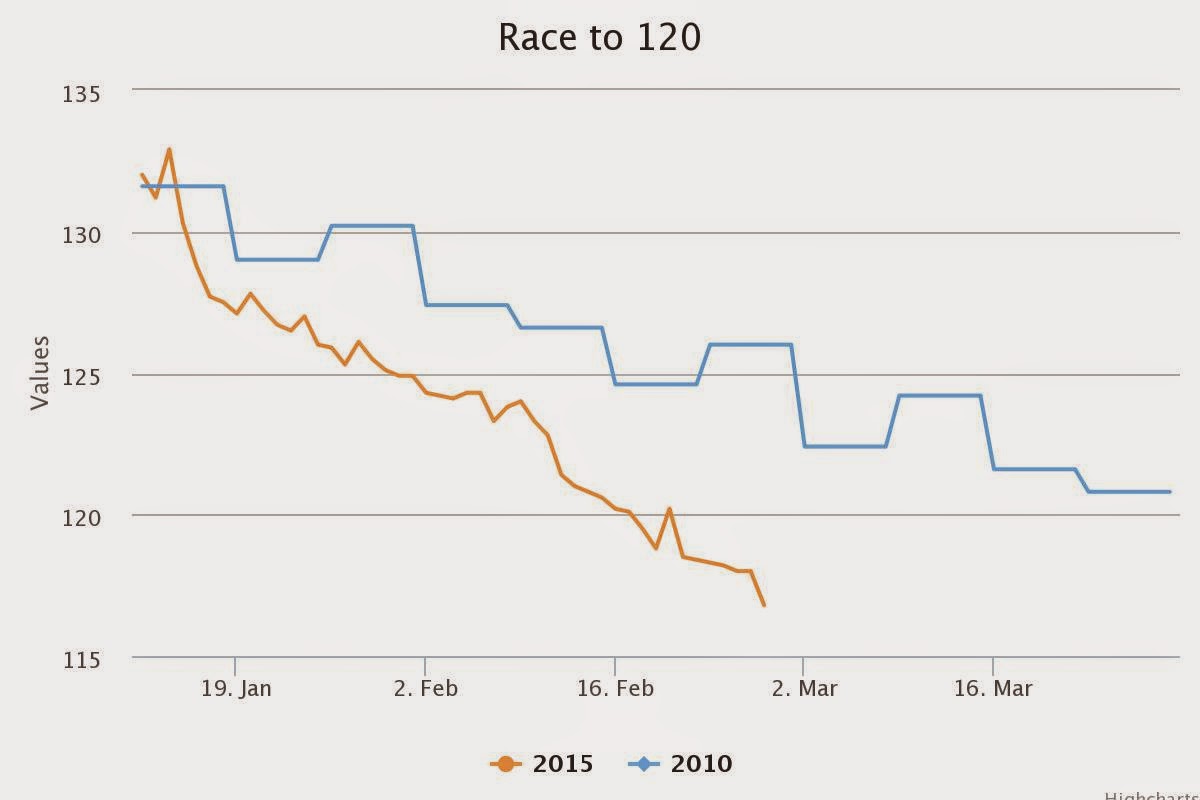
Weight loss has settled down to an average of 2.1 kg per week, consistent over the last 2 weeks and over the last 4 weeks. This lines up well with my rough prediction of 2.5 kg per week based on my daily intake, daily activity and my last-measured resting metabolic rate. Some of my readers will understand how happy it makes me that the experimental data is matching the prediction from the model so well.

I'm still using races against historical data to keep me focused and motivated. Every day or two I lovingly examine the graphs, turning them over in my mind. Here's me beating my previous journey down to 120 kg:


And now here's me racing against two previous campaigns to reach 110 kg:


(The different shapes of the graphs reflect weekly weighings in the past versus the daily weighings I do now.)

The 2011 data I'm racing here was part of a longer campaign and so doesn't include the rapid drop that the start of a campaign always includes. The 2012 data includes such a drop though, and beating that will be difficult in the first week of March.  

If I can maintain my current rate of loss, I will reach my 90 kg target at the end of May. Therefore, in April, I will need to firm up plans for the weight-maintenance project that will follow this weight-loss project at its successful conclusion.

For now, I am starting to think about what form of sport or physical recreation might appeal to me more than 3AM gym visits. Ideas so far include dance and renaissance fencing. If dance, then Latin (there seems to be many options in Brisbane) or flamenco interest me. I've also returned to the notion of cycling to work as an option for the cooler 6 months of the year. All this is still months away, but I'm keen to hear people's experiences with (or interest in) any of the things I've named, or other ideas I might not have yet considered.

Charts again by the Highcharts Cloud tool, which I love.


Thursday, 12 February 2015

Weight loss update 3

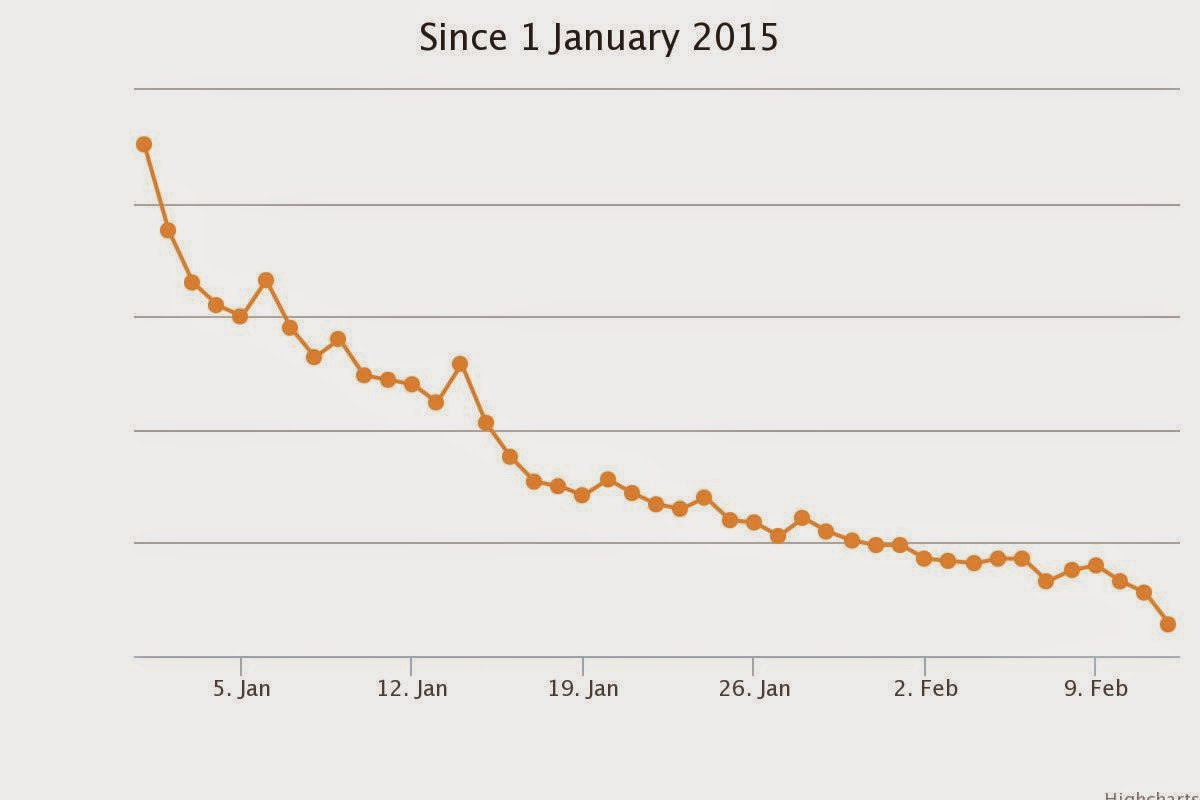
I've reached a new milestone today. I have now lost 20 kg since 1 January:


Divisions represent 5-kg intervals.

I'll admit that I've found the last few weeks a bit discouraging and frustrating. Of course, the rate of weight loss has tapered off a bit. Knowing from experience to expect this has certainly helped cushion the disappointment though.

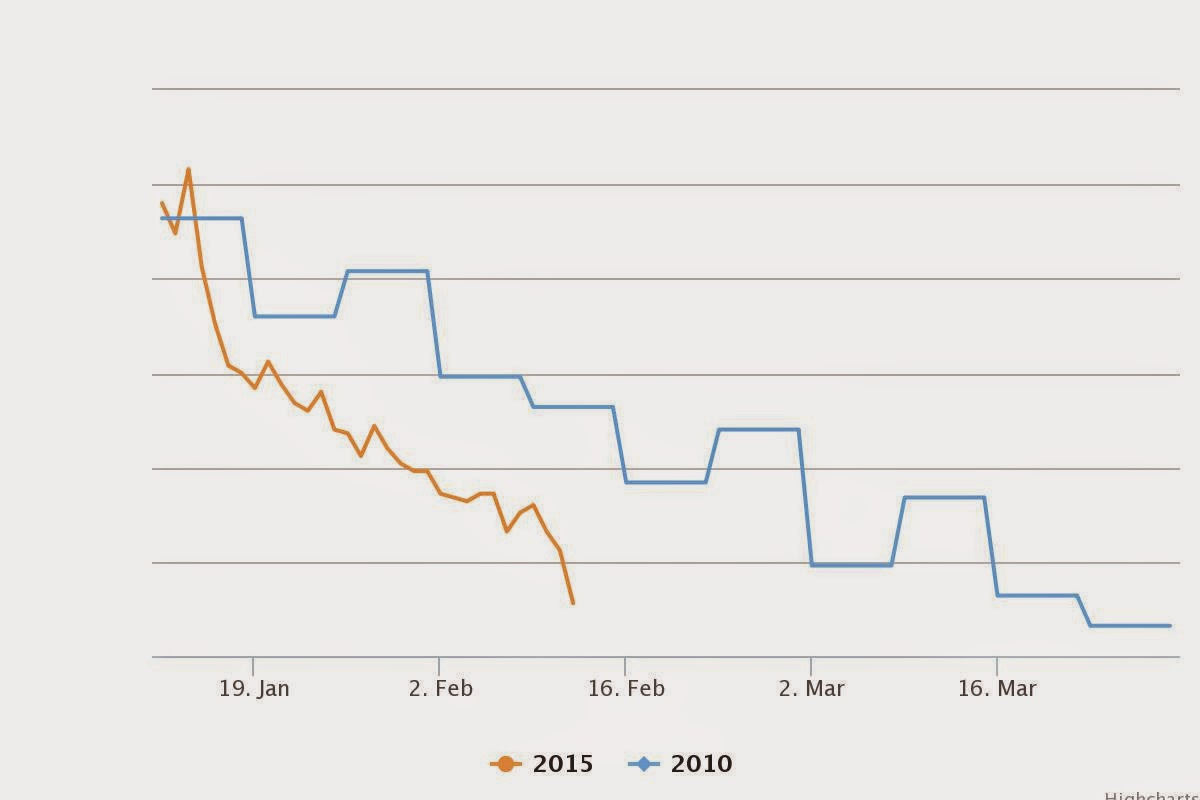
To help keep me motivated, I'm also tracking my progress against a past weight-loss campaign from September 2010. I've transposed my data from then onto a 2015 calendar so I can compare my efforts:


Intervals here represent 2.5 kg. The different shapes of the curves come from weekly weighings in 2010 compared to daily weighings today. The 2010 curve includes the lowest point I reached on that particular campaign. But in 2015, I plan to go far, far beyond there. When I do, I'll create a new "race" using data from a different campaign (and then try to beat it, both in absolute terms and in rate-of-loss).

Staying ahead of my past self certainly helps stay on track :)

Charts again by the Highcharts Cloud tool, which I love.


Sunday, 18 January 2015

Weight loss update 2

Two new milestones today:
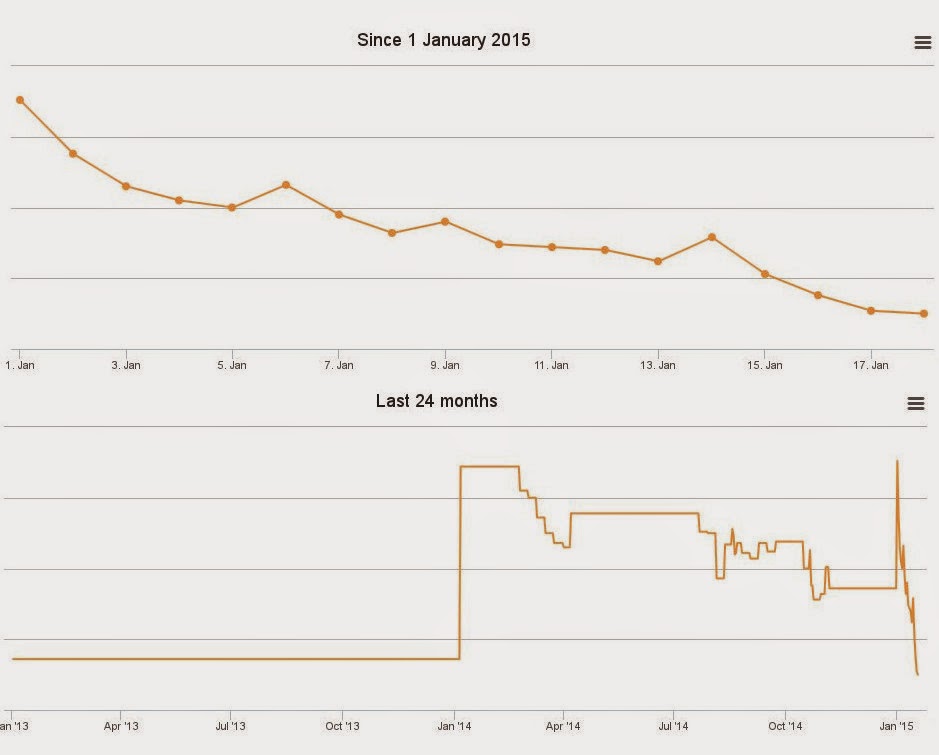
  • I have now lost 15 kg since 1 January (top graph)
  • I am now (just, barely) lighter than I have been at any point in the past 24 months (bottom graph). (Probably, anyway. I didn't weigh myself at all during the course of 2013, but I'm lighter than I was at my last data point for 2012, and it seems very unlikely that I could have lost weight unintentionally between then and the next data point in January 2014).


Divisions on both graphs represent 5-kg intervals.

A special mention here to the Highcharts Cloud tool — I really like the look of their easy-to-make yet highly customisable charts. The tool has social media sharing built-in too. Nice!


Saturday, 10 January 2015

Weight loss update 1

Just a quick update today to note passing two milestones of which I'm proud:
  • The first 10 kg lost (10.2 kg, top graph)
  • That I'm now (just, barely) lighter than I have been at any point in the past 12 months (by 0.4 kg, bottom graph)


In both graphs, the divisions on the vertical axis represent 5 kg intervals.

Friday, 9 January 2015

2015 project -- Lose (a lot of) weight


This year, my project is to lose a lot of weight. Specifically, I want to lose about a third of my body weight. My motivation is, over-ridingly, vanity, and I'm not ashamed to say so. I'm very unhappy with the way I look, and I mean to fix that. Of course, I know that there are many other benefits to me and my family if I lose weight, but as important as I think these benefits are, they are intellectual beliefs that I find more difficult to translate into motivation and action than ridding myself of a bad feeling: my embarrassment at the way I look.

This is a battle I've been having, on and off, for decades, ever since I was that fat nerdy kid at school who got bullied a lot, much of it targeted at my weight. The essential problem has two aspects to it:
  • The foods I love most have a very high energy density. I love sweet things, I love oily things. I also love convenience, which leads me to highly processed foods.
  • I have yet to discover the sport or form of physical recreation that appeals to me in the slightest. All of my favourite ways to relax or have fun are entirely sedentary. If I could be wired up to sufficient sources of information, I think that being a brain in a jar might be pretty cool.
So, my approach is to fight both these natural inclinations and to boost my physical activity and decrease my energy intake. As usual for me, I'm pursuing this very aggressively. The factors in my favour include that I can be very  stubborn, and that I don't get bored with routine. Another important weapon I have is that I am easily able to ignore feelings of hunger. Against me is the fact that because I don't actually enjoy what I'm doing here, I rely entirely on routine to keep me going. The upshot of that reliance is that if the routine is disturbed or disrupted in any way, the whole thing falls apart.

Physical activity:

To address the first part, I'm going to the gym every day to do 40 minutes of cardio (on treadmill and elliptical machine) and 20 minutes of resistance training on various upper-body machines. Because I'm so reliant on routine, I need to make sure I do this at a time of day where I'm never going to be disturbed, so I'm waking at 3:00AM to be at the gym from 3:30AM to 4:30AM and home by 5:00AM. To accommodate this, I'm getting to bed earlier. I aim for 9:00PM, but in practice it's usually somewhere between 10:00PM and 11:00PM.

Past experience shows me that this has to be daily, or the routine doesn't stick. I use a gym because, although I've had good results from just walking for an hour or two a day, if rain disrupts the routine for a couple of days, it's gone. Similarly, when I've worked with exercise physiologists in the past, they've assured me that I would get better fitness results from not doing resistance training every day, or from varying my exercise routine from day to day. I'm sure they're right. But I'm equally sure that the question is academic if it ends up with me not doing anything at all. It seems that I can form a pattern more easily around "I'm here at the gym; these are the five machines I must use" than around "I'm here at the gym; these are the three machines I must use because it's Tuesday."

Reducing intake:

On the other side, I'm reducing my calorie intake to practically nothing. By "practically nothing", I mean around 300 calories per day, which should be about what I'm burning in the gym session. Just enough to take in a few nutrients and to keep my gastro-intestinal apparatus running.

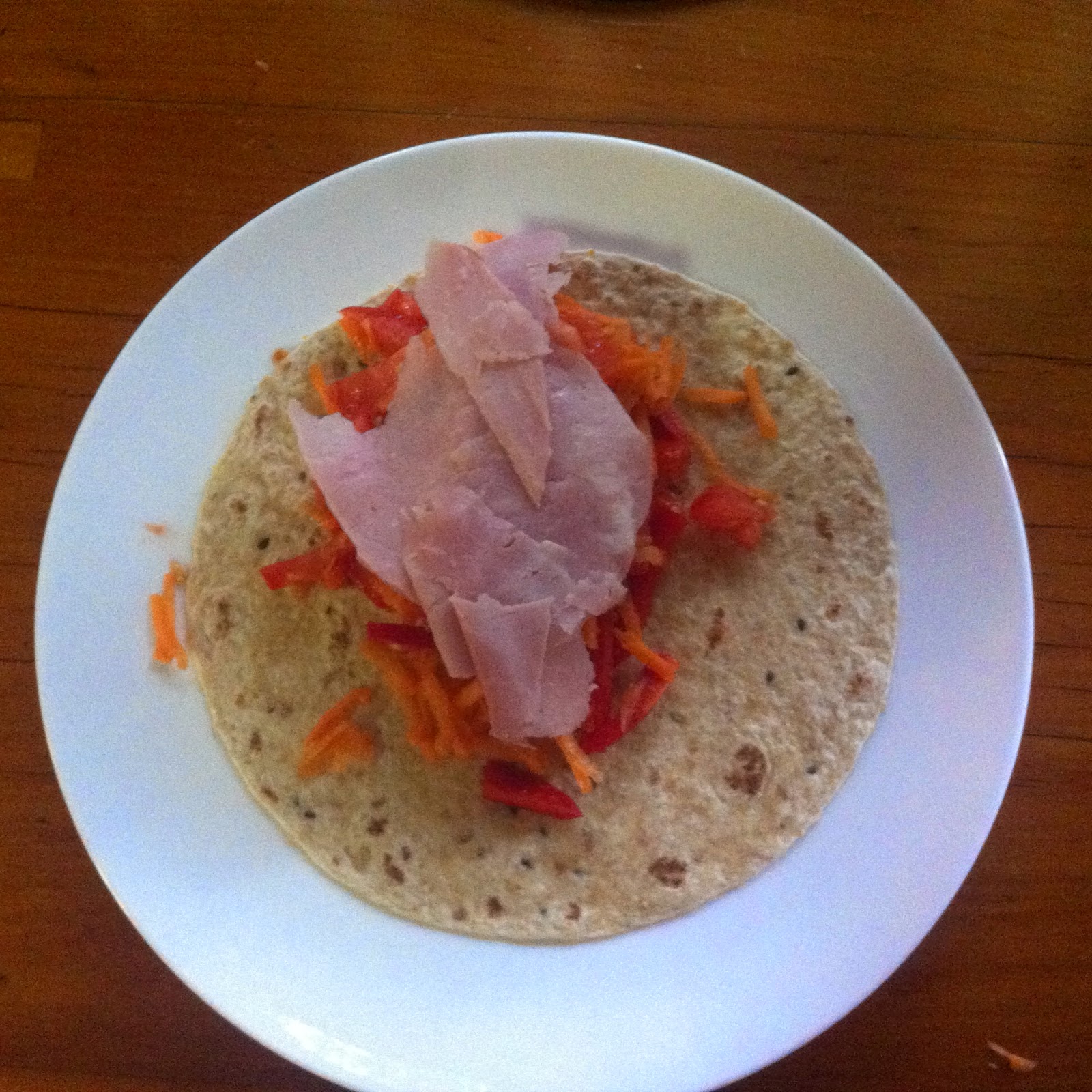
Again, to capitalise on the power of routine, I just eat practically the same thing every day. I have one meal a day, in the evening, which consists of a piece of flat bread wrapped around some salad and some ham or salmon.

An entire day's food intake for me in 2015 looks like:


I've had my resting metabolic rate measured in the past, so I know it to be close enough to 2500 calories/day to make the maths neat. With a net calorie intake of about zero and one pound of body fat equal to about 3500 calories, I'd expect to lose around 2½kg per week like this. (I know that weight loss doesn't work to as simple a formula as this. It's a ballpark number.)

I'm also conscious that food does have an important social function too! And so I will occasionally allow myself a treat at a social gathering (as I did last Sunday). My goal in those cases will still be to keep net energy intake for the whole day below 1000 calories. Tonight is games night, so I'll be treating myself to a few sushi rolls in place of my wrap. Yay!

Weight loss at the start of a diet is very rapid due to losing a lot of water. In the first week of 2015, I lost 8.1kg with the method described above. Now, I don't for a minute expect this rate to continue, but it is certainly a very pleasing start! :)

Physically, I already feel a difference in the fit of my clothes, in my posture, and in the flexibility of my joints. Psychologically, as in the past when I've been on extremely restrictive diets, I am experiencing a heightened sense of alertness. I also seem to notice smells more. (Past experience shows me that beyond this lies a kind of euphoria and a kind of floaty, out-of-body feeling, but I'm not there yet).

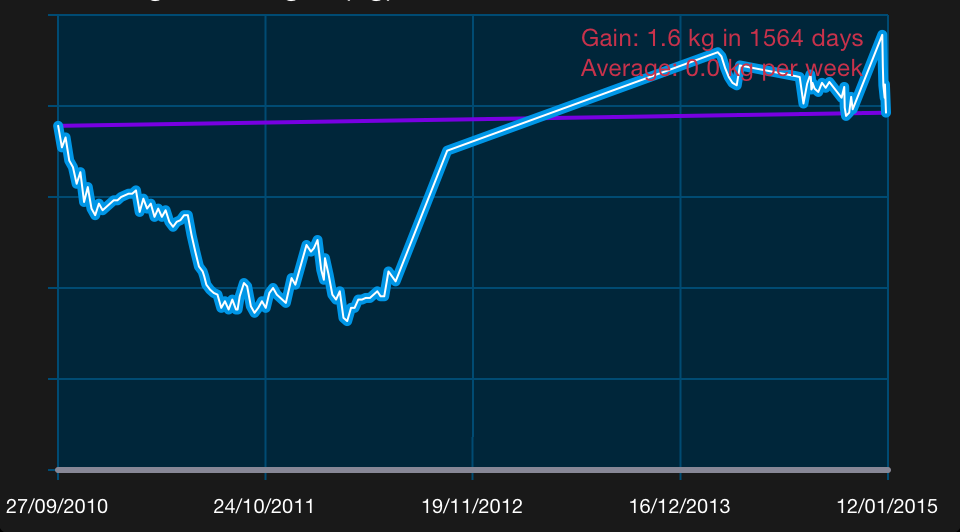
And as for the long term? I know I can't exercise like this and eat like this indefinitely. This regime isn't designed or intended for that. I also know from repeated past experience that when I come off an extreme diet, I very quickly revert to my sedentary lifestyle and mostly indiscriminate eating. This is a graph of my weight between late September 2010 and today:


A few key features:
  • The lines along the vertical axis represent around 10kg, so over the last four years, my weight has varied by about 30kg, and I'm presently close to the top of that range. Indeed, on 1 January 2015, I weighed more than I've ever recorded in my life. Note however, that there's four years along the horizontal axis, so it's not like I can gain or drop 10kg overnight. (That might take weeks!)
  • The long, featureless, upward slopes between late 2013 and mid 2014 are times when I was paying no attention to my weight at all, so no weigh-ins and no data. 
  • The instances of jagged upward drift were me trying to adhere to "sensible, healthy, everything-in-moderation" eating. I haven't been able to get this to work for me.
  • The slow downward slope through much of 2014 was me experimenting with a 5:2 diet that seemed to work for me for weight maintenance or very gradual weight loss. 
  • The big spike at the end of 2014 was when the 5:2 diet went away completely during the festive season of eating whatever I wanted. I can put on a lot of weight very quickly! (but then again, I can also take it off quickly).


So, it seems likely to me that even if I succeed in reaching my target with these extreme measures, the upward trend will set in again almost immediately. I don't really know what I'll do at that point, but it seems to me that the long-term strategy might be to shorten the cycles of weight gain and loss, so that I embark on these extreme measures sooner, at a lower threshold weight. Anyway, that's for the future.

I'll post updates to this blog to document how this attempt goes.


This blog post uses a mix of English and SI units. "Calories" here are "dietary calories" which are really "kilo-calories". People who want kilojoules, just multiply the numbers by four. Americans and Liberians who want pounds instead of kilogrammes, multiply those numbers by two. In both cases, you'll be "close enough" for the precision expressed in the numbers.