Showing posts with label exercise. Show all posts

Monday, 17 April 2017

First steps into dance

I was a chubby child. And somewhere between the ages of 6 and 8, the schoolyard taught me to see my body as disgusting and shameful. It was one of the most powerful, most enduring, most life-changing lessons I was to learn from school. I still experience its influence every single day.

One of the ways in which this knowledge manifested itself was in a particular horror at dance. Having internalised that my body was disgusting, the last thing I wanted to do was draw attention to it by moving it around, maybe causing it to wobble or jiggle. And, already bearing the brunt of ridicule and teasing for even existing in this body, I never wanted to do anything in public view where I might appear clumsy or inept, or in any way invite even more mistreatment and contempt.

So, apart from whatever enforced dancing lessons at school I could not escape by feigning illness, I avoided dance floors from then on at almost all costs. Maybe the highest of those costs were refusing point-blank to join in the dancing at my brother's wedding, and, a few years later, being relieved that my fiancée agreed to not having any dancing at our wedding at all.  

And yet...

Part of me loved dance. While I hated those dancing lessons at school, I loved the actual dancing (it would have been great if I were invisible, or alone). Over the years, I made a couple of furtive excursions into dance, when it felt very safe to do so. For example, a short stint of latin dance classes, accompanied by a nun I knew; or a casual, one-off Lindy hop class at a jazz festival with a group of other absolute beginners.

And I loved to watch dance: I remember first going to the ballet with my parents when I was about 10 or 11 years old,1 beginning a life-long adoration of this art form. Years later, I came to love watching flamenco performance as well. But for me, dance was something for other people to do.

Fast-forward to the present.

Step 1: Zumba

Over the last two years, I've been on a journey to re-make my body. Part of that has been exploring different forms of exercise. For me, the support and encouragement of friends has been a vital ingredient in this venture. So when one of them put out an invitation to join them for some free fitness classes being offered in our city (the Medibank Feel Good program), I was eager to go along. And when I looked up one of the classes, Zumba, and discovered that it wasn't that thing inside the big inflatable balls2 but was exercise inspired by latin dance, I was filled with a mixture of simultaneous trepidation and curiosity.

So, on 2 April 2015, a rainy Thursday afternoon, I made my way to South Bank. Looking around, I was relieved to see that I didn't know anybody other than my friend. I was still very worried about looking ridiculous.

The class wasn't easy for me. I felt like I was doing the right move only about 25% of the time and felt my balance and co-ordination taxed to their absolute limits. By the end of the 45 minutes, I was not only physically exhausted, but my brain had turned to mush from trying to control my limbs into making unfamiliar movements, while simultaneously translating the instructor's visual cues into actions. I felt sore and overwhelmed, but I had also had so much fun! Unlike running and cycling, which took time for me to fall in love with, Zumba hooked me right from the start. And as for my fears? I discovered that I was focusing so hard on the movements and following the instructor that I became completely unaware of anyone around me. I learned that I didn't have to worry about what anybody else thought: I wasn't going to perceive it anyway.

The Feel Good program runs twice a year, in ten-week blocks during autumn and spring. By the end of the autumn 2015 block, I became a Zumba regular and already started seeking other places to get my Zumba fix while Feel Good wasn't running. I was delighted to find out that Brisbane City Council was offering free Zumba classes on Saturday mornings as part of its Active Parks program.3 And when that block of classes finished, I found a regular Saturday morning class close to home and became a regular there.

By now, my confidence had grown enormously, and I felt like at last, I was dancing the right steps in most of the routines at least most of the time. A huge moment of validation arrived on 16 January 2016. Our instructor had a practice of inviting classmembers onto stage with them for some tracks, to dance in front of the whole class. On this day, I was invited up for the first time! In a little under a year, I had gone from someone who wouldn't dare to be seen dancing to being not just comfortable, but excited to be getting up on stage. I scored a commemorative wristband too.

But soon, some changes in my weekly schedule made it difficult to get to a Saturday morning Zumba class, and I was left searching for alternatives.

Although I hadn't known it at the time, connections that I'd made through the free, public programs I'd attended would pave the way forward. At Active Parks, I'd met an instructor whose style and energy I really enjoyed. When, later in the year, they also taught classes in the Feel Good program, I was excited to learn that they worked at Pure, a gym near my workplace that provides the instructors for the program. So when I was offered a great deal on a membership package there, I readily signed up!

Step 2: Barre

Zumba alone would have made my Pure membership worthwhile to me, but this gym also offers the most amazing variety of other classes: everything from traditional aerobics-style workouts to more kinds of yoga than I knew existed, to pilates classes on mats and on machines, to hula-hooping and mini-trampolining... and barre.

The start of my journey to become fit and healthy was purely being unhappy with the way I looked. I restricted food dramatically (even stupidly) and exercised intensely to shed a large amount of bodyweight: eventually, 63 kg (139 lb) of it.  As my weight decreased, I started having to engage with a new question: I knew what kind of body I didn't want; but what kind of body did I want? To be honest, I still don't really know the answer to that (and the question has become less important to me anyway). But when a friend suggested that maybe I could now start building muscle, I freaked out a little bit. As much as I knew I didn't want to live in a fat body any more, I also knew that I didn't like the look of a bulky, muscular physique. And by now, running and cycling had already made my thighs larger and more muscular than I was happy to see. I was actively avoiding any strength training out of fear of what it might do to my body. When I told my friend that, their advice was to look at athletes' bodies across different sports, see which physiques appealed to me most, and this might give me a clue about what kind of training might take me in the direction I wanted. My psychologist endorsed this approach too, and made me aware of photographer Howard Schatz's iconic and amazing work Athlete. (If you're not familiar with it, I highly encourage you to take a look!)

A fresh, full body workout using the ballet bar to burn fat, tone muscle and create long, lean physiques. Using a series of small, isometric movements to target the butt, thighs, abs and arms, this class is the fastest and most effective way to create your perfect ballerina body - and all in 30 minutes!
Beautiful. Graceful. Transforming. Pure Barre. Fusing classical ballet & innovative conditioning to offer a powerful, tightening, and toning workout.
As I perused these images, I could quickly see that none of them appealed to me as much as the understated leanness of a dancer's body: strength without bulk. But I had no real idea of where to even begin to translate that insight into any kind of training, and the idea just sat at the back of my mind. By the time I joined Pure several months later, I had never even heard of barre classes as a form of exercise outside of ballet training (and I couldn't imagine I'd be ever be doing that — isn't that something you have to start when you're about 3 years old? Don't you have to be ultra-flexible and have perfect balance and co-ordination?) So, when the timetable app and a poster on the gym wall offered this class and described it as "Beautiful. Graceful. Transforming." and as creating "long, lean physiques", I knew I had to give barre a try!

Before I even went to my first class, I was lucky to have a practical demonstration that strength does not equal bulk. A free personal training session was included in my Pure membership, and as luck would have it, the trainer to whom I was assigned was the architect of Pure's barre program, and a former professional ballerina. Much physically smaller than me, lean and slender, I was amazed to see her lift weights apparently effortlessly and with complete control that had me struggling and wobbling all over the place. It was a powerful visual reassurance not to fear becoming strong.

On 25 August 2016, I stood at the barre for the first time. I was nervous, but also wildly excited. When a couple of other participants also raised their hands at the instructor's question "Is this anyone's first barre class?" I felt myself relax a tiny bit. Over the next half-hour, I had the surreal experience of terms I'd known for years, and movements I could recognise by sight — plié and grand plié, relevé, arabesque, the positions of the arms and feet — suddenly coming to life. It felt like I had gained an extra sense. It's like reading a verbal description of a picture and then seeing it for yourself. And even more to my astonishment, although I was shaky and weak and my range of movement small, I could make some of these moves! Crude and imperfect, sure, but what I saw in the mirror was at least recognisable to me. Now, as we're often reminded, a barre class is not a dance class. But it does contain some of the same building blocks, and it was a thrill beyond words to experience that. It would set the scene for the next step.

And beyond all the positive ballet associations, nothing had ever made my body feel so good as barre does.  More than that — since radically changing the shape of my body, my whole sense of the space around my body feels weird and distorted. My body moves in unexpected ways. It fits through spaces it seems like it shouldn't. My limbs bend in ways that feel unnatural. Sometimes this just feels odd; other times it's even disconcerting. Nothing I have tried has better connected me to this new body, the way it moves, and the way it occupies the space around it than barre has. It's also done wonders for my posture!

So my appetite for barre quickly increased. One class a week was not enough, and soon I was doing two, then three. Taking more classes let me experience a range of different approaches to barre, reflecting different instructors' personal styles and backgrounds. Some classes had a stronger pilates flavour; others were more yoga-like; others more like an aerobics workout. I liked all of them, and enjoyed the variety of this barre-smörgåsbord. But the classes I found I liked best were the ones that had the strongest ballet elements. In these classes, it felt like my vocabulary of movement (and terminology) would grow just that little bit more every week: tendu, fondu, attitude, retiré... Discovering how much I enjoyed this style of class left me wanting still more.

But to skip ahead slightly, on 4 March 2017, I took part in a charity fundraiser ("Pure Palooza") which saw me do a barre class (amongst other classes) out in public — on the main stage of the Queen Street Mall, the heart of Brisbane's CBD. In other words, totally exposed and in public! Not only was I quite OK with this, but I really enjoyed the experience. Less dance-related, but more tellingly, I was also OK now with the other classes in public that formed part of the event, even things like hula-hooping and mini-trampolining that I had only done once or twice and was by no means competent at. My need to feel like I really knew what I was doing before letting other people see me do it was gone (at least in this context). The journey I'm describing in this post gave me that.

Step 3: Ballet

The appetite that barre classes had kindled in me led me to question my assumptions about ballet. Might it actually be possible to learn to dance as an adult? Google immediately confirmed that it was; and that there were a number of options for adult beginners in ballet right here in Brisbane, including classes offered through the community engagement and education arm of our state ballet company, Queensland Ballet. Their "Ballet Basics" level is a structured course designed specifically for people like me: adults who had never danced before. I couldn't wait to sign up!

On 12 January 2017, I attended the first of two "taster" classes I had enrolled for; opportunities for prospective students to see if they liked what the course had to offer. I did. Very much. The four months of barre had definitely helped prepare me by making some of the positions and movements familiar. But even from the very first taster class, I was learning new things, and loving the experience. And maybe the best thing that Zumba and barre had given me was the freedom to be wrong; in other words, to be a learner. I was OK with not being perfect straight away, even when other people could see me!

The course itself began two weeks later and over the next two months, we would vastly expand on our collection of steps. It was everything I had hoped for and more. By the end of Ballet Basics, we were stringing some of what we had learned together; week 5 was the first class in which I felt we had started to dance, even if it was a sequence of only about six steps. I realised that, in addition to the foundations of dance itself, I also enjoyed soaking up the little bits of the ritual and etiquette of this beautiful art that we were exposed to. In short, the more I experienced, the more I loved it.  

"Graduation" and the end of the course felt like another real validation, and I'm very eager to progress on to the next level: Beginner Ballet!

The best thing about being an absolute beginner is the joyful anticipation of the long journey ahead.


Final thoughts

I wrote this post to commemorate three recent milestones:
  • the second anniversary of "taking the plunge" at my first Zumba class
  • my 50th barre class
  • completing the Ballet Basics course

Two years ago, all of this would have been unimaginable: not only that I would be able to take up ballet, but even that I would want to learn to dance rather than just watch from the sidelines. My life has become unrecognisable, and I am deeply grateful to my friends and teachers for their inspiration and encouragement. And of course, to my darling wife Laura who supports all my dreams and passions. I loved dancing with you last year at your birthday, the first time outside a class context, and only the second time ever. And we have a big anniversary coming up...

You never know who's life you may change. Invite someone to class.
Collected from Facebook. Forgive the
grammar; the message itself
could not be more true.
My journey into dance has also been a journey out of self-consciousness and into self-confidence; and yet, if there's one message I wish I could send back in time to myself it's that dance is for everybody.

At Zumba, at barre, and at ballet, I have met fellow students with a wide range of ages, body shapes, and abilities, brought together by a love of just how well music and movement go together. If you're reading this, and you've always wanted to dance but you're worried about any of those things, I wish I could share that same message with you.


1 I'm disappointed that I haven't been able to pin-point the production, despite generous assistance from Queensland Ballet trying to match my childhood recollections with their historical records. It seems that my earliest ballet memories are a mish-mash of a number of different performances. 
2 That's Zorb, for the record.
3 New Farm Park; for any of my parkrun friends reading this, it was the proximity of this Zumba class that brought me to New Farm to try parkrun, even though Stone's Corner and South Bank parkruns are actually closer to me!

Note: this post updated 25 April 2017 for improved historical accuracy.

Thursday, 22 September 2016

On my 50th Parkrun

My third Parkrun, 16 May 2015.
My time was 28:36.1
This Saturday, I will run my 50th Parkrun, and the occasion makes me think about the role this movement has played in changing my life. If you don't know what it is, you should take a few minutes to read about it now.

If you know me or my story, you know about my struggle over the last year and a half with conquering my life-long obesity and building up my health, fitness, and confidence.

I don’t want to dwell on the food restriction part of what I did, because it was unhealthy and foolish — even dangerous — and nobody should feel “inspired” to copy it.

But this milestone Parkrun makes me reflect on how things used to be on the energy output side of the equation: miserable 3AM starts at the gym, so that I could get up on a treadmill for a daily dose of physical activity. I chose that time of day because I knew that absolutely nothing was going to interfere with my routine at that hour. I didn’t enjoy the gym, and I relied entirely on willpower and routine to sustain my activity there. Even when my wife and I would go away for a weekend, I would get up at the same time to take advantage of the hotel gym so I would not break my routine. I felt like if I allowed any exceptions, I wouldn’t be able to force myself back into the pattern.

But around April, a friend suggested replacing the gym ordeal with exercise that I might actually enjoy, and pointed me to Parkrun as an example.
I’ll admit that I was sceptical. The thought that I might like physical activity was still completely foreign to me, and nothing about the months of 3AM sessions at the gym had convinced me otherwise! But I like to pride myself on being open to trying new things, and so one Saturday in May, off I went.

I wasn’t an instant convert. But what I did immediately like was an overall sense of achievement and acceptance. It didn’t matter if I couldn’t run the whole 5km, and it didn’t matter that there were people faster than me or slower than me. So the next Saturday I came back, and I realised I liked being able to compare my effort and my results to the previous week. Soon, I was a regular.

But what turned Parkrun from a recurring calendar reminder into a passion was the sense of community. One week, a pacerunner helped me to a new PB, and chatted nearly the whole time we were out there — even when I couldn’t respond (“Can’t… talk… breathing…”) Not only that, but the next week, she greeted me again, and introduced me to some other regulars. Before I knew it, I had Parkrun friends.

It wasn’t long before Parkrun became a gateway into other recreational running, and soon I was entering events: City 2 South, Bridge to Brisbane, and then in early 2016, my first half-marathon!

And the gym membership? Cancelled. Exercise as an unwelcome chore had been replaced by exercise I loved: running, cycling, and Zumba (those are other stories…) Now, I don’t have to force myself into physical activity — I eagerly look forward to it in my daily life.

At my lightest, I dropped 63kg below my starting weight. I’m up a few kilos since then because although I’m still losing fat (more slowly now), I’m gaining muscle. And my health and fitness are the best they’ve been in my entire life.2

My theme for my 50th
Parkrun: Shiny and
sparkly!
Obviously Parkrun is just one ingredient in my journey over the last 20 months, but it’s been a vital one, because of the way it changed my outlook in a really fundamental and significant way. Therefore, 50 Parkruns is a particularly important milestone for me, because to me, it means that this is a transformation that has taken root and stuck. This is a lasting change.

I owe thanks to so many people: special thank-yous to Angela for a great suggestion, and to Kelly for befriending me and bringing me into the group. A big thank you to the whole New Farm Parkrun community for being a wonderfully accepting and welcoming group of people. Thank you to all my friends who offered so much encouragement along the way and “liked” or favourited” all those status updates and tweets — that really meant something to me. And thank you to my wife Laura and my ma Barbara for your unflagging, enthusiastic support for these big changes and transformations.


1 My current PB (personal best) for New Farm Parkrun is 23:35, run on 27 August 2016. My best 5km time anywhere is 23:02, which I ran at the International Women's Day Fun Run this year at Southbank. 

2 A few recent stats:
  • Resting heart rate: 46 beats per minute
  • VO2max estimated at 47mL/kg/min based on 85% submax test
  • Resting metabolic rate: 2059 Cal/day
  • Body fat: 14.6%

Saturday, 23 January 2016

Weight loss update 11

Events conspired in late 2015 to slow my weight loss. Contributing factors included:
  • my university study load taking my focus and attention from my weight loss 
  • a jaw injury from a bike accident forcing a change in my diet
  • eating festive food at Christmas

So in January, I have renewed my efforts. I had previously achieved my primary goal weight of 90kg, and at this point was pretty happy with how I looked. The two exceptions were a little more fat on my belly and on my upper back. So I have set a new goal of 80kg so I can reappraise at that point. 

This year, I'm trying something a little different: Nestlé's Optifast system. These are meal replacement shakes, each of which provides 200 calories. I am living on two of these per day: actually a little more than I was consuming in 2015. 

The system is simplicity itself! Optifast is sold in boxes of sachets of powder. Preparing a meal is as simple as tearing open a packet, adding it to 250mL of water, and shaking it up! This is my kind of cooking! 

I am also keeping physically active: maintaining my running, cycling, and Zumba, and still learning to swim. I try to achieve a calorie deficit of around 2,000 calories per day, which should be a weight loss in the vicinity of 2kg per week. 

The first week of Optifast gave me spectacular results, letting me shed 3.9kg,and this morning, I passed the 55kg milestone! 

Shouldn't be long to 80kg!

(And then the real work—figuring out how to stay there—begins...) 


Wednesday, 21 October 2015

Weight loss update 10 -- primary target achieved!

On January 1 this year, I weighed 142.6kg, and set myself the goal of losing weight until I got down to 90kg, then reappraising. This morning, I hit that target!

I weigh myself in the mornings, straight after exercise, and I’m aware that this number represents a low—I have an empty stomach and am a little dehydrated. Still, these are the same conditions under which I’ve weighed myself all the way down here.

A few months ago, I started thinking about what I would do at this point, and resolved to lose another 8kg from here. That’s still the plan. I’ve also had a series of bioelectrical impedance measurements over the last few months.

The most recent of these, on September 7, showed a body fat mass of 16.5kg, in a test that considers a range from 8.9kg to 17.7kg as normal for a male my age and height. I’ll have another scan in another couple of weeks and see how that number has moved.

In general, I’m getting pretty happy with the way I look, and in turn, I’m feeling a lot more self-confident. I don’t like how soft my midriff still is, but I wonder if that’s even correctable without surgery now. (And that’s a step I’m not willing to contemplate, at least not right now.)

So, the plan for the next 8kg is:
  • continue to restrict calories as severely as I can
  • continue cycling as my main means of transportation (this is a given now, anyway...)
  • continue at the gym, Mondays to Fridays: 30 minutes running on treadmill, plus a circuit of weights machines
  • continue Wednesday afternoon aerobics with the Medibank Feel Good program, and add Thursday afternoon Zumba there in November when uni finishes
  • continue my Saturday morning routine of cycling, ParkRun, and Zumba
  • continue Sunday morning long bike rides, replacing my cruiser bike for a road bike for this use-case as soon as possible. When that happens, I’ll also finally take the plunge into the exciting world of lycra.
  • learn to swim, and see if I enjoy that (that’s the other skill many people picked up in childhood that I don’t have)
And then reappraise how I look at 82kg! At that point, I might consider some personal training to build core strength: something I know is a current weakness.


Saturday, 5 September 2015

Weight loss update 9

Another milestone today: I weighed in at 91.4kg this morning, 51.2kg lighter than where I started. There’s now just 1.4kg to lose to hit my primary target. My newest exercise shorts are size S — six sizes smaller than what I was wearing in January. In fact, I can easily fit into one leg of those old shorts now.

I weigh less than at any point in my adult life. I have records stretching back to the last 10 years worth of battling with my weight, but I’ve never come this far. And as for before that? I don’t have records, but I know that I weighed 15 stone (95kg) by the time I was 16. I think I can safely claim that I am now leaner, faster, fitter, and stronger than ever. I am in the best physical condition that I have been in my life. Something else that’s been entirely new to me has been picking out a new wardrobe, and for the first time in my life, actually enjoying the clothes I’m wearing. This has been such a paradigm-shift for me that I’ll blog about it separately soon. My world has changed.

The rate of loss over the last few months has been maddeningly slow compared to the weight that was just falling off me at the beginning; and I feel myself losing patience and momentum. So, to ensure I’m maintaining a meaningful calorie deficit, I’ve upped my morning cardio routine to include a 5km run on the treadmill every day (which is also no doubt helping my ParkRun and fun run times). I’m also trying to do some longer bike rides on the weekends: I’ve now done a couple in the 30-km range and plan to extend these.

So, in another few weeks, I hope to be reaching for a new target — I still have my sights set on 82kg.


Friday, 7 August 2015

Learning to cycle as an adult: from complete n00b to daily commuter

Here in Australia, it seems that most people acquired two skills in childhood that I never did. One of these is riding a bicycle. When I was about eight years old, my parents did actually buy me one, but being the indoor sort of child that I was, I never developed an interest in it and never learned to use it.

Fast-forward a few decades, and I’ve been looking for ways to boost my level of daily physical activity as part of a plan to lose weight and keep it off. I’ve always walked a lot, and at various points in the past have regularly walked the 5 kilometres each way to and from work. But walking as commuting takes the better part of two hours out of my day and I wondered if cycling would give me a similar energy burn but without taking up so much time. The first challenge, though, was to figure out whether I’d be able to ride a bike.

My first conundrum was that I was hesitant to go out and buy a bike when I didn’t know whether I’d be able to learn to ride it. But how to learn to ride a bike without a bike?

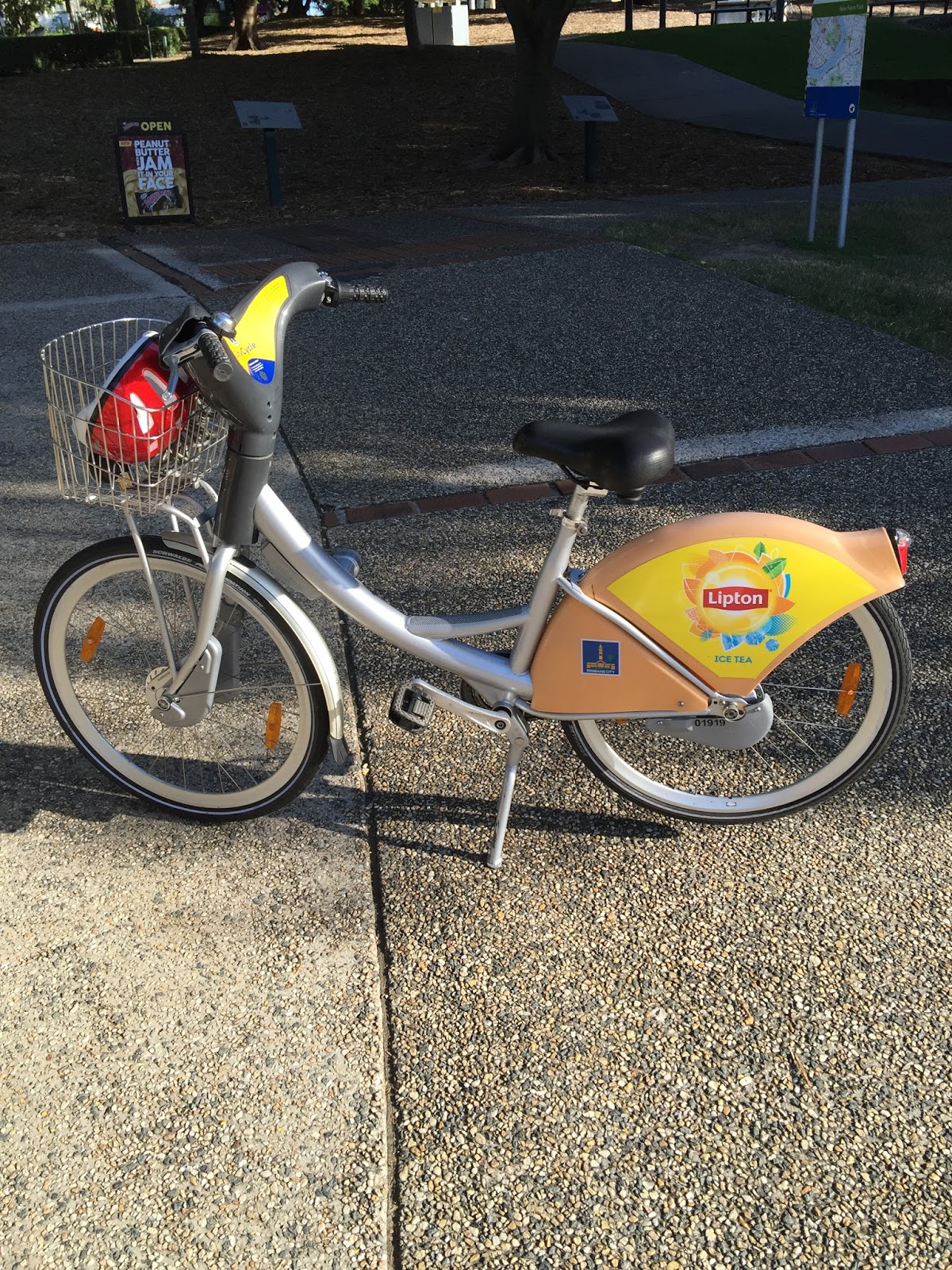
Fortunately I had access to a simple and obvious solution: my city (Brisbane) has a public bike-hire scheme (CityCycle). For a small subscription fee, you can access a fleet of bicycles available from racks stationed throughout the inner city. The success of the scheme overall is debatable, but it was a perfect fit for my purpose.

As for actually learning to ride, of course I turned to the Internet. Reading the experiences of other adult learners suggested separating out “riding a bike” into a set of discrete skills. The most fundamental of these was balancing on the bike while in motion. So, following the advice I gleaned online, I set myself the goal of balancing on a CityCycle while it rolled down a grassy slope in a park, using the bike’s brakes—and my feet—to stop it at the end of the slope. Advice I’d read also suggested removing the pedals from the bike while practicing this specific skill, but obviously that wasn’t an option for me!

I also considered lessons from a cycling coach. More on this later.

26 April — Lesson 1


So one Sunday afternoon, I spent an hour in a nearby park with a hired CityCycle. I adjusted its seat down as far as it would go, then I would walk the bike to the top of a slope, climb on, and just coast down the slope while attempting to remain upright. The first few attempts had me rolling only a few metres before I’d lose balance or confidence and put a foot down to prevent a fall. However, I was very surprised at how quickly I learned to balance on the bike. At the end of the hour (and some twenty or more coasts of about 50 metres), I was still scared, but had no trouble riding the whole way down the slope with both my feet off the ground. This was a major confidence boost for me. I don’t have a good sense of balance, and I had assumed that balancing was going to be the biggest obstacle I faced. With that concern out of the way, I felt much more certain that this whole riding-a-bicycle idea was actually feasible.

The other surprise for me was how the brakes operated. For some reason, I instinctively expected that if I pulled on the brake lever fitted to the left handlebar, the bike would veer left, and vice versa for the lever on the right handlebar. Of course, that’s not true and doesn’t reflect what I knew even then to be mechanically true of the bike, but it was an unconscious expectation nonetheless. To this day, three months and 600 kilometres later, I still have to fight this instinct occasionally. I wonder if this somehow distantly relates to my very earliest driving experiences being with a tracked vehicle with differential braking? (A Caterpillar D2, for the record).

9 May — Lesson 2


Two weeks later, at a different park, I again hired a CityCycle with the intention of adding steering and propulsion to the mixture, still confining myself to areas thick with grass.

Pedalling turned out to be a non-issue; and in retrospect, I now know that apart from cushioning any potential falls, the thick grass also served the very useful purpose of preventing me from building up too much speed too quickly.

Steering was a little more difficult for me to get the hang of. Initially, I had a very strong tendency to over-steer. It took quite some trial-and-error to determine that most of the turn needed to come from shifting my balance to one side or the other, with only small, gentle inputs from the handlebars. Initially, I think I expected the bike to steer more like a car. I liked discovering that it steers more like an aeroplane.

This week, I also experimented with the gears (on CityCycles, a three-speed, hub-geared arrangement with a twist shifter) but found little value in them. Indeed, I could feel so little difference between the gears that I had to enquire via social media whether “1” was the low gear (as in a car) or whether it was the other way around! (Yes, “1” is low, for anyone else wondering) I also learned that, unlike a car, shifting down gears does not provide a braking force. Another instinct that I still occasionally fight.

I spent an hour that day pedalling along the grass, describing long, lazy figures-of-eight. By the end of it, I could essentially ride a bike, even if my directional control was not wonderful.

So, for any other adult novices reading this: that’s two hours from zero to basic competence.

16 May — Lesson 3


The following weekend, I decided to attempt a real ride along a bike path. There’s a 5-km round-trip stretch of path that I knew quite well from doing weekly fun-runs on it (ParkRun). I knew it to be flat, wide along most of its distance, and not too busy. And my familiarity meant that I could remove finding my way from the cognitive load. I set out, slowly and tentatively.

It wasn’t hard to complete the 5 km, but it was a pretty nerve-racking experience for me, especially when sharing the path with other cyclists and pedestrians. It was during this ride that I discovered that the phenomenon of target fixation applies to cycling: that worrying about an obstacle like a pole or bollard would tend to make me steer directly for it.  I had to learn to disconnect my attention from such hazards and focus on where I wanted the bike to go rather than where I didn’t want it to go.

By the end of week three, I now knew that I was physically capable of staying on a bike and making a powered, controlled ride of approximately the distance I would need to cover to ride to or from work.

16 May — My first bike


By now, I was already researching what kind of bike I might like to buy. The criteria I had come up with included:

  • Upright riding position: I wanted a bike that emphasised comfort over speed, and the upright position suggested greater comfort than being hunched over the handlebars, as well as better safety due to better visibility.
  • Platform pedals: I wanted to be able to put a foot down quickly to avert a fall without having to disengage from any kind of retention mechanism.
  • Step-through (“ladies”) frame: And if I were to fall, I wanted to minimise the chances of getting entangled in or injured by the frame.
  • Hub gears and twist shifter: Hub gears seemed more robust and needing less maintenance than derailleurs. And the twist shifter seemed easier to use while keeping both hands firmly on the handlebars. Actually, I initially wondered if I’d need or want gears at all, but fortunately, friends convinced me that they were a must-have.
  • Pretty! I wanted a bike that had some character and which reflected my own aesthetic sense. As I see it, too many bikes lack any kind of style, or are actually (and perhaps deliberately) ugly.  
  • Cheap: Despite the promising experiments, I didn’t want to spend a lot of money on what was still an unproven concept. I hoped I would be able to spend less than $300 or so.
Something like the Papillionaire Sommer looked ideal, but at around $800, was a bit more than I planned to spend.

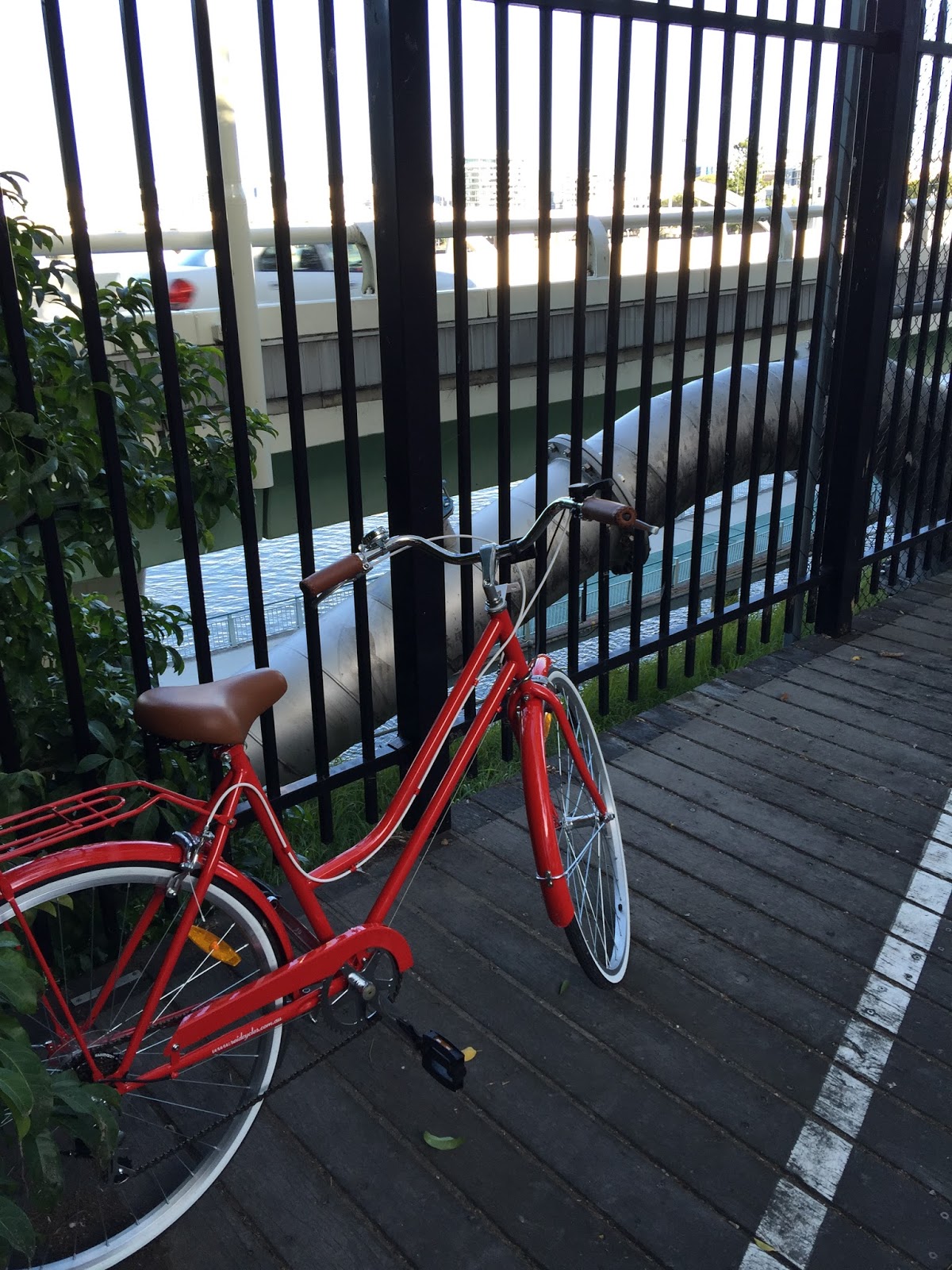
As it happened, the day of my third test ride, an advertisement by Reid Cycles appeared in my Facebook feed, promoting a deep discount on a bicycle that matched my criteria very closely. The only way that the Reid Vintage Ladies 7-Speed Classic diverged from my wish list was in its gearing: it has a derailleur and a thumb shifter. Still, a discount of over $100 off the list price brought the bike down to $200. Trading off that one feature for such a good price seemed acceptable to me, so I went straight to the Reid store in Fortitude Valley to buy one. I’ll review the bike and purchase experience separately in another post (update: here it is), but for now, I’ll say that overall, I’m very, very happy with this bike.


24 May — Test ride


This Sunday, I set out early in the morning to ride to my workplace and back, to confirm the route and my ability to ride it. I’m extremely fortunate to have a bike path that takes me from a few hundred metres away from my front door right to across the street from my office!

I have a terrible sense of direction, but Google Maps does a great job of indicating bike paths and other cycling infrastructure, so I found the way without too much trouble. I was also pleasantly surprised at how easy the ride was almost along its entire length. I only encountered two hills on the way to work and two (different) hills on the way home that required me to dismount and push the bike maybe a hundred metres or so each time.

I was set.

24 May — Coaching


Early on, I had considered hiring a cycle coach to teach me to ride, but in practice, it proved hard to find a coach at short notice with a schedule that worked in with my already very full one. By the time I’d successfully engaged a coach, there was a two-week wait before my lesson. When I booked it, I assumed that I’d still be learning to balance by then, but instead, I’d already taught myself to ride from the Internet, had bought my own bike, and had even ridden it all the way to work and back!

Nevertheless, I did buy an hour’s coaching with one of the trainers from CycleAway, and it did prove useful. I’ll admit that I was nervous at first, wondering if I’d be judged for buying something other than a “serious” road bike, or for wanting nothing more from cycling than to commute to and from work. But this proved completely unfounded. What I liked straight away was that the trainer listened to my choices and my use case, and then worked with me to optimise for them.

Specific useful advice I took from the session included how to progressively adjust the bicycle to my height, better riding posture to maximise comfort and control for a cruiser-style bike like mine, and (much) better braking technique. These are things that I would have been unlikely to have discovered on my own, so the session was definitely worth it.

25 May to now — Commuting and more


This is almost an anti-climax to this story. The next day, Monday, I rode to work instead of taking the train. And I did the same on Tuesday. And I’ve done the same practically every day since then. The only exceptions have been a couple of days that would have required a night ride home before I was comfortable doing that, and a couple of days where I needed to wear a suit and didn't want to cycle in that.

It hasn’t all been lovely, though. The absolute worst thing about learning to ride has been the behaviour of other cyclists. During the first few weeks of commuting, I was a lot slower than any other rider on the bike path, and when making my way up hills, a lot wobblier. During those weeks, I was verbally abused or physically menaced by other riders approximately one day in every two. Usually the menacing took the form of tailgating (do cyclists use that term?), cutting me off after overtaking me or on the inside of the curve while going around bends, or—in one incident—actually running me off the path. I wonder how many would-be cycle commuters have been turned off the idea forever after experiences like these?

Against that, there have been lovely cyclists, who offered words of encouragement and support after witnessing two of the worst such incidents, or who stopped and offered me assistance one day as I walked my bike home with a flat tyre. Those folks have been one of the best things about learning to ride.

But anyway, I’ve stayed with it, and I now do the ride to and from work in about half the time it took me at first.

The scope of my cycling has crept a little too! I bought this bike with the sole intention of riding it only to work and back. However, it wasn’t long before I started using it to replace the car for other trips of under 10km or so, where I would have been the only passenger and where I wasn’t to be carrying large or heavy cargo.

My total outlay to start cycling was about $440:


CityCycle membership for learning to ride $30
Helmet (compulsory in my state1) $10
Bicycle Queensland membership (for included insurance2) $90
Bicycle $200
Lights/lock/pump kit $20
Coaching session $90
Total: $440

Against that, I save about $36 per week in public transport fares, so after two months, I’m getting close to recouping my initial outlay. I’ll be revenue-netural in a few more weeks!


 The future


Even now, I’m not sure that I’d say that I like cycling. That is, it’s not something I would choose to do for its own sake (“It's a lovely day! I think I’ll go for a ride!”) However, I do know that I like it more than I like catching buses or trains. And I like it more than driving a car under most circumstances. And it does deliver the physical activity I was looking for without taking any more time out of my day than my commute by train did.

I commute in the clothes I work in. My workplace actually has showers and change facilities for cyclists, but I’m not comfortable with the idea of using them. That seems to be OK right now in the winter, but it might force me back onto the trains once Brisbane summer hits and brings with it heat, humidity, and rain. If that’s the case, I hope I’ll be able to overcome inertia and switch back to cycling as temperatures drop again.

I originally saw the bike I chose as an entry-level option and a stepping stone to something else. But now, I’m not so sure: it seems such a perfect fit for my use case! Sure, I’ll buy a few accessories like better lights, better tyres, and a better saddle, but I get the feeling I’ll be keeping this bike for a while.


1 Actually, CityCycle makes shared helmets available with some hire bikes. But ewwwwww... 

2  Bicycle Queensland is the state’s bicycle advocacy organisation. Membership includes public liability insurance for bodily injury and property damage. I think you’d be insane to ride in public without insurance of this kind. 


Friday, 9 January 2015

2015 project -- Lose (a lot of) weight


This year, my project is to lose a lot of weight. Specifically, I want to lose about a third of my body weight. My motivation is, over-ridingly, vanity, and I'm not ashamed to say so. I'm very unhappy with the way I look, and I mean to fix that. Of course, I know that there are many other benefits to me and my family if I lose weight, but as important as I think these benefits are, they are intellectual beliefs that I find more difficult to translate into motivation and action than ridding myself of a bad feeling: my embarrassment at the way I look.

This is a battle I've been having, on and off, for decades, ever since I was that fat nerdy kid at school who got bullied a lot, much of it targeted at my weight. The essential problem has two aspects to it:
  • The foods I love most have a very high energy density. I love sweet things, I love oily things. I also love convenience, which leads me to highly processed foods.
  • I have yet to discover the sport or form of physical recreation that appeals to me in the slightest. All of my favourite ways to relax or have fun are entirely sedentary. If I could be wired up to sufficient sources of information, I think that being a brain in a jar might be pretty cool.
So, my approach is to fight both these natural inclinations and to boost my physical activity and decrease my energy intake. As usual for me, I'm pursuing this very aggressively. The factors in my favour include that I can be very  stubborn, and that I don't get bored with routine. Another important weapon I have is that I am easily able to ignore feelings of hunger. Against me is the fact that because I don't actually enjoy what I'm doing here, I rely entirely on routine to keep me going. The upshot of that reliance is that if the routine is disturbed or disrupted in any way, the whole thing falls apart.

Physical activity:

To address the first part, I'm going to the gym every day to do 40 minutes of cardio (on treadmill and elliptical machine) and 20 minutes of resistance training on various upper-body machines. Because I'm so reliant on routine, I need to make sure I do this at a time of day where I'm never going to be disturbed, so I'm waking at 3:00AM to be at the gym from 3:30AM to 4:30AM and home by 5:00AM. To accommodate this, I'm getting to bed earlier. I aim for 9:00PM, but in practice it's usually somewhere between 10:00PM and 11:00PM.

Past experience shows me that this has to be daily, or the routine doesn't stick. I use a gym because, although I've had good results from just walking for an hour or two a day, if rain disrupts the routine for a couple of days, it's gone. Similarly, when I've worked with exercise physiologists in the past, they've assured me that I would get better fitness results from not doing resistance training every day, or from varying my exercise routine from day to day. I'm sure they're right. But I'm equally sure that the question is academic if it ends up with me not doing anything at all. It seems that I can form a pattern more easily around "I'm here at the gym; these are the five machines I must use" than around "I'm here at the gym; these are the three machines I must use because it's Tuesday."

Reducing intake:

On the other side, I'm reducing my calorie intake to practically nothing. By "practically nothing", I mean around 300 calories per day, which should be about what I'm burning in the gym session. Just enough to take in a few nutrients and to keep my gastro-intestinal apparatus running.

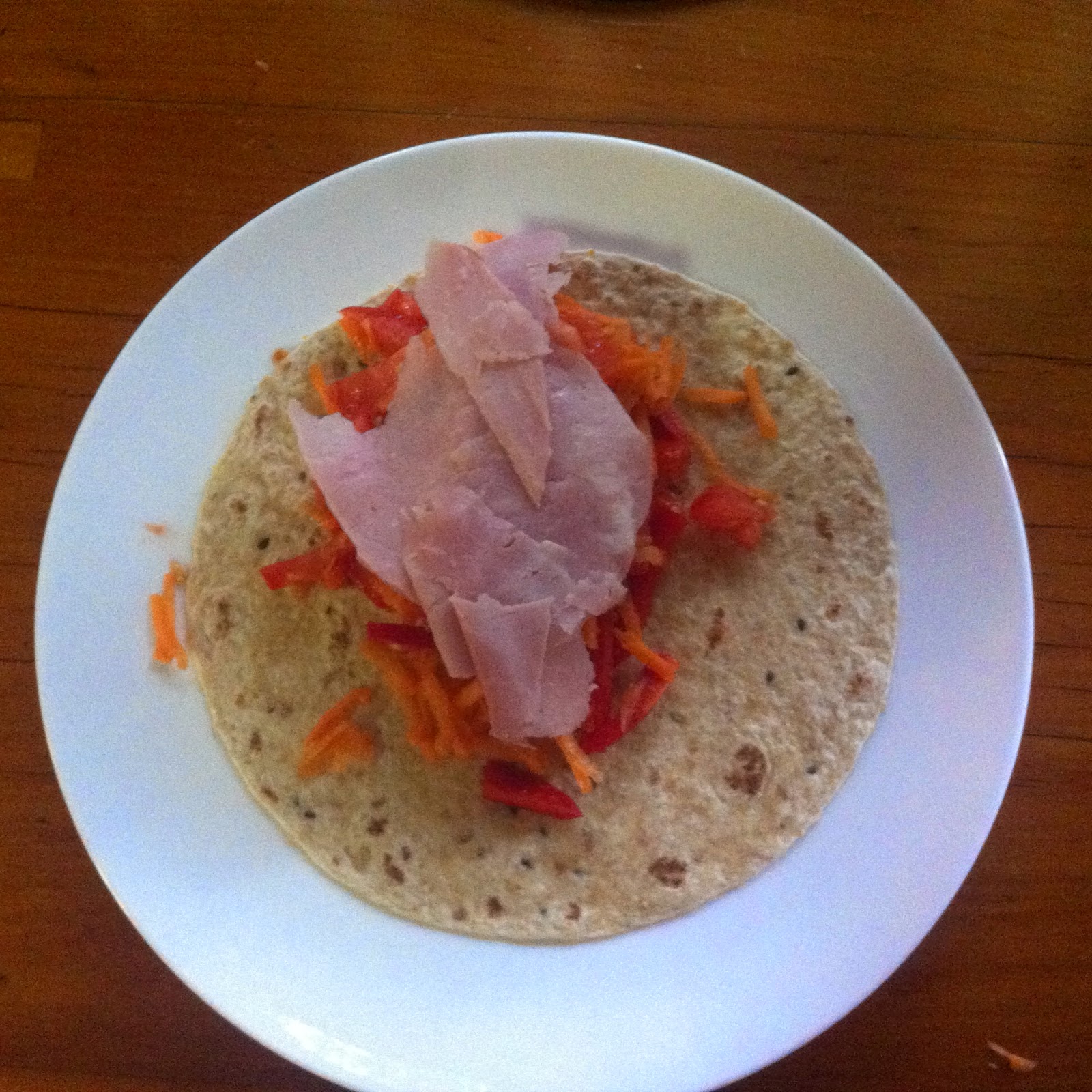
Again, to capitalise on the power of routine, I just eat practically the same thing every day. I have one meal a day, in the evening, which consists of a piece of flat bread wrapped around some salad and some ham or salmon.

An entire day's food intake for me in 2015 looks like:


I've had my resting metabolic rate measured in the past, so I know it to be close enough to 2500 calories/day to make the maths neat. With a net calorie intake of about zero and one pound of body fat equal to about 3500 calories, I'd expect to lose around 2½kg per week like this. (I know that weight loss doesn't work to as simple a formula as this. It's a ballpark number.)

I'm also conscious that food does have an important social function too! And so I will occasionally allow myself a treat at a social gathering (as I did last Sunday). My goal in those cases will still be to keep net energy intake for the whole day below 1000 calories. Tonight is games night, so I'll be treating myself to a few sushi rolls in place of my wrap. Yay!

Weight loss at the start of a diet is very rapid due to losing a lot of water. In the first week of 2015, I lost 8.1kg with the method described above. Now, I don't for a minute expect this rate to continue, but it is certainly a very pleasing start! :)

Physically, I already feel a difference in the fit of my clothes, in my posture, and in the flexibility of my joints. Psychologically, as in the past when I've been on extremely restrictive diets, I am experiencing a heightened sense of alertness. I also seem to notice smells more. (Past experience shows me that beyond this lies a kind of euphoria and a kind of floaty, out-of-body feeling, but I'm not there yet).

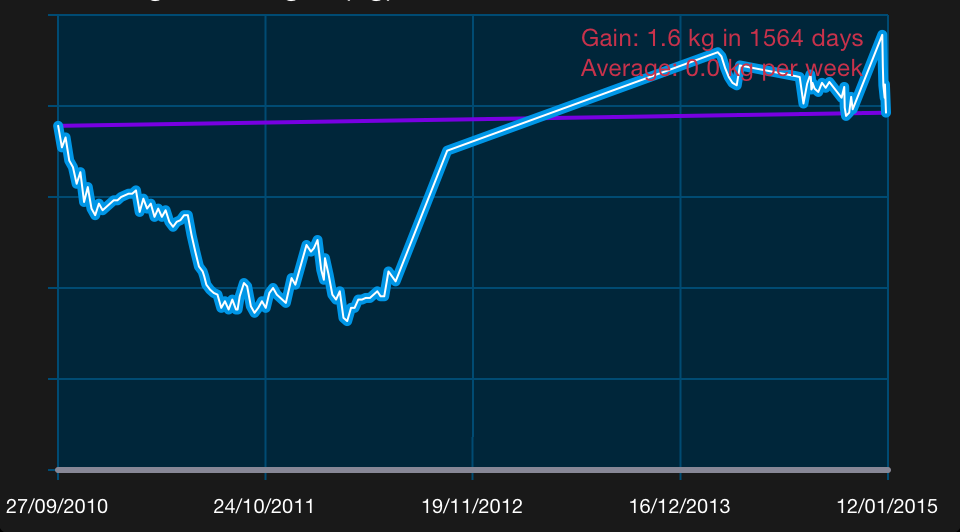
And as for the long term? I know I can't exercise like this and eat like this indefinitely. This regime isn't designed or intended for that. I also know from repeated past experience that when I come off an extreme diet, I very quickly revert to my sedentary lifestyle and mostly indiscriminate eating. This is a graph of my weight between late September 2010 and today:


A few key features:
  • The lines along the vertical axis represent around 10kg, so over the last four years, my weight has varied by about 30kg, and I'm presently close to the top of that range. Indeed, on 1 January 2015, I weighed more than I've ever recorded in my life. Note however, that there's four years along the horizontal axis, so it's not like I can gain or drop 10kg overnight. (That might take weeks!)
  • The long, featureless, upward slopes between late 2013 and mid 2014 are times when I was paying no attention to my weight at all, so no weigh-ins and no data. 
  • The instances of jagged upward drift were me trying to adhere to "sensible, healthy, everything-in-moderation" eating. I haven't been able to get this to work for me.
  • The slow downward slope through much of 2014 was me experimenting with a 5:2 diet that seemed to work for me for weight maintenance or very gradual weight loss. 
  • The big spike at the end of 2014 was when the 5:2 diet went away completely during the festive season of eating whatever I wanted. I can put on a lot of weight very quickly! (but then again, I can also take it off quickly).


So, it seems likely to me that even if I succeed in reaching my target with these extreme measures, the upward trend will set in again almost immediately. I don't really know what I'll do at that point, but it seems to me that the long-term strategy might be to shorten the cycles of weight gain and loss, so that I embark on these extreme measures sooner, at a lower threshold weight. Anyway, that's for the future.

I'll post updates to this blog to document how this attempt goes.


This blog post uses a mix of English and SI units. "Calories" here are "dietary calories" which are really "kilo-calories". People who want kilojoules, just multiply the numbers by four. Americans and Liberians who want pounds instead of kilogrammes, multiply those numbers by two. In both cases, you'll be "close enough" for the precision expressed in the numbers.