Friday, 1 January 2016

2015 in review, and goals for 2016

It is my custom at this time of year to list off the films, books, and performances that I've enjoyed over the previous twelve months (2014, 2013), but 2015 was a very strange year for me, one in which I read hardly a book, watched hardly a film or TV show, played hardly a game, and didn’t go to a single play, concert, opera, or ballet.

Instead, I have worked on transforming my life.

2015

The biggest changes for me this year were:
  • Losing a lot of weight (52kg; photos below taken just over 1 year apart!)
  • Returning to tertiary study for the first time in 17 years (starting an MBA at UQ Business School mid-year)
These had a number of follow-on effects:
  • I discovered forms of exercise that I either enjoy for their own sake (intrinsic motivation): Zumba and cycling, or which I enjoy for the sense of achievement that I get from participating in events (extrinsic motivation): running. Social motivation is strong in both cases too, and I am indebted to the friends who introduced me to these activities, and to the new friends I have made through them who keep me focused and coming back.
    City2South
    14 June
    14km in 1h33m
    Brisbane Marathon
    Festival
    2 August
    10km in 57min
    Bridge to Brisbane
    30 August
    10km in 58 min
    Brisbane 2 Gold Coast
    18 October
    100km in 4h56m

  • Of these forms of exercise, I have been open to experimenting with ones entirely new to me: Zumba and cycling were things I’d never done before. I’m now experimenting with swimming, which is practically new too. 
  • I have enjoyed buying clothes in regular sizes and being able to experiment with finding a style for myself. My life up to now has been having to make do with what was available in plus sizes and trying to find clothes to disguise my shape as much as possible. I’m not confident that I really know what I’m doing yet, but I’m working on it and I’m enjoying the process. 
  • I have developed a level of self-confidence I’ve never had before. I feel like I’ve finally bested the crippling shyness that’s been with me all my life. Part of this has been a huge reduction in the amount of body-shame I feel, and part has been learning from friendly, confident people (in the ParkRun community and in the MBA course). I have been able to adopt some of their confident behaviours until I felt the confidence myself. 
  • I have learned to play to my strengths more consciously and deliberately, encouraged by both my workplace and my studies. Conversely, I learned a difficult but valuable lesson in the futility of trying to be what I thought other people wanted me to be (which turned out to be wrong anyway).

2016


So, on to what I want to achieve for the year ahead (SMART goals in bold):

  • Lose more weight! My rate of weight loss plateaued off late in the year as my study commitments intensified, followed quickly by food changes brought about by a broken jaw (bicycle accident) and the festive season. In late October, I hit my initial goal weight of 90kg; and this morning I weighed 97kg (that difference is not only body weight though; it also includes the fact that I’m presently well-fed and well-hydrated). I want to get my weight down to a new goal of 80kg by the end of June, and then stabilise it. 
    • The stabilisation will require thinking about eating for long-term nutrition, not just as fuel (calories). I need to find foods that strike the right balance of enjoyable–nutritious–convenient. At the moment, it seems hard to satisfy more than two of those criteria. 
  • Finish my MBA. The UQ MBA is made up of 12 units: 
    • I completed 3 in Semester 2 last year
    • I am doing 2 in the present Summer Semester
    • I plan to do 
      • 3 more in Semester one, 
      • 2 more in the Winter Semester, and 
      • the final 2 in Semester two
  • Running: presently, I do a 5km weekly ParkRun, and participate in events around the 10km mark. I want to:
    • keep ParkRunning, and  
      • earn my 50-run shirt this year
      • get my time down to under 24 minutes for the 5km.
      • Volunteer at ParkRun after every 10 runs.
    • extend the 10km runs to half-marathons this year, where available.
    • Consider getting some coaching
  • Cycling: I will 
    • keep commuting by bike 
    • participate in more events this year in the 100km-ish range. 
    • find or create more opportunities for social cycling too. 
    • ride my first “Imperial century” — 100 miles (160km). 
    • ride 10,000km in 2016 (I rode 3,000km in 2015.) 
    • Consider getting some coaching
  • Zumba: I will keep zumbaing! I have no specific goals right now beyond getting better!
  • Swimming: I want to be able to 
    • swim 1km in under 30 minutes and then appraise whether this is something I want to keep in my life. Assuming that I learn to like it enough to keep doing it, I am attracted to the idea of triathlon. 
  • Read for pleasure again, see some movies, watch some TV, go to a play/concert/opera/ballet, play a board game — do some fun stuff again! (No numbers on these though)

Other stuff I want to do but for which I have no specific goals yet. I don’t know how much of this I’ll be able to cram into 2016!
  • Fix my posture: I have a bad stoop from a lifetime of obesity and social anxiety. Now that I’m thinner, I’m really noticing this in photos.
  • Fix my flexibility: Even with so much weight gone and with so much regular exercise, I am not very flexible. In particular, my lower back is a problem: the closest I can come to touching my toes is just past my knees. This made it very difficult to get the right fit on a road bike for me. (My current set-up is comfortable, but probably not as efficient as it could be).
  • Overcome more fears and anxieties. A few years ago, I bettered my fear of dentistry. This year, I overcame a life-long shyness. There are a few other specific fears I want to target “soon”. (I have no idea yet of how to even approach these. I tried a head-on approach to the needle phobia a few years ago and I think I made it worse...)
    • needles (about a 1-in-4 chance of passing out; nausea, tunnel-vision, and sound of blood rushing in ears even discussing the subject)
    • authority figures (police and security of all kinds; practically guaranteed to freak me out the longer an interaction continues)
    • body shame (I have only been able to get into a swimming pool covered up Edwardian-style!)
      • Note that the fear of authority figures and the body-shame work together to keep me from travelling by air. The body-shame keeps me from medical screening that I should get. 
  • Try some more things I’ve either never done before or not done much of. Some ideas include:
    • latin dance
    • fencing
    • horse-riding
    • rifle-shooting
    • archery
    • fly a glider (sailplane, not hang-glider)
    • sail a boat (increased proficiency in swimming might be a prerequisite to this one!)
  • Investigate meditation. I bested my fear of dentistry by learning how to put myself into a state of deep relaxation. I would like to explore further in this direction. 
That should be enough for a year!

Sunday, 22 November 2015

Bicycle.Next

As my cycling extended from transportation to recreation over the course of 2015, my desire for a road bike to supplement my cruiser grew too. I completed a 100-km ride in October, and wanting to participate in a 70-km and another 100-km ride coming up in early 2016 made the desire more urgent. So I drafted up a set of criteria (details in an earlier post) and began my search online.

In terms of equipment, I didn’t find much to differentiate the various  manufacturers’ offerings around the price point I was looking at: all feature carbon-fibre forks and frames, alloy wheels, and conventional rim brakes. The Shimano 105 compact groupset is ubiquitous. Technical differentiators seemed to be mostly at the detail level: this bike is a little cheaper because it has the Shimano gears but not the Shimano shifters; that bike has some special vibration-dampening technology in it; this one has a saddle made by a specialist manufacturer rather than in-house by the bike manufacturer. The final decision was not going to be made on detail items like this.  

The hunt


The first thing I learned about my criteria list was that I needed to let go of my preference for a step-through frame. Carbon road bikes with step-through frames simply don't exist (if you know better, I'm dying for you to correct me!) With that criterion eliminated, I was left searching for a light and pretty road bike optimised for endurance. Surely that was a more achievable goal?

Well, maybe.

I started out with an impression of road bikes as very brutish-looking: all straight lines and harsh angles. And while this is certainly true of a lot of what's out there, the more I looked, the more exceptions to the rule I found. So, the second thing I learned is that there’s much more variety in road bikes than I had thought, and that, while none of them looked as attractive to me as my cruiser does, I felt increasingly confident that I’d be able to find a bike to love.

The next step was to get to some shops and actually try out some of the alternatives. I made a list of retailers around Brisbane that had picked up favourable comments online and started visiting them. These included:1

In general, I found the whole in-person shopping experience to be a really, really positive one. Everywhere I went, salespeople were knowledgeable, friendly, and never too pushy. I got the opportunity to sit on many different bikes and even try out a few. That was an experience! Coming from my commuter onto a carbon-fibre road bike less than half its weight, I was reminded of something that World War II flying ace Adolf Galland said after testing one of the world’s first jet fighters: “Es ist, als wenn ein Engel schiebt!”2 — “It’s as if an angel is pushing!” On this bike, I could actually accelerate up hills! Moving the pedals felt almost effortless; it reminded me of exercising on an elliptical machine at the gym with its resistance dialled right down.

I was measured up by most of the places I visited, and the various systems and methods they used produced recommendations of frame sizes in the 56cm to 58cm range. Of the bikes I actually sat on, the lower end of this band felt much better to me, with my favourites being, in order:
  • a Merida Ride (size L, equivalent to 56cm)
  • a Cannondale Synapse (56cm) 
  • a Bianchi Infinito (57cm)

By now, however, I was noticing something. Henry Ford famously remarked of his Model T, “Any customer can have a car painted any colour that he wants so long as it is black.”3 In the price range I was looking at, the same seems to hold true of bikes: choices are very limited in anything other than black or dark grey. Usually matte black or matte dark grey. Blergh.

Unless... I also looked at bikes marketed to women, as I did with my cruiser. I’d seen these while I hunted in vain for a step-through frame. Now, it seemed that if I wanted a bright, pretty road bike, I’d be revisiting the ladies’ section.4 So be it. The problem is almost reversed there: just about every bike is white; cheeriness comes mostly via accent colours. At least the white of a carbon-fibre bike is the bright, clean, smooth whiteness shared by other graceful vehicles like sailplanes and yachts.

In turn, looking at these bikes introduced another complication:  I soon discovered that many of the ones I liked were only available in sizes too small for me! The range of “ideal” frame sizes generated at the shops and the calculators I found online suggested to me that there is a certain amount of leeway here, well within the range of sizes available in seatposts and stems. Still, I had to reluctantly disqualify a few models whose maximum size was more than 2cm smaller than my 56-cm ideal (including the prettiest bike on the shortlist). I also disqualified a couple of bikes I’d found on line where the manufacturer didn’t seem to have a point of presence in Australia. I didn’t want problems with parts and servicing later.

By now, the shortlist of bikes looked like this (items in red I considered show-stoppers, items in orange I considered warning bells):

Bike Attractive Frame? Attractive Colour? Largest Size Local Dealers? Comments

Bianchi Intenso Dama Bianca
Yes Yes 55cm Yes The equivalent “unisex” (ie, andronormative) model goes up to 59cm and is available in... black.

“Unisex” Intenso models with more expensive groupsets are also available in Celeste (Bianchi’s signature blue-green) and white (although with a less attractive finish than the Dama Bianca has).

Cannondale Synapse Carbon 105


No No 61cm Yes At least black isn’t the only option for this bike—they make it in orange too!

(Not that I’d buy it in that orange.)

Devinci Leo 105 WF
Yes Yes 54cm No Very pretty

Diamondback Airén 4 Carbon
Yes No 56cm No

Felt ZW5
Yes No 50cm Yes

Lapierre Sensium 200 Lady
Yes Yes 52cm Yes Gorgeous accent colours!

The equivalent “unisex” model goes up to 61cm and is available in... black (also with gorgeous accent colours, but still!)

Liv Avail Advanced 3
Yes Yes 48cm Yes Prettiest of them all, I think
Merida Ride 4000
No No 62cm Yes “Unisex” design. To me, the least pretty bike on the whole list, but so comfortable!
Norco Valence Ultegra Forma


Yes Yes 55cm Yes The only bike on this list to have the Ultegra groupset. The equivalent “unisex” model goes up to 61cm and is available in... black.
Orbea Avant M20
Yes Yes 60cm Yes “Unisex” design

Specialized Ruby
Yes Yes 57cm Yes
Trek Silque
Yes No 54cm Yes Also very pretty


So, it came down to the Bianchi Intenso Dama Bianca, the Norco Valence Forma, the Orbea M20, or the Specialized Ruby. I got to test-ride close relatives of the Bianchi and the Specialized, and much preferred the feel of the Bianchi. The Specialized put a lot of pressure on the heels of my hands for some reason, and I didn’t enjoy it at all. And it was on the Bianchi that I had my “an angel is pushing” experience.

I’ll also admit that the Bianchi brand appealed to me very much. When I began my search, the only one of the brands on the short list I’d even heard of was LaPierre, and that only because a friend owns one. As I researched and read, the Bianchi story really appealed me and I soon knew that this is a marque I would be proud to own. (Just as the Specialized story did not appeal to me.) So, having already fallen in love with the looks of the Intenso Dama Bianca and the heritage of the Bianchi brand, plus a successful test ride of a similar bike, I didn’t feel the need to track down a Norco or Orbea to try out.

In the balance between features, fit, fashion, and finance I was most willing to compromise on the fit. Compromising on features would probably have meant abandoning the idea of a carbon bike and choosing a pretty bike with an aluminium frame like the Bianchi Via Nirone: considerably cheaper, but almost a kilogramme heavier than the Intenso. Compromising on fashion would have left me with a bike I could never look at without wishing it looked half as good to me as the Dama Bianca that I didn’t buy. And I really didn’t have the money to spend to go to the next tier up, or to buy a “unisex” Intenso and have it resprayed in a colour scheme I actually liked (I had this priced — it would be about $1000).

So the Intenso Dama Bianca it was, in the full knowledge that getting the bike I wanted meant deliberately buying one a size too small and trusting a bike fitter to close the gap for me.


Making her mine


The next hurdle was that the Intenso Dama Bianca was sold out from the local Bianchi dealers. New stock was expected, but not for a few months, and the price was expected to be a lot higher than last year's price. Bugger.

Just as I was contemplating what to do next, an incredible series of coincidences led me to the partner of a friend of a friend who had exactly the bike I was looking for sitting in their garage. Purchased nearly a year ago with the best of intentions, it had been ridden exactly twice! Money changed hands and we both walked away happy.


Finishing touches


During my search for a bike, the team at Epic Cycles at Paddington had really gone the extra mile to try and find me a bike I’d like. So although I didn’t buy from them in the end, I knew which business I wanted to provide service and support for my new bike in the long term. I took it in there for a mechanical once-over and bike fit. As expected, as soon as their fitter got me up on the bike on an indoor trainer, she frowned and said “It’s too small!” So we had a good chat why I’d chosen a bike too small, my expectations, and her reservations about the limitations of this approach.

As I had anticipated, a longer stem and taller seatpost were needed, but the fitter also found that the seatpost needed some extra setback too. She ordered those parts in, and to make the bike feel a whole lot better for me in the meantime, she dropped the handlebars as low as they would go, and raised the existing seatpost as high as it would. I was actually very surprised what a difference these centimetres made, especially at the handlebars.

A few days later, the new stem and seatpost had arrived in store and I took the bike back to have them fitted. Seeing the parts confirmed again for me that I had made the right choice with Epic Cycles — the fitter had completely understood what I wanted in this bike. The stem was an authentic Bianchi part5, but was not only a better size: it replaced the original alloy stem with a carbon stem. And while there was no Bianchi seatpost with enough height and setback, the FSA part she chose was understated and plain-looking enough to be completely unobtrusive on the bike, and also replaced alloy with carbon. Exactly the choices I would have made for myself. With a final caveat about the limitations of the approach (both the longer stem and large setback affect steering in their own ways) we were done!

I had been looking for another bike that would send my heart racing, and this Dama Bianca certainly does that. I would absolutely make the same choices and same compromise again.

Riding the “white lady”

When I first test-rode a road bike, it seemed to me that I was going to have a whole lot of re-learning to do. It felt like a different type of vehicle — not a bicycle at all (when your entire frame of reference for “bicycle” is a cruiser!) I found it a bit scary to feel perched so high off the ground, and intimidated by just how quickly the bike picked up speed. A few short trips and one 90-minute ride with the Dama Bianca has started to transmute raw fear into a kind of fearful respect.

My speed on the cruiser is limited by how fast I can pump my legs against the resistance of the bike’s weight and mechanical friction, plus the aerodynamic drag of my upright body. My speed on the road bike is presently limited by my confidence in my bike-handling skills and my fear of serious injury. I have not yet explored the top of the gear range, even on stretches where I know my legs could take me further up there. 

It’s also a whole lot less comfortable than my cruiser, confirming my decision to keep commuting on my first bike. Riding the cruiser now feels like rolling a big, comfy, favourite armchair down the street, and the sprung, leather Brooks saddle feels positively luxurious.

The most immediate change in my riding has been re-learning starting and stopping. I can no longer just put a foot down: the ground is out of reach. Fortunately, I found a really helpful article and video on-line to show me what to do. I first practiced these techniques on the cruiser, whose greater inertia and friction made it easier to learn them before I transferred the skill to the road bike. I wouldn’t say that it’s second nature to me yet on either bike, but I’m getting better.

Learning to manage the gears is challenging too: I’m used to being able to look down at the thumb-shift lever and see which gear I’m in. Not so on the road bike, so I have to mentally update that information as I shift up and down. I’ve only had one fall from this bike so far, and that came from forgetting what gear I was in, and then actually shifting the gears in the wrong direction as I rode up a hill, until I lost speed and stability and fell over. Now I just remember: big levers select bigger chainring or cogs, little levers select littler chainring or cogs!


The future

I suspect padded shorts are going to be necessary if I’m going to spend any serious hours on this bike. Ninety minutes the other weekend had me really sore for the first time in my cycling experience. Not even five-hour rides on the cruiser had done that.

As my confidence at handling this bike picks up, I will switch over to clipless pedals. I’m interested in the Shimano Click’r system as a way to get started, with its reputed ease of unclipping (like probably every other n00b, my biggest anxiety about clipless pedals is being unable to free a leg to prevent a fall) and its pedals that can be used as platform pedals with ordinary shoes. 

I’m looking forward to years of fun and adventures with my Dama Bianca. If the day ever comes to replace her, I'll be hoping there will be better-looking, more colourful bikes in larger sizes than there are today!


1. Other stores that made the short list based on good reputations, but which I didn’t actually get to visit in my search included:
2. In Galland's autobiography Die Ersten und die Letzten (The First and the Last), 1975, p. 347. Galland test-flew the Messerschmitt Me 262 on 22 May 1943. The Me 262 would become the first jet fighter in the world to reach operational status.

3. In Ford's autobiography My Life and Work, 1922, p.72

4. The existence of this category also demands a post on the rampant androcentrism and casual sexism of how bicycle manufacturers market their products. Later. 

5. Well, Bianchi-branded and -coloured FSA, like the original equipment on Bianchi bikes. 


Wednesday, 21 October 2015

Weight loss update 10 -- primary target achieved!

On January 1 this year, I weighed 142.6kg, and set myself the goal of losing weight until I got down to 90kg, then reappraising. This morning, I hit that target!

I weigh myself in the mornings, straight after exercise, and I’m aware that this number represents a low—I have an empty stomach and am a little dehydrated. Still, these are the same conditions under which I’ve weighed myself all the way down here.

A few months ago, I started thinking about what I would do at this point, and resolved to lose another 8kg from here. That’s still the plan. I’ve also had a series of bioelectrical impedance measurements over the last few months.

The most recent of these, on September 7, showed a body fat mass of 16.5kg, in a test that considers a range from 8.9kg to 17.7kg as normal for a male my age and height. I’ll have another scan in another couple of weeks and see how that number has moved.

In general, I’m getting pretty happy with the way I look, and in turn, I’m feeling a lot more self-confident. I don’t like how soft my midriff still is, but I wonder if that’s even correctable without surgery now. (And that’s a step I’m not willing to contemplate, at least not right now.)

So, the plan for the next 8kg is:
  • continue to restrict calories as severely as I can
  • continue cycling as my main means of transportation (this is a given now, anyway...)
  • continue at the gym, Mondays to Fridays: 30 minutes running on treadmill, plus a circuit of weights machines
  • continue Wednesday afternoon aerobics with the Medibank Feel Good program, and add Thursday afternoon Zumba there in November when uni finishes
  • continue my Saturday morning routine of cycling, ParkRun, and Zumba
  • continue Sunday morning long bike rides, replacing my cruiser bike for a road bike for this use-case as soon as possible. When that happens, I’ll also finally take the plunge into the exciting world of lycra.
  • learn to swim, and see if I enjoy that (that’s the other skill many people picked up in childhood that I don’t have)
And then reappraise how I look at 82kg! At that point, I might consider some personal training to build core strength: something I know is a current weakness.


Sunday, 18 October 2015

Bicycle.Next — beginnings

I believe that a major contributor to why I have been so hugely overweight most of my life is that I never found any sources of physical recreation I enjoyed, leading me to an almost completely sedentary lifestyle. Therefore, an important part of my journey in 2015 to lose weight and keep it off has been to seek out such activity. So far, I’ve had three successes.

I fell in love with Zumba almost as soon as I tried it. I’ll write about it more another time, but it makes me very happy and I can’t imagine a life without it now.

And I’ve developed a weird relationship with running. I can’t say that I enjoy it exactly; at least, not while I’m actually doing it. But I love the sense of challenge and achievement that I get from progressively improving my best times, and from completing events that are longer and harder than my usual runs. And friends in the ParkRun community have made me feel so welcome and at home. So, running will be an ongoing part of my life too.

Then there’s cycling, which has kind of snuck up on me.

I started riding a bike as a way to build “free” exercise into my day. That is, cycling to and from work wasn’t going to take any more time or create any greater inconvenience than public transport did already. I had never ridden a bike before, so I taught myself, bought myself my first bike—an elegant-looking cruiser—and off I went. At the time, I thought I was buying a bike for a single purpose: travelling only between work and home. However, almost immediately, I found myself cycling for all kinds of short trips. Bicycle had quickly become my primary means of transportation. Use-case one.

I soon discovered local communities of other cyclists who also enjoyed riding stylish, elegant bikes on short jaunts: the Style Over Speed group, and the Brisbane Bicycle Explorers’ Club. With them, I enjoyed joining my first group rides. Cycling had now crossed over into recreation, not just transportation. A second use-case.

The very day that I bought my bike, a friend challenged me to participate in a 100-km ride in five months’ time. Up to that point, I had ridden a bike on exactly three occasions, and covered a total distance of little over 5 kilometres. Of course, the idea was irresistible to me! Over the coming weeks and months, I became increasingly confident and competent on rides of up to around 10km, but I had no experience of what lay beyond; and certainly no idea of whether I could make it ten times that distance. So in August, I set out on some longer rides.

Almost every Sunday morning, I ventured further out along the bike paths. I started with rides around 30 km, which became rides of around 50 km, then 70 km, until on the first Sunday in October I rode 90 km. It was clear that I could certainly go the distance, but it also became increasingly clear that my commuter bike with its heavy steel frame, crude drivetrain components, and basic gears was particularly ill-suited to long-distance rides. I found I liked these longer rides, but Brisbane’s hilly terrain made parts of them extremely laborious. This severely restricted my speed, and therefore my range if I didn’t want to spend all day in the saddle. So, a third use-case had emerged, and it seemed quickly obvious that no single bike would suit all three cases well.

Breaking them down:
  • Style rides:  my cruiser is already perfect! A (modern) road bike would be out of place here. 
  • Transport: my cruiser is pretty good, but better hubs and gears, lighter tyres, and swapping some steel components for aluminium will improve her, and I plan to make those changes progressively over time. A road bike is less well suited to this for me because of its diminished carrying capacity, lack of mudguards, pneumatic tyres (I run solid tyres on the cruiser—for when you absolutely, positively know you won't be late somewhere because of a puncture, or be changing a tyre in your good clothes), and having to worry a lot more about security. 
  • Long-distance recreational rides: the hunt is on for a separate bike to satisfy this third use case—a road bike.

So, updating the criteria I had for my original commuting use-case, what I’d ideally like from a road bike is:
  • Comfortable — Initial research has disclosed a class of road bikes optimised for longer-distance rides. Known as “endurance” or sometimes “marathon” bikes, they’re set up for a little more comfort over long distance at the expense of a little speed due to their higher riding posture. In other words, they’re exactly what I’m looking for, since racing is not on the agenda.
  • Lightweight — Weights of around half that of my 16-kg commuter certainly make road bikes easier to move up hills and less tiring over long distances. I’ve decided to focus my search on bikes with carbon frames.
  • Step-through frame. I still want a bike where the frame is less likely to take me down with it if the bike topples, or injure me with its top tube.
  • Pretty! I love my cruiser—I love looking at her, I love thinking about her. I need to love any other bike I buy too. I once bought a very sensible, reliable car that I ended up loathing for years because it had so little personality or flair. I won’t make that mistake again. 
  • (I dropped a fifth criterion—platform pedals—when I learned that bikes in the class I’m looking at here don’t come with pedals. And even if they did, they’re trivial to swap over).
I do not believe I will find a bike to satisfy all these criteria. In particular, lightness and the step-through frame appear to be incompatible wants. At least, I haven’t been able to find anybody making really light-weight step-through road bikes. Step-through road bikes of any kind at all are extremely few and far between.

Anyway, the preliminary, online research is done; some brands and models have been noted, and the search can now begin in earnest.


Saturday, 5 September 2015

Weight loss update 9

Another milestone today: I weighed in at 91.4kg this morning, 51.2kg lighter than where I started. There’s now just 1.4kg to lose to hit my primary target. My newest exercise shorts are size S — six sizes smaller than what I was wearing in January. In fact, I can easily fit into one leg of those old shorts now.

I weigh less than at any point in my adult life. I have records stretching back to the last 10 years worth of battling with my weight, but I’ve never come this far. And as for before that? I don’t have records, but I know that I weighed 15 stone (95kg) by the time I was 16. I think I can safely claim that I am now leaner, faster, fitter, and stronger than ever. I am in the best physical condition that I have been in my life. Something else that’s been entirely new to me has been picking out a new wardrobe, and for the first time in my life, actually enjoying the clothes I’m wearing. This has been such a paradigm-shift for me that I’ll blog about it separately soon. My world has changed.

The rate of loss over the last few months has been maddeningly slow compared to the weight that was just falling off me at the beginning; and I feel myself losing patience and momentum. So, to ensure I’m maintaining a meaningful calorie deficit, I’ve upped my morning cardio routine to include a 5km run on the treadmill every day (which is also no doubt helping my ParkRun and fun run times). I’m also trying to do some longer bike rides on the weekends: I’ve now done a couple in the 30-km range and plan to extend these.

So, in another few weeks, I hope to be reaching for a new target — I still have my sights set on 82kg.


Wednesday, 12 August 2015

Review: Reid Vintage Ladies 7-Speed Classic

Not having acquired the skill in childhood, I recently learned to ride a bike as an adult. I’ve written about that journey elsewhere, so I mention the fact here only because it obviously affects my perspective on the bike I’m about to review. It’s effectively my first bike, and my only basis for comparison are the public-hire CityCycles available in my city. So I’m evaluating this bike purely on its own merits.

Just to recap what I was looking for in my first bike though:
  • Upright riding position
  • Platform pedals
  • Step-through (“ladies”) frame
  • Hub gears and twist shifter
  • Pretty!
  • Inexpensive
The Reid Vintage Ladies 7-Speed Classic satisfied every one of these criteria except for the gearing: it has a (single) derailleur and a thumb shifter instead. But at a discount price of $200, I was willing to compromise.

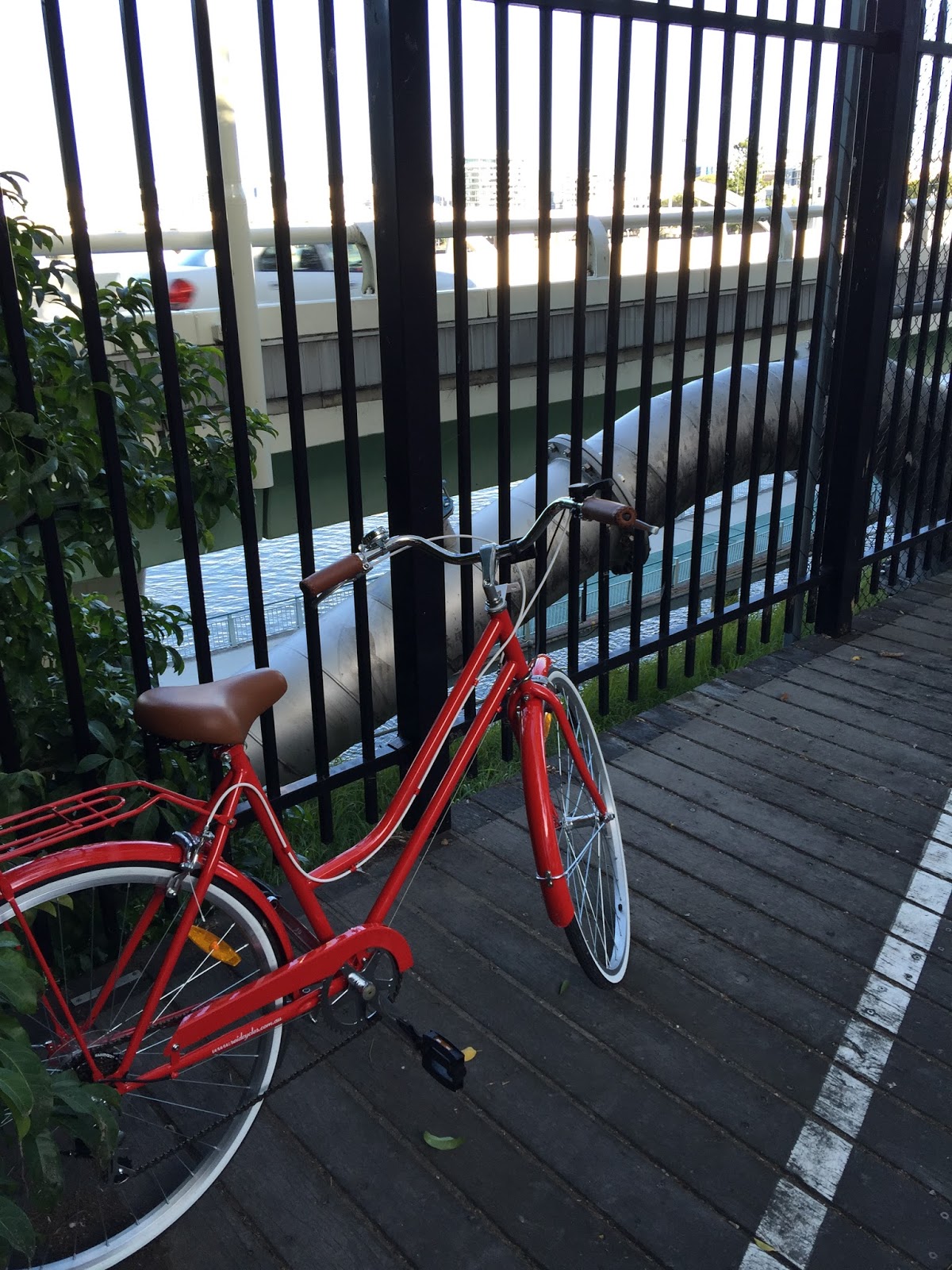
So, on to the review. Well, for a start, I find this to be an insanely good-looking bike. See for yourself! 


As pictured, the bike is exactly stock. Note the white bracket at the top of the head tube to which a basket available as an option mounts. I love the little finishing touch of the whitewall tyres too — they’re standard, as are the fenders and rear carry-rack. The finish overall is really nice: shiny, bright, and very cheerful.

I was looking for a comfortable ride, and Reid provided one. At 184 cm (6 ft) tall, I’m right at the top limit Reid recommends for this, the Large-size frame (for people 165 cm to 183 cm tall; the bike is also available in a Small frame, recommended for people between 151 cm and 165 cm tall). Still, even with the seat and handlebars close to their lowest positions, as in the photograph, I could ride comfortably upright, with my arms relaxed and easily able to reach the grips. With the bike properly adjusted (more on this later), it’s even more comfortable.

I found that I got used to the thumb shifter very quickly, so the decision to compromise on my preferred gearing solution turned out OK. The only (slight) downside is that while I was still getting used to commuting by bike, I was gripping the handlebars very firmly and with my right hand very close to the shifter, meaning that I quickly developed a callous on the knuckle of my right index finger that’s only now starting to go down. But I don’t consider this a flaw in the bike itself.

The gears seem ample for my commuting use-case. If anything, I would probably be just as happy with half the number of gears, but I guess it’s nice to have the finer grain there if I ever need it.

The saddle is comfortable, but not nearly as nicely sprung as the CityCycles I learned on, and I will probably replace it sometime soon. The “leatherette” vinyl of the saddle and grips looks attractive, but feels a bit cheap. That’s not something I’m going to complain about on a $200 bike, especially when these items are so easily upgraded at any time.

The only really poor feature on this bike is the chainguard. This is extremely flimsy and easily bent out of shape. Combined with the fact that its design is such that it’s snagged several times on clothing or footwear, I really wonder how long it will last. I’ve already got my eyes open for an after-market replacement (suggestions welcome!)

But overall, I’m extremely happy with this bike. Indeed, although I purchased it with the intention of it being a proof-of-concept bike from which I’d upgrade when I knew I’d continue commuting by cycle, I now can’t see what a dearer bike in a similar style would offer me that I can’t get by just accessorising this one. (But let me know if you think there’s something I’m overlooking. This is my first bike, remember).

The purchasing experience


I’ll just finish this review with a few thoughts about the experience of buying this bike. Unfortunately, it did leave quite a lot to be desired. When I went into Reid’s Fortitude Valley store on a Saturday, they didn’t have the size and colour combination I wanted right there, but told me they would order it in for me and text me when the bike was ready to pick up, expected to be by Tuesday. They never contacted me, and when I phoned on Thursday to find out what was happening, they confirmed that the bike had arrived and had been ready to pick up for days.

I picked it up on Friday afternoon and rode it home. A number of issues big and small soon set in.

On my way home from work on my fourth day of riding, the saddle suddenly and unexpectedly tipped back while I was in motion. Fortunately, this didn’t result in a fall, but I did need to walk my bike the rest of the way home. It turned out that the nuts securing the saddle to the top of the seat post could have used a lot of tightening. No big deal in daylight and with the right size spanner handy, but disappointing on a new bike and obviously not something you want to happen while actually riding it.

Not dangerous, but annoying, was all the noise that the bike made, especially from the front fender. I initially put it down to a design quirk until I discovered that the nut that secures the fender and front brake caliper to the fork also needed a lot of tightening, at which point the noise went away completely.

Finally, when comparing my bike to another Reid Vintage Ladies 7-Speed Classic that parks in my building, I noticed that the rear brakes were set up very differently, in that the brake pads on mine were very low (at the very bottom of their adjustment slots) so that only half the pad actually contacted the wheel rim. This was different from the front brakes on my bike and from the brakes on the other bike. I moved the brake pads so that all their surface area contacted the rim, and braking became a lot more effective.

If I had to take a guess at what happened, I think someone got most of the way through setting it up before being called away to do something else. Hence final adjustment and tightening never happened and I was never contacted to pick it up.

It would also have been nice for Reid to at least have offered to set the bike up for me when I came in to collect it. I had read about these adjustments during my basic bike research, but had no idea of how much difference it made until I adjusted it myself on the advice of a cycle coach. If I hadn't obtained that third-party opinion, chances are that I'd still be riding a bike today that wasn't even close to being right for me.

Summary

I wholeheartedly recommend this bike for anyone who wants to commute with a bit of style.

As for the customer experience, I have no way of knowing if this was typical for even this Reid store, let alone any other Reid store, and I like to give the benefit of the doubt. So, I'll just say to any other novices out there:

  • if you don't know what you're doing, take an experienced cyclist with you on the day you buy your bike.
  • bicycles should be next to silent. If yours is rattling and clanging along, something needs tightening
  • bikes should be adjusted to your body. It makes a lot of difference.
  • if you didn't have an experienced cyclist with you when you purchased the bike, have one check the bike's mechanicals as soon as possible afterwards: wheels, drivetrain, brakes.


Friday, 7 August 2015

Learning to cycle as an adult: from complete n00b to daily commuter

Here in Australia, it seems that most people acquired two skills in childhood that I never did. One of these is riding a bicycle. When I was about eight years old, my parents did actually buy me one, but being the indoor sort of child that I was, I never developed an interest in it and never learned to use it.

Fast-forward a few decades, and I’ve been looking for ways to boost my level of daily physical activity as part of a plan to lose weight and keep it off. I’ve always walked a lot, and at various points in the past have regularly walked the 5 kilometres each way to and from work. But walking as commuting takes the better part of two hours out of my day and I wondered if cycling would give me a similar energy burn but without taking up so much time. The first challenge, though, was to figure out whether I’d be able to ride a bike.

My first conundrum was that I was hesitant to go out and buy a bike when I didn’t know whether I’d be able to learn to ride it. But how to learn to ride a bike without a bike?

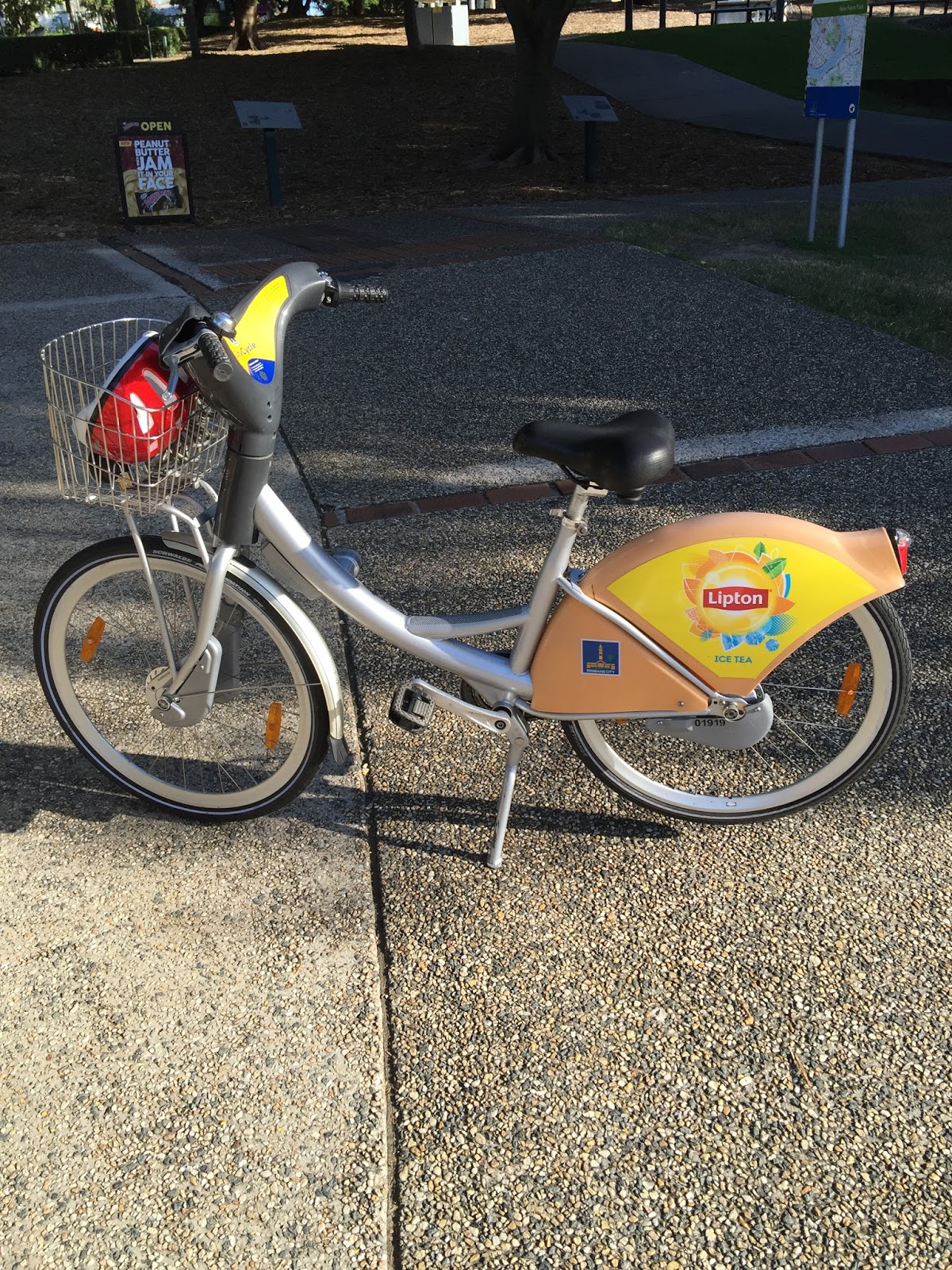
Fortunately I had access to a simple and obvious solution: my city (Brisbane) has a public bike-hire scheme (CityCycle). For a small subscription fee, you can access a fleet of bicycles available from racks stationed throughout the inner city. The success of the scheme overall is debatable, but it was a perfect fit for my purpose.

As for actually learning to ride, of course I turned to the Internet. Reading the experiences of other adult learners suggested separating out “riding a bike” into a set of discrete skills. The most fundamental of these was balancing on the bike while in motion. So, following the advice I gleaned online, I set myself the goal of balancing on a CityCycle while it rolled down a grassy slope in a park, using the bike’s brakes—and my feet—to stop it at the end of the slope. Advice I’d read also suggested removing the pedals from the bike while practicing this specific skill, but obviously that wasn’t an option for me!

I also considered lessons from a cycling coach. More on this later.

26 April — Lesson 1


So one Sunday afternoon, I spent an hour in a nearby park with a hired CityCycle. I adjusted its seat down as far as it would go, then I would walk the bike to the top of a slope, climb on, and just coast down the slope while attempting to remain upright. The first few attempts had me rolling only a few metres before I’d lose balance or confidence and put a foot down to prevent a fall. However, I was very surprised at how quickly I learned to balance on the bike. At the end of the hour (and some twenty or more coasts of about 50 metres), I was still scared, but had no trouble riding the whole way down the slope with both my feet off the ground. This was a major confidence boost for me. I don’t have a good sense of balance, and I had assumed that balancing was going to be the biggest obstacle I faced. With that concern out of the way, I felt much more certain that this whole riding-a-bicycle idea was actually feasible.

The other surprise for me was how the brakes operated. For some reason, I instinctively expected that if I pulled on the brake lever fitted to the left handlebar, the bike would veer left, and vice versa for the lever on the right handlebar. Of course, that’s not true and doesn’t reflect what I knew even then to be mechanically true of the bike, but it was an unconscious expectation nonetheless. To this day, three months and 600 kilometres later, I still have to fight this instinct occasionally. I wonder if this somehow distantly relates to my very earliest driving experiences being with a tracked vehicle with differential braking? (A Caterpillar D2, for the record).

9 May — Lesson 2


Two weeks later, at a different park, I again hired a CityCycle with the intention of adding steering and propulsion to the mixture, still confining myself to areas thick with grass.

Pedalling turned out to be a non-issue; and in retrospect, I now know that apart from cushioning any potential falls, the thick grass also served the very useful purpose of preventing me from building up too much speed too quickly.

Steering was a little more difficult for me to get the hang of. Initially, I had a very strong tendency to over-steer. It took quite some trial-and-error to determine that most of the turn needed to come from shifting my balance to one side or the other, with only small, gentle inputs from the handlebars. Initially, I think I expected the bike to steer more like a car. I liked discovering that it steers more like an aeroplane.

This week, I also experimented with the gears (on CityCycles, a three-speed, hub-geared arrangement with a twist shifter) but found little value in them. Indeed, I could feel so little difference between the gears that I had to enquire via social media whether “1” was the low gear (as in a car) or whether it was the other way around! (Yes, “1” is low, for anyone else wondering) I also learned that, unlike a car, shifting down gears does not provide a braking force. Another instinct that I still occasionally fight.

I spent an hour that day pedalling along the grass, describing long, lazy figures-of-eight. By the end of it, I could essentially ride a bike, even if my directional control was not wonderful.

So, for any other adult novices reading this: that’s two hours from zero to basic competence.

16 May — Lesson 3


The following weekend, I decided to attempt a real ride along a bike path. There’s a 5-km round-trip stretch of path that I knew quite well from doing weekly fun-runs on it (ParkRun). I knew it to be flat, wide along most of its distance, and not too busy. And my familiarity meant that I could remove finding my way from the cognitive load. I set out, slowly and tentatively.

It wasn’t hard to complete the 5 km, but it was a pretty nerve-racking experience for me, especially when sharing the path with other cyclists and pedestrians. It was during this ride that I discovered that the phenomenon of target fixation applies to cycling: that worrying about an obstacle like a pole or bollard would tend to make me steer directly for it.  I had to learn to disconnect my attention from such hazards and focus on where I wanted the bike to go rather than where I didn’t want it to go.

By the end of week three, I now knew that I was physically capable of staying on a bike and making a powered, controlled ride of approximately the distance I would need to cover to ride to or from work.

16 May — My first bike


By now, I was already researching what kind of bike I might like to buy. The criteria I had come up with included:

  • Upright riding position: I wanted a bike that emphasised comfort over speed, and the upright position suggested greater comfort than being hunched over the handlebars, as well as better safety due to better visibility.
  • Platform pedals: I wanted to be able to put a foot down quickly to avert a fall without having to disengage from any kind of retention mechanism.
  • Step-through (“ladies”) frame: And if I were to fall, I wanted to minimise the chances of getting entangled in or injured by the frame.
  • Hub gears and twist shifter: Hub gears seemed more robust and needing less maintenance than derailleurs. And the twist shifter seemed easier to use while keeping both hands firmly on the handlebars. Actually, I initially wondered if I’d need or want gears at all, but fortunately, friends convinced me that they were a must-have.
  • Pretty! I wanted a bike that had some character and which reflected my own aesthetic sense. As I see it, too many bikes lack any kind of style, or are actually (and perhaps deliberately) ugly.  
  • Cheap: Despite the promising experiments, I didn’t want to spend a lot of money on what was still an unproven concept. I hoped I would be able to spend less than $300 or so.
Something like the Papillionaire Sommer looked ideal, but at around $800, was a bit more than I planned to spend.

As it happened, the day of my third test ride, an advertisement by Reid Cycles appeared in my Facebook feed, promoting a deep discount on a bicycle that matched my criteria very closely. The only way that the Reid Vintage Ladies 7-Speed Classic diverged from my wish list was in its gearing: it has a derailleur and a thumb shifter. Still, a discount of over $100 off the list price brought the bike down to $200. Trading off that one feature for such a good price seemed acceptable to me, so I went straight to the Reid store in Fortitude Valley to buy one. I’ll review the bike and purchase experience separately in another post (update: here it is), but for now, I’ll say that overall, I’m very, very happy with this bike.


24 May — Test ride


This Sunday, I set out early in the morning to ride to my workplace and back, to confirm the route and my ability to ride it. I’m extremely fortunate to have a bike path that takes me from a few hundred metres away from my front door right to across the street from my office!

I have a terrible sense of direction, but Google Maps does a great job of indicating bike paths and other cycling infrastructure, so I found the way without too much trouble. I was also pleasantly surprised at how easy the ride was almost along its entire length. I only encountered two hills on the way to work and two (different) hills on the way home that required me to dismount and push the bike maybe a hundred metres or so each time.

I was set.

24 May — Coaching


Early on, I had considered hiring a cycle coach to teach me to ride, but in practice, it proved hard to find a coach at short notice with a schedule that worked in with my already very full one. By the time I’d successfully engaged a coach, there was a two-week wait before my lesson. When I booked it, I assumed that I’d still be learning to balance by then, but instead, I’d already taught myself to ride from the Internet, had bought my own bike, and had even ridden it all the way to work and back!

Nevertheless, I did buy an hour’s coaching with one of the trainers from CycleAway, and it did prove useful. I’ll admit that I was nervous at first, wondering if I’d be judged for buying something other than a “serious” road bike, or for wanting nothing more from cycling than to commute to and from work. But this proved completely unfounded. What I liked straight away was that the trainer listened to my choices and my use case, and then worked with me to optimise for them.

Specific useful advice I took from the session included how to progressively adjust the bicycle to my height, better riding posture to maximise comfort and control for a cruiser-style bike like mine, and (much) better braking technique. These are things that I would have been unlikely to have discovered on my own, so the session was definitely worth it.

25 May to now — Commuting and more


This is almost an anti-climax to this story. The next day, Monday, I rode to work instead of taking the train. And I did the same on Tuesday. And I’ve done the same practically every day since then. The only exceptions have been a couple of days that would have required a night ride home before I was comfortable doing that, and a couple of days where I needed to wear a suit and didn't want to cycle in that.

It hasn’t all been lovely, though. The absolute worst thing about learning to ride has been the behaviour of other cyclists. During the first few weeks of commuting, I was a lot slower than any other rider on the bike path, and when making my way up hills, a lot wobblier. During those weeks, I was verbally abused or physically menaced by other riders approximately one day in every two. Usually the menacing took the form of tailgating (do cyclists use that term?), cutting me off after overtaking me or on the inside of the curve while going around bends, or—in one incident—actually running me off the path. I wonder how many would-be cycle commuters have been turned off the idea forever after experiences like these?

Against that, there have been lovely cyclists, who offered words of encouragement and support after witnessing two of the worst such incidents, or who stopped and offered me assistance one day as I walked my bike home with a flat tyre. Those folks have been one of the best things about learning to ride.

But anyway, I’ve stayed with it, and I now do the ride to and from work in about half the time it took me at first.

The scope of my cycling has crept a little too! I bought this bike with the sole intention of riding it only to work and back. However, it wasn’t long before I started using it to replace the car for other trips of under 10km or so, where I would have been the only passenger and where I wasn’t to be carrying large or heavy cargo.

My total outlay to start cycling was about $440:


CityCycle membership for learning to ride $30
Helmet (compulsory in my state1) $10
Bicycle Queensland membership (for included insurance2) $90
Bicycle $200
Lights/lock/pump kit $20
Coaching session $90
Total: $440

Against that, I save about $36 per week in public transport fares, so after two months, I’m getting close to recouping my initial outlay. I’ll be revenue-netural in a few more weeks!


 The future


Even now, I’m not sure that I’d say that I like cycling. That is, it’s not something I would choose to do for its own sake (“It's a lovely day! I think I’ll go for a ride!”) However, I do know that I like it more than I like catching buses or trains. And I like it more than driving a car under most circumstances. And it does deliver the physical activity I was looking for without taking any more time out of my day than my commute by train did.

I commute in the clothes I work in. My workplace actually has showers and change facilities for cyclists, but I’m not comfortable with the idea of using them. That seems to be OK right now in the winter, but it might force me back onto the trains once Brisbane summer hits and brings with it heat, humidity, and rain. If that’s the case, I hope I’ll be able to overcome inertia and switch back to cycling as temperatures drop again.

I originally saw the bike I chose as an entry-level option and a stepping stone to something else. But now, I’m not so sure: it seems such a perfect fit for my use case! Sure, I’ll buy a few accessories like better lights, better tyres, and a better saddle, but I get the feeling I’ll be keeping this bike for a while.


1 Actually, CityCycle makes shared helmets available with some hire bikes. But ewwwwww... 

2  Bicycle Queensland is the state’s bicycle advocacy organisation. Membership includes public liability insurance for bodily injury and property damage. I think you’d be insane to ride in public without insurance of this kind.