Showing posts with label TV. Show all posts

Wednesday, 4 October 2017

First thoughts on Star Trek: Discovery

Last time a Star Trek series
debuted, I could never have
imagined that I'd delay
watching the next one until I
got home from ballet class...

TL;DR version: There's this new Star Trek series that's just started on Netflix, called Star Trek: Discovery, and I like the first two episodes more than anything else that's been on TV for the last 23 years. 


I've been a huge Star Trek fan practically my whole life. Its original 1960s incarnation and The Next Generation from the 80s are my favourite TV shows by a long margin. I think this love comes from a unique combination of factors that resonate strongly with me:
  • wonder at the exploration of "strange, new worlds... new life and new civilizations"
  • the optimism of the future depicted; its vision that "the human adventure is just beginning" and that the best is yet to come for our species
  • it's a modern-day fable; that from the very outset, the show was intended to (and regularly did) explore social issues, and questions about the nature of being human

When I have failed to enjoy various incarnations of the show since The Next Generation ended in 1994, I think it's because they have failed to deliver on one or more of those fronts. Without them, all that was left was fairly standard action/adventure shows and movies set in space. And to me, it seems a shame to have lost something unique.

Such is my love of the show that even having been burned time and time again by new additions to the franchise, I was still very excited last week to see the debut its newest incarnation, Discovery.

But reviews aren't worth much without understanding what the reviewer values (and doesn't), so a little bit more about that first.

I don't care that the look of the show has changed.
What the future looked
like in 1964: "The Cage"
Discovery is set about ten years prior to the original 60s series that featured the adventures of Captain Kirk and Mr Spock. This places it roughly concurrent with the pilot episode of the original series, "The Cage", which was set under a former captain of the USS Enterprise, Christopher Pike. TV production values have come a long way in the 53 years since "The Cage" was filmed. I have no expectation that the sets, props, or costumes of the new show would align with that was presented way back then.

This also extends to what's bound to be the most contentious change in the show's visuals: the makeup design of the Klingons. This is the third major revision of "what Klingons look like" in the history of the show, and an article on the Ex Astris Scientia website ("The Evolution of Klingon Foreheads") descibes all the minor revisions in minute detail too. In short, there's been such little consistency over the last 50 years that I'm not about to get upset about another change now.

I don't care about story arcs
Similarly, TV storytelling has changed substantially over the last few decades. Whereas series were once more like anthologies of short, stand-alone stories that rarely referred to anything that had gone before, now series are constructed more like novels. I'm happy with either, although I've been more frequently disappointed by attempts at long-form TV storytelling than I've been impressed by it.

I'm not here for the characters
When it comes to sci-fi and other speculative fiction genres, I'm watching for the setting and the ideas; if I wanted interesting, well-rounded characters, I'd be watching a European art film instead. I set the bar really low here: I just don't want to be actively annoyed by the characters.

So, all that said...

What I loved about Discovery (mild spoilers)


Ideas: clash of cultures
The first episode quickly establishes that this is an ideas show. The political tensions of the original show were driven by confrontation of space superpowers — Cold-War concerns. The tension in Discovery is driven by xenophobia and religious fundamentalism — twenty-first century concerns. There's a post-colonial narrative as well, provided by the Klingons' desire to "remain Klingon" in the face of what they see as the cultural imperialism of the Federation.

Ideas: nature vs nurture
The central character of Michael Burnham is a human who was raised by Vulcans and is portrayed as behaving more in line with her nurture than her human genetics. This is not a new theme to Star Trek, but in an era where "identity politics" are contested, is more relevant than ever.

Ideas: pre-emptive strike
The dramatic climax of the opening two-parter revolves around a question of whether it is acceptable to undertake a pre-emptive strike against a known belligerent who has not yet made a hostile move in this encounter. How far should the benefit of the doubt be extended? This story seems ripe for discussion and debate for a long time, just like other notable examples from Star Trek's past. My wife and I still debate 1968's "A Private Little War" every time we see it.

Respect for the past
I do like the small nods to what has gone before, in visuals, sound, and dialogue. For example:
  • the sidearms that the Starfleet officers carry are styled after the hand phasers of the original series, but feature muzzles/emitters that are clearly based on the earlier "hand lasers" in "The Cage"
  • the inclusion of a ship's dedication plaque next to the elevator ("turbolift") doors on the bridge of the USS Shenzhou, just like on the bridges of Federation starships all the way back to the original series (and, as an aside, naming a starship USS Shenzhou, after Communist China's first human spaceflight vehicle)
  • one of the sensor noises on the bridge, taken directly from the original 60s series
  • use of the bosun's whistle, again, a nautical "Hornblower in space" touch that goes all the way back to the original series
  • many aspects of Klingon ritual that draw on what was established during The Next Generation (death rites), but also in the novels and (pen-and-paper) role-playing games of the 1980s (the "Black Fleet") and perhaps even a nod to a single, throw-away line in one of the 80s Star Trek movies (a Klingon "mummification glyph")
  • This characterisation of Michael Burnham echoes that of Captain Pike's un-named first officer, "Number One" in "The Cage", also Vulcan-like in her demeanor 
  • an albino Klingon, as established in Deep Space Nine
  • "phase cannons" as starship armament, as established in Enterprise
  • and probably a lot of other things I missed on my first viewing!
In short, there are a lot of easter eggs here, while none of them seemed intrusive.


Summary
I'm really excited by what Discovery promises so far! I'm hoping it continues as a science-fictional fable for our age, inviting us to think about ethics and the human condition in a setting that is both new and also respectful of its past. That's a hard balance to strike, but the introductory two-parter has me feeling very optimistic.


Thursday, 1 January 2015

My favourites and least favourites of 2014

Here’s a round-up of the things I liked and the things I didn’t in 2014:

Books

Per Goodreads, here’s a list of what I read in 2014. I only got through 41 out of the 50 books that I had challenged myself to. Among them were three books that I absolutely loved: Dahlgren, The Fiftieth Gate: A Journey Through Memory, and Colorless Tsukuru Tazaki and His Years of Pilgrimage. Of these, I was amazed by the first two books as much as anything that I’ve ever read, and being so very different, I find it impossible to chose a favourite between them. Dahlgren is a long piece of surrealist paranoia that is experienced as much as it is read. My Goodreads review of it here. I found it to be one of those books that stretched my understanding of what an author could do with a text. The Fiftieth Gate: A Journey Through Memory is a work of memoir that touches one of the darkest chapters of human history, but also explores really complex ideas of memorialisation and of ownership of the past. I haven’t read many books that I have found both emotionally wrenching and intellectually stimulating. This is such a book; my Goodreads review is here.

The book I enjoyed least was Insites: The Book, which I didn’t even finish reading (very rare for me). I found it utterly vapid: my review is here. Other books from which I derived no pleasure this year were David Vann’s Goat Mountain [review] and, astonishingly to me, Stephen King’s The Gunslinger [review].

Live music

I didn’t get out much in 2014, and so I don’t have much to discuss here. I think I only made it to two performances! I enjoyed both of them: The Audreys touring their new album, ’Til My Tears Roll Away, and Early Music Queensland’s programme of late baroque music, Musicalischer Circul. Obviously two very different shows! However, the Audreys performed with a polish absent in the other show, and I enjoyed theirs more.

Albums


I didn't listen to much new music in 2014 either, but I liked ’Til My Tears Roll Away more than anything else I heard. It does fall squarely into the “more of the same” category from The Audreys rather than explore anything new, but because I happen to like the sound of their previous albums so much, I’m perfectly OK with that!

The big disappointment for me was Ella Hooper’s solo debut, In Tongues. This was a surprise, since I liked Killing Heidi and The Verses so much. It was a shock to discover that there wasn’t a single track on this album I could connect with. 

Theatre

I only saw two plays in 2014: Queensland Shakespeare Ensemble’s The Tempest, and La Boite’s production of Kathryn Marquet’s Pale Blue Dot. I find it impossible to choose between these: one is my favourite of Shakespeare’s plays, performed with the tremendous energy and enthusiasm that QSE always brings to their work, and the other was a delightfully nutty yet thoughtful piece superficially about alien abduction, but really more about belief and trust. Both were outstanding.

Movies

The eight movies I watched in 2014 make it perhaps the leanest year for film for me in decades. This was mostly through not having easy access to Apple TV for a large chunk of the year, my main movie- and TV-watching platform these days. Out of what I saw, the highlight was very definitely The Cabin in the Woods, which I enjoyed for its cleverness and Whedon’s evident love of his material. This latter element is something I find lacking in so much mainstream film and is one of the things that draws me to low-budget, amateur film so much. My review is on IMDb.

The film I liked least in 2014 was Interstellar. To explain why, I’ll just recycle the summary I wrote for my IMDb review: I found it to be a film of interesting images, breathtaking visuals, and little consistency or sense.

TV

Early in the year, I heard a lot of buzz around True Detective, and although it very much sounded like not my thing at all, I gave it a try and loved it! Partly, I was drawn to the show’s brooding intensity and bleakness, but there was another element that elevated it to becoming one of my favourite pieces of TV ever. That element is a major spoiler, so I won’t discuss it here, but will instead direct curious readers to my review on IMDb. I'll also mention Broadchurch as another show that defied and grossly exceeded my expectations (and to which I also gave a ten-star rating on IMDb).

In 2014, I continued to sample a wide range of TV in search of new things to enjoy from the last 20 years or so that I’ve been mostly tuned-out to television. Predictably, this turns up a lot more misses than hits. The low-tide mark for my enjoyment of a show during the year was that time I sampled two excruciating episodes of Bob’s Burgers. I have absolutely no idea why so many people find this funny.

Computer games

I played only two computer games in 2014: Papers, Please, and Qwirkle. I really liked the idea and implementation of Papers, Please and could imagine myself getting quite addicted to it, given the opportunity. I haven’t invested the time to discover if that’s actually true though. Qwirkle is a computer implementation of an award-winning boardgame, but I’ll mention it here because I’ve only sampled the computer version. I like it a lot and am definitely addicted. Like most of the board games I enjoy, its mechanics make it appear deceptively simple, but there’s deep strategy to the game that I am very much still learning.

Role-playing games

After a long time, I liked the opportunity of trying out a couple of new games this year. My favourite (of a field of two!) was definitely the new, 5th edition of Dungeons & Dragons. (Note that “editions” of D&D are largely new games with fundamentally different and incompatible sets of rules.) I documented my initial reactions to the game elsewhere in this blog, and I’m glad to report that my positive impressions have persisted as I’ve continued to play it. I like this better than any edition of D&D since 2nd ed in 1989.

I’m less sold on Trail of Cthulhu. This game features a computer-game-like mechanic of ensuring that before leaving a scene in the story, the player-characters always receive the clue that will advance the plot to the next scene. I understand (and relate to!) the problem that this mechanic is designed to address, but the end result feels a bit too much like a “ghost train” to me. That said, I’d still choose to play Trail of Cthulhu ahead of many other games.

Things that I didn’t do in 2014

Things I normally enjoy but didn’t get to do in 2014 include:
  • see a dance performance
  • go to the opera
  • play board games
Hopefully, I’ll get to do more of those in the new year :)


Monday, 25 August 2014

The problem of Doctor Who: Deep Breath and its Tyrannosaurus

So today, I was extremely happy to get along to one of the cinema screenings of the new Doctor Who season opener, “Deep Breath”, which also of course introduces Peter Capaldi as the 12th 13th 14th whateverth Doctor.

I enjoyed it! I found the story was mostly forgettable, but that’s normal for a new Doctor’s introduction, where the focus is very definitely on the character. (Doctor Who is a series with a mild, recurring case of pilotitis) The real joy was watching Capaldi’s interpretation of this much-beloved character. Anyway, I digress.

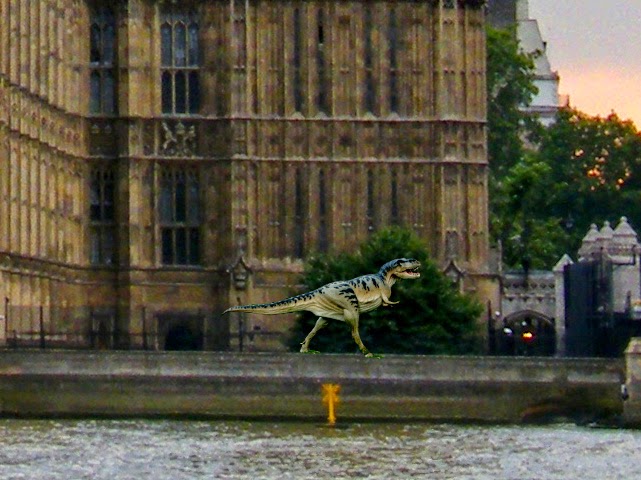
One thing bothered me, though: the size of the Tyrannosaurus. I had no real idea of how big the clock tower of Westminster Palace (popularly, though inaccurately known as “Big Ben”) is, but I knew it had to be much bigger than it appears to be beside the Tyrannosaurus stomping around beside it. When I got home, I looked it up, and the tower is quite huge—96 metres high!

Yet shots like these make it clear that the dinosaur is meant to be very nearly as tall as the clock tower, and the multiple angles and directions confirm that this is not just a trick of perspective, but that this is the intended size:


Now, an adult Tyrannosaurus was only about 4 metres tall at the hip, so really, to be in proper scale, it would have to look more like this:


Can’t see it? It’s just about almost as tall as the clump of greenery there at the base of the tower:


So really, a very very long way away from what was depicted on screen!

As a final note, the last time Doctor Who depicted a Tyrannosaurus loose in London was in 1974’s serial “Invasion of the Dinosaurs”. Here’s what it looked like back then:


There’s obviously no contest in realism here (or in accuracy—we know so much more about these animals now than we did forty years ago!)

However—and this is the important point—notice that the 1974 Tyrannosaurus is depicted around about the right size! If anything, it looks very slightly too small for an adult, maybe around 3 metres at the hip. So perhaps this one was a juvenile?


All images from Doctor Who are copyright BBC. I assert that my use here is fair dealing for the purposes of criticism and review.

My composite images of the correctly-scaled Tyrannosaurus against the clock tower are made from an image of the clock tower by Adriano Aurelio (via Wikimedia Commons under a Creative Commons CC-BY 2.0 licence) and an image of a model Tyrannosaurus by User Pibwl (via Wikimedia Commons under a CC-BY-SA 3.0 licence). I release this composite image under a CC-BY-SA 3.0 licence.


Sunday, 16 March 2014

Stop telling me it's good just because you liked it!

In the vast majority of cases, I find that when somebody says that some movie or book or TV show is “good”, all they really mean is that they liked it, and when they say something is “bad” or “stupid”, what they really mean is that they didn’t like it. Which is fine and all, but unless I know the reviewer and their æsthetic preferences really well, it’s a pretty meaningless appraisal.

For some time now, I’ve been trying to be more explicit about whether my appraisal of something is an evaluation of its quality, or is a description of my own reception of it.

Good things that I don’t like

The need to make this distinction was driven home to me this week as I read Jonathan Tropper’s novel This is Where I Leave You

My full review is on Goodreads, but the gist of it is that:
  • I think this book is extremely well executed, and
  • I didn’t like it much at all.
That is, I think it is very much a good book, even it it’s not my thing.

In practical terms, this means that I would very honestly and enthusiastically recommend it to somebody whose æsthetic preferences I know run in the direction that Tropper takes his readers. (I don’t immediately know who that is, but I strongly suspect that if you liked The Royal Tenenbaums or Arrested Development, you’ll get some good laughs out of this book.)

Similarly, in TV terms, I might not have liked The Wire, but I would confidently recommend it to fans of gritty police procedurals, and although I ground my teeth all the way through the episodes of Glee that I sampled, I have honestly, wholeheartedly, and successfully recommended it to other people.


Things I like that are not good

In the opposite direction, I’m perfectly comfortable to say that there’s a lot of stuff that I like or even love that isn’t very good in any objective sense. I’m talking about the books, movies, and TV shows that people too often describe as “guilty pleasures” — a term I despise and reject because of its inherent notion of shamefulness at simply liking something that other people don’t like.

Schadenfreude

First, as a connoisseur of truly awful cinema, it’s important for me to distinguish between things I like despite their being not very good, and things I like because they’re really, really bad. The first category recognises that there’s more to æsthetic preference than simply the quality (“how-well-done-ness”) of a book, film, or TV show. The second category just reveals some kind of gleeful schadenfreude on my part.

To put that in perspective, the films I’m talking about in the second category aren’t the multi-million-dollar Hollywood flops that make up the “worst movie” lists of the Internet, but the films that make those flops look like masterpieces of cinematic art. I’m talking about the indie films that can’t even keep a shot in focus, or where (as a product of the script or the edit) whole scenes make no sense at all (“what just happened there?”), or where hapless actors unconvincingly pretend to be terrorised by a giant turkey head made of papier-mâché, or where the whole thing appears to have been shot in one take on a camcorder by some dude who clearly saw The Exorcist that one time. Seriously.

So as much as I enjoy watching these train wrecks, I think my enjoyment of them comes from a different place and does not reflect æsthetic appeal. And yet, I honestly liked Blood Freak and enjoyed the time I spent watching it more than the time I’ve spent watching many highly-acclaimed and competent films (anything by Quentin Tarantino, for example).

Investment in a bigger narrative

Maybe the most common examples of narratives that I (and probably many other people) like for reasons other than quality are individual sub-par installments of  TV shows, novel series, or film franchises. As a Star Trek fan, this investment in a larger narrative has kept me watching “Spock’s Brain” over and over and over again across decades as the episode comes up in my regular re-watches of the series.

My reception of this episode and similar atrocities from the Star Trek and Doctor Who canons can be explained wholly in terms of a belief in the overall quality of the series or franchise. (And I still draw the line at Voyager :P)

Geniune aesthetic appeal

Yet, there are still other narratives I like not for their incompetence, not for their part in a bigger narrative that I like, but simply—for whatever reason—on their own terms. 

For example, consider End of Days. I adore this film. I like its scope, its themes, its look, and its end-of-the-millennium vibe (for long-term readers familiar with my system of appeal characteristics, it scores high on story and affect; and medium-low on craft and idea). However, there’s no way that I’m ever going to try and defend it as a good film, and I have no idea of to whom I could possibly ever recommend it. There’s plenty of other genre films I could name here too, whose appeal to me is entirely disproportional to the skill of their execution or their ability to realise their creators‘ visions.

Conclusion

Next time you go to tell someone how “good” or “bad” you think a book, movie, or TV show (or painting, or dance performance, or game, or album) is, stop for a moment and ask yourself what you’re really claiming. Is the piece really that terrible or stupid just because it doesn’t appeal to you personally? And is your approbation all that’s required for a work to be “good”?

At the very least, framing an appraisal in terms of either “good” or “liked” makes further discussion and debate meaningful: the parameters are defined and explicit.


Tuesday, 31 December 2013

My favourites and least favourites of 2013

Shamelessly “inspired” by my friend Lucas Costi’s post on a similar topic, here’s a list of some of the stuff I liked most and least this year. I quite specifically make no representation about the quality or otherwise of any of these things: their inclusion here signifies nothing other than how much or how little I personally enjoyed them.

Books

Per Goodreads, here’s a list of what I read in 2013. I only got through 32 out of the 50 books that I told myself I’d read this year, but there were some wonderful things in there. It’s not a new publication, but the book I enjoyed most was Jeffrey Eugenides’ Middlesex: intelligent, lyrical, and surprising. My review is on Goodreads.

The book I enjoyed least was Intrusion by Ken MacLeod. I felt it was a senseless squandering of some genuinely interesting ideas, that only got worse the longer it went on. My review is here. It narrowly beats out Christopher Gerrib’s The Pirates of Mars, because at least that book stuck to what it set out to do and didn’t change horses in mid-stream.

Dance

I only went to one dance performance this year: Project Rameau by the Sydney Dance Company. I was amazed by how much I enjoyed the juxtaposition of modern dance with the stately elegance of Rameau’s music. “Favourite” is meaningless in a field of one, but I loved this.

Live music

I think the only live music performance I went to this year was the Badinerie Players’ Concert of French- and Italian-Style Baroque Music at the ABC studios. I really love this ensemble, and am very disappointed that while researching the above link I found that they performed twice in November and I never knew about it! I would totally have gone to that!

Theatre

Another single-entry category. My one excursion to the theatre this year was to Queensland Shakespeare Ensemble’s A Midsummer Night’s Dream, which I enjoyed as much as I usually enjoy this company’s work—which is to say, very much indeed!

Movies

I didn’t watch many movies this year. Of that small bunch, Gravity is the one I liked most; my review is on IMDb. In short, I found it incredibly beautiful and moving.

By a long margin, the movie I liked least in 2013 (and one of the films I enjoyed least out of everything I’ve ever sat through including a low-fi, low budget feature film of some Korean teenager SMSing his friends) is J.J.’s Space Adventure II, aka Star Trek Into Darkness. My review is elsewhere here on my blog, but in short, I found it a mediocre (at best) action film, poor science fiction, and practically unrecognisable as Star Trek. Fail.

TV

2013 saw me continue my survey mission to seek out shows I might enjoy out of what has been broadcast in the 20 or so years since Star Trek: The Next Generation ended. The results have been very hit-and-miss, but I was blown away by the one episode of Rome that I trialled. I am just itching to return and watch this series through!

For sheer oh-my-God-stop-this-now hatred, I immediately point to Louie. Not only did I find this horribly unfunny (pretty much a deal-breaker for a comedy for me...)  but the smugness of its central character actually made me angry. Every minute of watching this was unpleasant for me.

Board games

I just realised with horror that I played a grand total of only two new board games this year: Red November and A Game of Thrones. That’s too few to rank a most or least favourite, but I found both games quite fun.

Computer games

I also tried only two computer games in 2013, and really enjoyed both, even if, again, this doesn’t make for a meaningful “most favourite” and “least favourite”. One was XCOM: Enemy Unknown, for which I wrote a long review here on my blog. The other is a relatively recent discovery: Fsim Space Shuttle, which I’m still struggling with, but it feels like a worthy challenge! I’m sure I’ll review it in due course :)


So there it is. Clearly, I need to make more effort to get out more in 2014! Although, that said, I don’t feel like I missed out on anything this year that I knew was on but didn’t get to.


Saturday, 23 November 2013

Doctor Who: the latest missing episode recovery rumour

TL;DR version: the Mirror is reporting a rumour that the 1st season Doctor Who story “Marco Polo”, currently missing from the archives, has been recovered. I think there are good grounds to believe the rumour and speculate that the episode has come back from Africa with a locally-produced dubbed soundtrack in a language other than English. Detailed analysis follows:


Today, the Mirror is running the story that the seven episodes missing from the first-season Doctor Who story “Marco Polo” (that is, the entire story) have been recovered and will be announced by the BBC as part of the show’s 50th anniversary celebrations.

Rumours of the return of missing Doctor Who episodes are practically unending in fandom, fuelled by a demonstrably inexhaustible supply of wishful thinking. For anyone who’s been paying attention to these for more than a few years, the reaction is usually “I’ll believe it when I see it”. Maybe I’m feeling especially credulous right now because the Mirror was the first mainstream news source to tip the return of nine 5th season episodes about a week before the BBC made an official announcement last month, but there’s something about this story that has the ring of truth about it for me.

The Mirror’s version of events this time around is that the source of “Marco Polo” is:
“a fan who enthusiastically recorded the episodes ... directly from the television onto a 16mm film camera.... The recording - which is a silent film - came out really clearly so it will be easy to watch.... There are already audio recordings of the episodes so the Beeb have had to match everything up. There are some gaps in the audio so it has been a painstaking process.”
There are significant problems with this version of events:
  1. Domestic home-movie cameras were certainly available in 1964, but their film magazines lasted only a few minutes: a typical 100-foot roll would be finished in a little under 3 minutes of shooting. 
  2. Short clips from early Doctor Who stories have indeed been recovered from a fan who shot these snippets on an 8mm camera. These snippets show heavy distortion and flickering. This is to be expected from the technical limitations of this approach, which include the distortion inherent in early television picture tubes, and a mismatch between the frame rate of the TV signal (50 frames-per-second) and the movie camera (24 frames-per-second). Even if somebody had a home-recording of Marco Polo on the technically superior 16mm format, it would still suffer from the same limitations as the 8mm material previously recovered and be in no way “really clear” and “easy to watch”.
 Against that, it also includes elements of truth:

    1. The BBC does hold audio copies of all seven episodes of “Marco Polo”. At least two fans, David Holman and James Russell, had independently made off-air audio recordings of these episodes. 
    2. Of the two sets of recordings, Holman’s are far higher-quality, but, like the Mirror report states, do contain some gaps. Holman edited out the opening and closing titles of the episodes, and the brief reprises of the action that took place at the start of each episode to recap the action of the previous week’s episode. Additionally, Holman’s recording of episode 7 (“Assassin at Peking”) is missing around ten seconds.
    3. Restoring these vintage, amateur audio recordings is challenging because of technical limitations of the original equipment. For example, the speed at which the tape ran through the recorder might not have been exactly to standard, meaning that the recording was slightly faster or slower than real-time. The speed could also vary within a particular tape, due to the changing tension in a reel of tape when it was empty compared to when it was full, as well as the stretchiness of individual tapes. When remastering these episodes for CD release, the Doctor Who Restoration Team has had to make best guesses about the the tape speed, and the results can be approximations only. Attempting to “match everything up” between this audio with a film print would indeed be challenging and “painstaking”.
    4. 16mm recordings of early Doctor Who were indeed made—not by fans, but by the BBC itself for foreign TV stations. The show was originally produced on 2” videotape, but that equipment wasn’t widely available in the BBC’s export markets, so the episodes were transferred to 16mm instead. It is these film recordings on which all 1960s Doctor Who survives—every single one of the videotape masters was erased (and re-used) a long time ago.
    One missing piece of the puzzle: if we assume that 16mm recordings of “Marco Polo” have been recovered, why would they need to be re-synched to  amateur-made audio recordings?  The BBC telerecordings were all sound film, with the audio tracks present right there optically on the film print itself. One obvious possibility is that the the recovered prints are not of the English originals, but are dubs into another language. Past recovery efforts have yielded prints in at least Arabic and Spanish, but in every one of these previous cases, English-language prints were already known to exist. Admittedly, though, no known dubs were made of Marco Polo, and indeed, the special “sound effects and music only” prints on which foreign TV stations relied to dub programs into a local language were never produced for “Marco Polo”. [Afterthought: actually, on further reflection, it seems to me more likely that the need to re-synch the soundtracks is simply a red herring: a case of confusion of the recovered material with the fan-made off-air audio recordings.]

    Complete prints of “Marco Polo” were sent to no fewer than 23 countries at one time or another, but not every country got a fresh print. It was normal practice for the BBC to send out prints to one country after another country had already screened the material and returned it. Matching up the known movements of these prints suggests that probably 10 sets existed for “Marco Polo”: The Destruction of Time website has a great summary.The last known prints in existence were in Ethiopia, where the story was transmitted in 1971. Each of these 23 countries broadcast the story in English.

    Recent Doctor Who recovery efforts have centred on Africa, and the Mirror specifically (but impossibly) named Ethiopia as the source of the Trougton material recovered last month.

    Putting it all together:


    Speculation:

    • “Marco Polo” has indeed been recovered.  
    • It exists as a professionally made, 16mm telerecording. 
    • The print is a second-generation print made with a locally produced soundtrack in a language other than English. 
      • Revised opinion: the print is in English and (apart from maybe the need to patch up a damaged audio track here-or-there, there's no need to re-sync the print with the existing off-air audio recordings.
    • The print comes from Ethiopia, and the dub is in Amharic.

    As always, time will tell!


    Thursday, 10 October 2013

    Early Doctor Who: What's Missing?

    Just how much early Doctor Who is missing? A lot!
    I'm very much looking forward to this infographic being out of date tomorrow!
    And here it is!
    As I predicted earlier in the week, the find was a batch of season 5 episodes discovered in Nigeria.


    Monday, 7 October 2013

    What are the newly-recovered Doctor Who episodes?

    Updated 8 Oct

    For a few months now, persistent rumours have been circulating among Doctor Who fandom of the return of a huge cache of episodes that are presently not held in the BBC archives (the so-called ‘missing episodes’ or ‘lost episodes’) from somewhere in Africa. How huge? Rumours varied from around a dozen or so up to 90 of the 106 episodes. The rumours reached their peak in June, fuelled by customs evidence of 3 tonnes of archival material being imported into the UK from Nigeria by a noted film and TV archivist, and then diminished again when the archivist released a public statement that the material had no Doctor Who among it.

    Still, the rumours never completely went away, and denials by the BBC and people connected with it tended be to very coy and carefully worded—of the “There are always rumours and speculation about Doctor Who missing episodes being discovered, however we cannot confirm any new finds” variety.

    “There are always rumours and speculation about Doctor Who missing episodes being discovered, however we cannot confirm any new finds,”
    Read more at http://www.thedrum.com/news/2013/06/20/bbc-cannot-confirm-recovery-lost-dr-who-archive#LfHMLVx7K5jjtJTW.99
    “There are always rumours and speculation about Doctor Who missing episodes being discovered, however we cannot confirm any new finds,”
    Read more at http://www.thedrum.com/news/2013/06/20/bbc-cannot-confirm-recovery-lost-dr-who-archive#LfHMLVx7K5jjtJTW.99
    Then, yesterday, The Mirror newspaper ran a story claiming that all 106 episodes had been recovered from Ethiopia, and this morning, the Radio Times reports that the BBC will make two newly-recovered stories available for sale on Wednesday. The Radio Times went on to say that these stories are “believed to be from the Patrick Troughton era” (second Doctor, seasons 4–6) and that “It is understood that other episodes have also been found”.

    Subsequently, The Mirror reports that the announcement of the missing material has been postponed to the end of the week.

    So what might have come back?


    I've put together a spreadsheet to show the countries to which each of the stories that contain one or more missing episodes were sold, based on the amazingly detailed research shared on the BroaDWcast website. I’ve also included a few annotations:
    • cells with grey dates indicate that the print used for that broadcast is recorded as having left the country afterwards (although in at least one case, a print turned up in Australia even after being recorded as returned to the UK).
    • cells with dates struck out indicate that the print used for that broadcast is recorded as specifically having been destroyed. In reality, it’s likely that most of the prints sent to New Zealand were actually destroyed there, even if specific records have not been found for this.
    • cells with dates in square brackets indicate that the story was viewed by TV executives or government censors in that country, but it was not actually broadcast. 
    • cells with dates in bold indicate the last known transmission of that story.
    • columns in green indicate countries in Africa, the continent to which recent rumours consistently point.
    • story titles in blue are those which I feel there is some reasonable possibility that they could be among a hypothetical trove of episodes retrieved from Africa.

    Assessing the rumours


    For a start, it’s simply not credible that all 106 missing episodes have been found anywhere in Africa. In the 1960s, Doctor Who was produced on 2-inch videotape; an expensive resource that had the virtue of being reusable when its contents were no longer needed. The fact that any Doctor Who from the 1960s and early 1970s has survived at all is due to the BBC’s sales of the show to overseas broadcasters. The BBC was one of the world’s early adopters of videotape, a technology that very few of its foreign customers had in the mid 1960s. Therefore, to sell the show abroad, its sales division, BBC Enterprises, had to transfer the videotape masters to film (usually 16mm, but occasionally 35mm) with a process called telecine: a film camera was pointed at a special, flattened television screen, and filmed whatever was played from videotape. At the other end, the foreign TV station would reverse the process: projecting the 16mm film print onto a screen and pointing a television camera at it for live broadcast! Usually, multiple sets of film prints would be made from the one set of negatives so that BBC Enterprises could send prints to multiple customers simultaneously (although some customers would sometimes have to wait until another customer was finished with their set and could send them on).

    Of the 106 episodes not publicly known to be present in the BBC archives today, one episode (“The Feast of Steven”, episode 7 of the serial The Daleks’ Masterplan) was a Christmas novelty episode and was never transferred to film because its foreign sales prospects were deemed non-existent. Therefore, when its master videotape was wiped (as they all were by 1974), we can say that it was gone for good. We’re now down to 105 episodes that could conceivably come back from somewhere in Africa.

    Beyond that, prints of the remaining 11 episodes of The Daleks’ Masterplan plus its “teaser” episode Mission to the Unknown, were only made for one country (Australia). It’s therefore very unlikely that the 9 mising from these 12 would be among any stories recovered from Africa if that’s indeed where any recent finds came from. (Down to 96)

    Similarly, only three foreign countries showed William Hartnell’s last story (The Tenth Planet) and Patrick Troughton’s debut (The Power of the Daleks): Australia (which records returning its prints of these stories to the BBC in 1975), New Zealand (which forwarded its prints to Singapore in 1972), and Singapore. So it’s pretty certain the 7 episodes missing from these 10 can’t be among any hypothetical African treasure trove. (Down to 89)

    The number of prints of The Evil of the Daleks is a little less certain. Four countries showed it. One print went to Australia in early 1969 and is recorded returned to the UK in 1975; this seems to be a separate print from the one that aired in other countries. The story  also aired in Hong Kong and Singapore later in 1969 and in New Zealand in 1970. The New Zealand print is recorded as destroyed in 1974. So there was at least one, probably two, and maybe even three more prints made of this story (Singapore and New Zealand sometimes exchanged prints, as we’ve already seen), but none went anywhere near Africa. (Down to 83).

    By the early 1970s, only two African countries were left buying Doctor Who in black-and-white: Nigeria and Zambia. By that time, Nigeria seems to have been getting its prints from New Zealand: film prints recovered from Nigeria bear cuts made by the New Zealand censorship board, and when New Zealand did not buy and show a particular story, Nigeria did not either. New Zealand did not buy Fury from the Deep (perhaps because its theme of monsters attacking oil rigs was not helpful to a government trying to close a major offshore natural gas deal at the time) and in fact, stopped buying the show after this season (season 5), meaning that the penultimate story of season 5, The Wheel in Space was the last that Nigeria got of the black-and-white years. The circulation of prints into Zambia is less certain, but whatever their source, BBC records indicate that the final batch of Patrick Troughton episodes screened in the country was the first half of season 5 and the second half of season 6. Therefore, Fury from the Deep didn’t screen in Zambia either, and neither did The Invasion, which, coming in season 6 was after New Zealand and Nigeria had stopped buying the show. Therefore, the 8 episodes missing from these 2 stories are unlikely to turn up in Africa, I think. (Down to 75).

    Speculation on what exactly might have been retrieved depends on which individual chunk of the rumour you privilege:

    Episodes found somewhere in Africa

    This part of the rumour is common to all its incarnations, I’m basing all speculation on this part being true. If we remove the Africa constraint, then all kinds of other possibilies open up, but such speculation is completely baseless: “90 missing episodes found in basement of eccentric billionaire film collector in Sussex!” Sure, but there’s really no way to guess what that might include.


    Some huge number of episodes found: most of what's currently missing


    If there really is a huge hoard of these episodes, Zambia is the only realistic source: in fact, of the 75 episodes that could conceivably be found in Africa, prints of all 75 were certainly in that country at some time, and there doesn't seem to be solid records of them having been sent on to other countries, sent back to the UK, or of being destroyed. In fact, it’s the one country in the world in which such a stash might have survived.

    However, Zambia isn’t mentioned in any version of the rumour.

    Episodes found in Nigeria

    Nigerian archives had already been searched for missing episodes in the 1980s. That aside, if a stash of episodes turned up there, they are likely to be the ones missing from Hartnell’s first two seasons, or from season 5 in Patrick Troughton’s time. It seems that Nigeria is the last place on earth to have transmitted the season 5 stories. Furthermore, although the search in the 80s was prompted by a viewer’s remark that Nigerian TV was so far behind the times that it was still showing Patrick Troughton, the only stories recovered then were Hartnell stories.

    Episodes are Troughton stories

    If the stories to be released this week are indeed from Troughton’s time as the Doctor, as the Radio Times suggests, Nigeria and Zambia are both possible sources. The Troughton stories most likely to emerge from Africa are, in their original screening order:
    • The Abominable Snowmen
    • The Ice Warriors
    • The Enemy of the World
    • The Web of Fear
    • The Wheel in Space
    • The Space Pirates
    I can’t see any reason to think that any of these are any more or less likely to emerge from Africa than any of the others. They were all broadcast in Nigeria or Zambia in the early-mid 1970s, and one of those countries was the final known location of each of those episodes.

    Episodes found in Ethiopia

    I think this element of the rumour is so inconsistent with any of the other claims that I’m simply inclined to dismiss it. However, if this piece is true, it implies that: the haul of episodes is relatively small (11 missing episodes) and that the episodes come from the Hartnell era, not Troughton.

    Another possibility, though: the entire first two seasons of the show (81 episodes) have been recovered in Ethiopia, of which the BBC archives already holds copies of 70. Ethopia is the final known location for many of these episodes, and in particular, of all the episodes missing from seasons 1 and 2.

    Episodes found in Sierra Leone

    In The Mirror’s update of the story, Sierra Leone gets a mention. Like Ethiopia, this is inconsistent with Troughton material being recovered, but Sierra Leone would be a good source for Hartnell’s decimated season 3; the country was the last in Africa to broadcast these stories and it’s possible that the prints never left. On the other hand, Sierra Leone’s film and sound archives were destroyed in civil unrest in January 1999.

    Speculation

    Of course, I’m just guessing, but I think that starting on Wednesday and over the weeks leading up to the show’s 50th anniversary extravaganza,  we will learn that a substantial chunk of season 5 has been recovered from Nigeria, probably a mix of episodes that the BBC already has, plus many that it doesn’t.

    I’d like to hope its the “Zambia 75” instead though!


    Tuesday, 4 June 2013

    Liking books, TV shows and movies: Affect

    This is the sixth and final part of a series in which I examine elements of the appeal of a book, movie, or TV show. I disclose and discuss my own personal preferences here, but I believe that the approach is more generally applicable: just substitute your own preferences for mine.

    In previous installments, I covered character, setting, plot, craft, and idea. As the final aspect, I consider affect. The schema I describe in these articles is a development and extension of a schema proposed by librarian Nancy Pearl.[1] Affect is the second completely new characteristic which I add to hers, and considers how a book, film, or TV show makes me feel.

    Generally, I value a story that can make me feel intensely. In some cases, the feelings that a story brings out in me might be my main reason for liking it. One example that springs immediately to mind is Nanni Moretti’s film La stanza del figlio (‘The Son’s Room’). This is an intimate observation of the grief of a family as they cope with the death of a teenager. The characters are unremarkable people, there is little actual story to speak of, and while competently filmed, nothing about its production stands out for me. But I found watching it a devastating, wrenching experience. This is a film which, for me, the main appeal is entirely in its affect. As another example, while I certainly enjoyed the clever and quirky ideas in The Time Traveler’s Wife, it’s the way that the book made me feel that has made it one of my all-time favourites.

    I can think of one case, however, where my intense feelings about a book worked against its appeal: American Psycho, which I found gratuitously cruel (yes, I understand that was the whole point). The revulsion I felt at the text meant that I abandoned the book before I got very far with it. This is an exception though.

    The appeal of comedy lies almost entirely within the realm of affect. If I don’t find a comedy funny, then it doesn’t really matter to me how well put-together it is, or how otherwise appealing I might have found its setting or characters. Given my strong preferences for science fiction and fantasy, I really expected to like Red Dwarf and the Discworld novels. However, as examples of comedies that I didn’t find funny, any appeal for me in them remains unrealised and theoretical.

    ‘They’ve jammed the radar!’
    Spaceballs, copyright MGM
    Conversely, funny is all I really need from a comedy. Sure, great use of language or well-observed characters might certainly add to the appeal, but the sight of goons dragging a giant comb through the desert as they are combing it for fugitives (get it?) is all the reason I need to like Spaceballs.

    I like feeling frightened by a well-told horror story, I like feeling romantic from being told a love story, I like the sense of awe and wonder (admiratio) that epic science-fiction or fantasy can instil in me.

    As I’ve been outlining appeal characteristics in these articles, I've been looking for interesting things that various commentators have said about each characteristic. I’ve been surprised by how little authors and critics have had to say about the importance of affect. I had assumed that the ability to make a reader or viewer feel something deeply would be a central and prized characteristic of storytelling, but apparently not.

    And of all the characteristics I’ve described, affect is certainly the most subjective and the most difficult for which to create a litmus test. The test is the emotion itself. Did I laugh? I probably found it funny. Did I cry? I probably found it sad or tragic. Did I feel on edge and jumpy afterwards? I probably found it scary.


    That, then, is the system I currently use to think about why I liked or failed to like a book, TV show, or movie. Did it hold any appeal for me via any of:
    • its characters
    • its setting
    • its plot
    • the craft (writing or production) with which it was made
    • the idea it presented
    • how it made me feel
    Synthesised, these characteristics might work together something like:
    If you’re going to tell me a story about mundane people in some dull place doing unimportant stuff, you’d better have a helluva idea to get across, or your writing had better be effing spectacular, or you better know just how to pull my heartstrings just the right way.
    I can’t emphasise enough that all I’m doing here is trying to characterise why I liked or failed to like something. I make no pretence about my personal preferences correlating with anybody else’s, nor with whether a particular book or TV show or film is any good or not in any kind of objective sense.

    I’ll write something on the difference between claiming ‘it was good’ and reporting ‘I liked it’ some other time [update: here it is]. I’d also like to present a few practical examples of how this schema might apply to some actual things I’ve read or watched.

    Thanks to anyone who has stayed with me this long! :)


    Monday, 27 May 2013

    Liking books, TV shows and movies: Idea

    This is the fifth part of a series in which I examine elements of the appeal of a book, movie, or TV show. I disclose and discuss my own personal preferences here, but I believe that the approach is more generally applicable: just substitute your own preferences for mine.

    In previous installments, I covered character, setting, and plot—based on librarian Nancy Pearl’s description of appeal characteristics—and craft, an expansion of the characteristic she calls language.[1] This week, I cover the first of two extra characteristics I use to understand the appeal of a book, movie, or TV show: Idea.

    Pearl identified her four characteristics for mainstream literary fiction. However, the appeal of some narratives lies outside these, when the main enjoyment to be found in the work is the presentation of some interesting idea or concept. Neal Stephenson put it like this in an interview when asked to define science fiction:
    ‘Fiction that’s not considered good unless it has interesting ideas in it. You can write a minimalist short story that’s set in a trailer park or a Connecticut suburb that might be considered a literary masterpiece or well-regarded by literary types, but science fiction people wouldn’t find it very interesting unless it had somewhere in it a cool idea that would make them say, “That’s interesting. I never thought of that before.”’ [2]
    Science fiction, and, more broadly other speculative fiction, often asks ‘what if...’ when establishing a setting outside of our real-world experiences. And often, the answer is what readers or viewers find compelling. For example, the seminal dystopias of 1984 and Brave New World are not renowned for their memorable, three-dimensional characters or intricate and clever plots. Their settings are developed only to the point where they allow Orwell and Huxley to present their ideas, and it is for these ideas that these novels are famous.

    When I started thinking about idea as an appeal characteristic of fiction, I had thought exclusively in terms of speculative genres. However, a friend (thanks B!) pointed out to me that the appeal of particular narratives in all kinds of genres might also lie at least partially in its presentation and exploration of ideas. For example:
    • A romance might revolve around an extremely unlikely couple. 
      • The idea explored might be ‘how can true love blossom between two such different people?’ 
    • Historical fiction set in the Wild West or in the Age of Chivalry might present an honourable character with conflicting loyalties. 
      • The idea explored might be ‘how is it be possible to satisfy both?’
    • A contemporary literary novel or art film might follow the ripple effect of a dispute through a community.
      • The idea explored might be ‘how could such a small thing end up dividing so many people so completely?’
    In each of these cases, the reader’s reaction of ‘that’s interesting. I never thought of that before’ identifies an idea-driven story every bit as much as in a science-fiction story driven by ideas. However, removed from the necessity of fitting into the real world as we know it, speculative genres do allow authors to ask more abstract, hypothetical questions, like:
    • What if wars were fought entirely by computer and casualties of simulated attacks just stepped into disintegration chambers when ordered? What would that be like?
    To generalise: the more far-fetched and hypothetical the idea, the more interested I’ll probably be. Also, everything else being equal, I’m probably also more interested in questions with bigger repercussions than smaller ones: issues that affect a whole society or civilization instead of just a town or even only a few individuals. For example:
    • What if people suddenly stopped dying?
    is prima facie more interesting to me than:
    • How might the death of one person affect a whole town?
    Similarly:
    • How could we talk to aliens who only communicate by tasting subtle but rapid chemical changes in each other’s skin?
    interests me more than:
    • How could an avowed pacifist and an officer in the military overcome their differences and find true love?
     And I’m much more likely to read or watch a narrative that asks:
    • What criteria will we use to judge whether we have created computers with consciousness?
    than one that asks:
    • Should it matter whether the prize-winning cake at the town fair was created from raw ingredients or from a packet? (although the depiction of the fallout from this dispute might be perversely entertaining)
    I highly value idea-driven narratives. Interesting ideas are the fuel for my life-long devotion to Star Trek, for example. I like to think that idea is what matters to me most of all; that provided with a suitably interesting idea, I don’t require much in the way of believable characters, well-realised setting, compelling plot, or even good writing or production. However, recent encounters with a couple of science-fiction novels that failed to deliver me anything but a few interesting questions reminded me that sometimes a cool idea might not be really enough to sustain my interest in a narrative!


    Next week, I’ll conclude this series by considering affect as an appeal characteristic.


    Monday, 20 May 2013

    Liking books, TV shows and movies: Craft

    This is the fourth part of a series in which I examine elements of the appeal of a book, movie, or TV show. I disclose and discuss my own personal preferences here, but I believe that the approach is more generally applicable: just substitute your own preferences for mine.

    In his short story, ‘Low Men in Yellow Coats’, Stephen King has one of his characters comment on a book that a boy is reading. He tells the boy that the book (a Clifford D. Simak novel) has a ‘great story’ but ‘not such great writing’. He continues:

    ‘There are also books full of great writing that don’t have very good stories. Read sometimes for the story, Bobby. Don’t be like the book-snobs who won’t do that. Read sometimes for the words—the language. Don’t be like the play-it-safers that won’t do that. But when you find a book that has both a good story and good words, treasure that book.’[1]

    In previous installments, I covered character, setting, and plot. I based these three elements on Nancy Pearl’s description of appeal characteristics.[2] This week, my schema and hers start to diverge. Also, the three elements I’ve discussed so far are characteristics of the world depicted in the story itself: the people, places, and events. This week’s installment deals with the first of three external characteristics of the story that I want to discuss.

    Pearl formulated her characteristics with mainstream literary fiction in mind. After character, setting, and plot, she considered language as her fourth and final characteristic:

    ‘...the quality of the writing is what makes [this] novel stand out. The author’s use of language is evocative, unusual, thought-provoking, or poetic... [It] is impossible to talk about [these books] without commenting on the way each of their authors makes use of language.’

    To me, she’s describing the writer’s craft, which in a novel is entirely expressed in the words used to tell the story. However, on film or TV, the words of the screenplay or script are only one tool out of a wide range with which storytellers work. For example, I would say that 2001: A Space Odyssey is an ‘evocative, unusual, thought-provoking, [and] poetic’ film, but almost none of this has to do with the text of its screenplay. Rather, the cinematography, visual design, and music do most of the work here.

    Therefore, I take Pearl’s notion of language as an appeal characteristic of novels, and broaden it to craft as an appeal characteristic of stories told in other media too.

    It’s pretty rare for the craft to be the only thing—or even the main thing—that I like about a book, movie, or TV show, but it can occasionally happen. And if I like the way that a writer uses their words (or a film-maker uses their other tools) I might find myself interested in stories about people, places, and events that might otherwise hold no appeal for me. More often, though, the craft adds appeal to something that I find appealing for other reasons, like the example of 2001 I mentioned earlier, or much European and Asian cinema.

    Writing

    Wells Tower’s short-story collection Everything Ravaged, Everything Burned is a recent example of of a book where the primary appeal for me was in the craft. Nothing about this book appealed to me other than Tower’s writing: the stories are about ordinary, shabby people leading lives full of failure mostly in awful places in contemporary rural America—quite the antithesis of the kinds of people, places, and events about which I prefer to read. Yet I enjoyed this book more than most other books I’ve ever read. Kate Grenville’s novel of convict-era Sydney The Secret River is another example. These two books typify two very different styles of prose that I enjoy, one sparse and economical, the other expansive and lyrical. Compare:

    ‘But it was not a pleasant surprise when I came home one afternoon, and there, in the sunlight on our living room floor, was Jane sitting in her brassiere, Barry’s hands on her bare shoulders. When I walked in with our daughter, Marie, they both jumped up and started laying on about how Barry was just showing off some new shiatsu moves. I then lashed out at Barry with a piece of hose I’d brought home to stick on the bath spigot. I shouted and made my daughter cry. I broke some things. I made promises of more and worse violence, and Jane left with Barry and Marie. I remember her standing in the doorway with an armful of clothes, her jaw muscles standing out and her telling me how I’d rue what I had done.
    And she was right: I did wind up ruing it, but after a while, neither often nor deeply. Jane bought out my share of our house at a fair price. I took a place outside of town, a redone shotgun cottage on six acres with a creek running through the yard. The house suited me well, except for a million black wasps chewing holes in the clapboards. The little fellows made an awful grinding racket, and on weekend afternoons when feelings of failure and regret could not be kept at bay, I found pleasant distraction in squirting poison up those holes.’
    —‘Down Through the Valley’ in
    Everything Ravaged, Everything Burned
    , pp.91–92
    with:

    ‘Thornhill’s wife was sleeping sweet and peaceful against him, her hand still entwined in his. The child and the baby were asleep too, curled up together. Only Thornhill could not bring himself to close his eyes on this foreign darkness. Through the doorway of the hut he could feel the night, huge and damp, flowing in and bringing with it the sounds of its own life: tickings and creakings, small private rustlings, and beyond that the soughing of the forest, mile after mile.

    When he got up and stepped out through the doorway there was no cry, no guard: only the living night. The air moved around him, full of rich dank smells. Trees stood tall over him. A breeze shivered through the leaves, then died, and left only the vast fact of the forest.

    He was nothing more than a flea on the side of some enormous quiet creature.
    Down the hill the settlement was hidden by the darkness. A dog barked in a tired way and stopped. From the bay where the Alexander was anchored there was a sense of restless water shifting in its bed of land and swelling up against the shore.

    Above him in the sky was a thin moon and a scatter of stars as meaningless as spilt rice. There was no Pole Star, a friend to guide him on the Thames, no Bear that he had known all his life: only this blaze, unreadable, indifferent.’
    The Secret River, pp.3–4

    Writing is also a major factor in the kind of comedy I enjoy. I’ll discuss comedy in more detail in a later installment (on affect) but I note here that most of the comedy that I value most highly relies on clever, subversive, or eccentric use of language, or just plain wordplay. This is true whether in a book (Lewis Carroll, Douglas Adams, Jasper Fforde) or as a script (much of the Monty Python and Muppet oeuvres, my favourite parts of Yes, Minister). For example:

    Wensleydale: Good morning, sir.
    Mousebender: Good Morning. I was sitting in the public library on Thurmon Street just now, skimming through ‘Rogue Herries’ by Horace Walpole, when suddenly I came over all peckish.
    Wensleydale: Peckish, sir?
    Mousebender: Esurient.
    Wensleydale: Eh?
    Mousebender: (broad Yorkshire) Eee I were all hungry, like!
    Wensleydale: Oh, hungry.
    Mousebender: (normal accent) In a nutshell. So I thought to myself, a little fermented curd will do the trick. So I curtailed my Walpolling activites, sallied forth and infiltrated your place of purveyance to negotiate the vending of some cheesy comestibles. (smacks his lips)
    Wensleydale: Come again.
    Mousebender: (broad northern accent) I want to buy some cheese.
    Wensleydale: Oh, I thought you were complaining about the music!
    Mousebender: (normal voice) Heaven forbid. I am one who delights in all manifestations of the terpsichorean muse.
    Wensleydale: Sorry?
    Mousebender: I like a nice dance—youre forced to.
    Monty Python’s Flying Circus, episode 33, ‘Salad Days’
    written by Graham Chapman, John Cleese, 
    Eric Idle, Terry Jones, Michael Palin, 
    and Terry Gilliam


    Finally, I very much enjoy writing that uses language in unusual ways or which deliberately pushes language to its limits. Examples include: 1984, A Clockwork Orange, Riddley Walker, the Twilight Zone episode ‘Wordplay’, the Star Trek: The Next Generation episode ‘Darmok’.
    Goodparley said, ‘I can as plain the mos of it to you. Some parts is easyer workit out nor others theres bits of it wewl never know for cern jus what they mean. What this writing is its about some kynd of picter or dyergam which we dont have that picter all we have is the writing. Parbly that picter ben some kynd of a seakert thing becaws this here writing (I dont mean the writing youre holding in your han I mean the writing time back way back what this is wrote the same as) its cernly seakert. Its blipful it aint jus only what it seams to be its the syn and foller of some thing else. A Legend thats a picter whats depicted which is to say pictert on a wall its done with some kynd of paint callit fidelity. St is short for sent. Meaning this bloak Eustace he dint jus tern up he wer sent. A.D. 120 thats the year count they use to have it gone from Year 1 right the way to Bad Time. A.D. means All Done. 120 years all done theyre saying thats thats when they begun this picter in 120 nor they never got it finisht til 1480 is what it says here wel you know there aint no picter cud take 1360 years to do these here year numbers is about some thing else may be wewl never know what.’
    Riddley Walker, pp.124–125

    Film and TV production

    The craft of a film or TV show encompasses more than the words of its script. Some of the most obvious avenues of appeal on the basis of craft would include aspects such as the acting and direction; the visual design including sets, costumes, and special effects; and cinematography. There are plenty of other aspects to film production too, but I think these are probably the ones most likely to provide significant appeal. That is, I’ve never heard anyone tell me: ‘you’ve just got to see this film! The sound effects are incredible!’ However, if you know that really good foley is one of the things that you admire in a film, you should certainly consider that aspect when assessing why you liked or did not like a particular movie.

    Acting and direction

    I don’t follow many actors or directors; it’s quite common for me not to even know the names of stars who appeared in a movie I’ve just seen. It’s just not something to which I’ve ever paid much attention. I actually believe that most acting and direction in most professional productions is really rather good. If you don’t believe me, I suggest a trip to the local amateur theatre or watching some fan films on YouTube. There’s sometimes gold there, true, but I usually find that it recalibrates my expectations of even the most modest professional performances. If I had to define litmus tests for the kinds of performances I like, the most important one would be the degree to which I’m conned into thinking that the person on the screen is who they say they are and that I forget I’m watching a performance. Really compelling performances like this can certainly make me interested in characters and situations about which I might not otherwise care. Two films that I liked a lot more than I expected to were Taxi Driver and American Beauty, both because of performances that I really enjoyed watching.

    Visual design

    I honestly can’t think of a film or TV show where the visual design (including special effects) has led me to like something that I otherwise wouldn’t have liked anyway. The closest I can come is the couple of episodes I watched of Mad Men or Boardwalk Empire were so beautiful that they almost lured me in, but in neither case was it quite enough to make me want to follow either series. I know I’m drawn to sumptuous period pieces like Cyrano de Bergerac, La Reine Margot, The Duchess, or Master and Commander, but these are films with high appeal due to their settings anyway.

    I’m interested in the technology of special effects, but they are not a strong source of appeal for me. I can take them or leave them, and at most, they add appeal to films that would have appealed to me anyway.

    Cinematography

    It’s not an original observation, but I find some films are so beautiful to look at that I’d blow up just about any frame and hang it on the wall. 2001: A Space Odyssey is like that for me, but that’s a film with very strong appeal for me from other directions. I’ve also enjoyed wild landscapes like Atanarjuat and... a Japanese film whose name I can’t remember right now (one word, starts with ‘S’) [edit—I have since recalled it was Naomi Kawase’s Suzaku] but whose bamboo forests are as vivid in my mind’s eye as when I saw the film over ten years ago.

    Lack of craft

    Craft is not a strong source of appeal for me, and poor craft will rarely be an obstacle to my liking something that appeals to me for other reasons. And complete incompetence is likely to provide its own perverse appeal to me as well.


    Next time, Idea.


    Monday, 6 May 2013

    Star Trek: Deep Space Nine — a response

    So, I’ve done it—watched DS9 through for the first time.

    I first tried DS9 when the series was new. It was first available in Australia on sell-through VHS tape (even before it had been broadcast on TV). I bought the first two seasons, and watched most of those before I reluctantly abandoned the show. This was really hard for me to do! I had been a devoted fan of Star Trek's original series, as well as The Next Generation, and the movies for many years. I had read dozens of spin-off novels and hundreds of comics. It seemed like high treason to just give up on Star Trek! But I had to face the fact that if the characters hadn't been wearing Starfleet uniforms and talking about familiar technology and locales in the Star Trek universe, there is no way I would have kept watching even that long. So I gave up.

    Although I’d heard that people liked the show a whole lot more the further along it got, I’d remained sceptical and never made the time to revisit it and find out for myself.

    My decision to finally watch it through came when I inherited some of the DVDs from someone very dear to me, who had loved the show. I just wish I could have had this discussion (and argument!) with them. So, A., this post is for you.

    When I abandoned DS9 in the mid-90s, it was for a variety of reasons. Not only did I not warm to most of the main characters: I found most of them actually irritating. I found the storylines—with their emphasis on character development instead of galactic exploration—petty and dull. Having just watched the whole series from start to finish, I stand by those initial assessments almost completely.

    Almost.

    Because, here are the things I found to like about DS9, in no particular order:
    • Garak, played with such palpable relish by Andrew Robinson. I always wanted to know more about this character whenever he appeared.
    • Quark and his family. It took a few seasons, but I eventually grew to like the Ferengi characters, maybe when the show stopped playing them exclusively for laughs and took Rom and Nog in some unexpected directions. Leeta too.
    • Kai Winn, right up until the silliness that was season 7. I thought this character was beautifully written and acted. She was the fundamentalist religious leader you just love to hate. Moreover, her complete oppositeness to other, more sympathetic, Bajoran religious leaders was a nice depiction of how a change in leadership can so abruptly change the face of a culture. 
    • The Klingons in general, and Martok in particular. Yeah, there was nothing new or unexpected here, but they were just so much fun as the gloriously untrammelled id. 
    • Tora Ziyal and the storyline around her. I really felt for this character.
    • The first appearance of the prophets in ‘The Emissary’. Their puzzled frustration at the non-linearity of Sisko’s memories, even though he lives in linear time has become a powerful image for me. 
    • The design of the runabouts.
    These things aside—and as I write them down, I realise that what I came to like about the show basically boils down to some of the regular supporting characters—I mostly stand by my initial assessment. In 176 episodes, DS9 rarely told a story that interested me, and I actively disliked most of the main characters.

    But as DS9 progressed, I found another powerful reason to dislike the show: despite its trappings, the show's ethical centre seemed a long way from Star Trek. I saw this in Sisko's complicity in manufacturing a casus belli to draw the Romulans into the Dominion war (‘In the Pale Moonlight’) and in his casual gunning down of Jem'Hadar soldiers (‘Rocks and Shoals’). I saw it in the actions of Starfleet's intelligence agency, Section 31 (particularly in its decision to commit genocide against the Founders, again, with Sisko's complicity). DS9 is not Roddenberry's utopian, humanist future.

    I also thought that the show wasted a wonderful opportunity in the character of Kira. Apart from the superb first season episode ‘Duet’, I never felt the series explored her coming to terms with not being at war with Cardassia any more. I didn't think that Kira was forced to confront and re-examine her prejudices regularly enough or deeply enough. Captain Kirk makes a far more meaningful journey in this regard in two hours of Star Trek VI than Kira did in seven seasons of DS9.

    So, I'm glad that I watched it all the way through, but only for what it did for my Star Trek literacy. I still watch the original series and TNG all the way through once every three years, but do not plan ever to sit through the whole of DS9 again.

    A, I would have loved to argue all this with you into the small hours of the morning. And then again another weekend. And another. I am very, very sorry that it took me so long to get here. I hope that one day we will discuss all of this beyond the final frontier.

    Sunday, 5 May 2013

    Liking books, TV shows and movies: Plot

    This is the third part of a series in which I examine elements of the appeal of a book, movie, or TV show. I disclose and discuss my own personal preferences here, but I believe that the approach is more generally applicable: just substitute your own preferences for mine.

    In previous installments, I covered character and setting. This time I focus on plot, another element that I have adopted from Nancy Pearl’s appeal characteristics.[1] By ‘plot’, I mean the events described in the story, as well as the way in which they are assembled.

    Events

    The events of a story usually form the answer to the question ‘what do these characters do?’ or at least, ‘what do these characters witness?’ if they do not participate in the events described.

    I find some areas of human activity—real or imagined—far more interesting than other areas, and I suspect that most other people do too. Let’s call this the subject of the plot. So, to return to the idea of a storyteller offering a story to me, the storyteller who says:
    ‘These people are searching for a lost grimoire.’
    or
    ‘These people are hunting an enemy warship.’
    or
    ‘These people interpret barcodes on ordinary household items to uncover evidence of a vast conspiracy.’
    or
    ‘These people are building a spacecraft to put a crew on Mars.’

    already has my attention. If the offer is:

    ‘These people solve homicides.’
    or
    ‘These people are setting up a small business.’
    or
    ‘These people are working hard to save their farm.’
    or
    ‘These people are having mid-life crises.’
    I’ll need something more to convince me that this is a tale I want to hear.

    The degree to which the subject of the plot can profoundly affect my reception of a book was illustrated most vividly to me by Flashman’s Lady. This book is the sixth in a series by George Macdonald Fraser, depicting the various escapades of a Victorian-era cavalryman and anti-hero, Harry Flashman. Most of the books involve ‘Flashy’ participating (and seeking to avoid participating) in the various colonial wars of the era. As much as I adore the series, a lengthy first part of Flashman’s Lady relates to Flashman’s cricketing exploits: a game about which I know very little and care even less. Trudging through this was a truly miserable experience, even populated with characters in whom I was interested, located in a setting in which I was interested, and in the context of a series that I was already five books invested in. Fortunately for me, the novel progresses to Flashy fighting pirates in Borneo and becoming a pet slave to mad queen Ranavalona of Madagascar—and showed me just how large an effect subject matter can have on the appeal of a tale.

    The subject matter of a tale is thrown into greater relief by contemplating what’s at stake in the story. Screenwriter Max Adams reduces the premise of any plot-driven film to:
    ‘(Title) is a (genre) about (protagonist) who must (objective) or else (dire thing that will happen if protagonist fails).
    [...]

    Apollo 13 is a drama about three astronauts who must repair their spacecraft or they will suffocate in space before reaching home.

    [...]

     Raiders of the Lost Ark is an action/adventure about Indiana Jones, a procurer of lost artifacts who must travel to Egypt and find the Ark of the Covenant before the Nazis unearth it and use it to take over the world.’[2]
    If it happens that I don’t actually care about the thing that will happen if the protagonist fails, I’m unlikely to care whether the protagonist succeeds or not.

    Structure


    Most narrative does not simply recount events: it claims connections between these events. My favourite insight on narrative structure comes from screenwriter Lew Hunter:

    ‘In life, things happen one after the other. In structure one thing happens because of the other.’[3]

    A story that neglects that sequencing is a very strange tale indeed: the effect is surreal and disorienting. Eschewed deliberately and thoughtfully, an absence or ambiguity of causality between events can produce a masterpiece like . When causality is ignored by a film-maker who shows no evidence of knowing what they’re doing, that same absence or ambiguity produces that hapless handbook on how not to make a movie, The Room.

    Most stories relate events in a straightforward linear pattern and deviate from this only in their use of flashbacks, or perhaps a framing narrative. I enjoy complex structures, so any story that goes beyond these fundamentals already offers me something that I might enjoy. For example, I like the unreliable narrators of Rashōmon or The Usual Suspects or Iain Pears’s An Instance of the Fingerpost. I like the multi-linear storytelling of Amores perros, the reverse storytelling of Irréversible, and the ‘what if?’ storytelling of Casomai

    Engagement

    Quite aside of any intrinsic interest I have in the subject matter of a story and of whether I think it’s told in an interesting way, I might still find a story engaging. I admit that I find it hard to define what characteristics might lead to this engagement, but I certainly know it when I experience it. I know that I’m engaged with a story when it passes the Scheherazade test—I feel that I have to know what happens next. Conversely, if after some time I realise that I have no interest in finding out what happens next in a story, I know I’m disengaged and will probably stop watching or reading at that point.

    The Scheherazade effect can be a powerful one. I found the characters of The Da Vinci Code unlikeable and dull, the setting uninspiring, and the subject matter tired and ill-considered. Yet, for some reason that eludes me, I found it a compelling page-turner of a novel and I just had to finish it—I really needed to know what happened next. Having-to-know is also the factor that has me hooked on True Blood. Not caring about what happens next is ultimately why I abandoned such highly acclaimed series as The Wire and Breaking Bad.


    The three characteristics that I’ve discussed so far—the characters, the setting, and the plot of a story—are all intrinsic to the world of the story itself (they are diegetic). Next week, I’ll begin to discuss three characteristics extrinsic to that world (extra-diegetic), the first of which will be craft. Before that, I might also write up a summary as an intermission.