Showing posts with label Doctor Who. Show all posts

Monday, 25 August 2014

The problem of Doctor Who: Deep Breath and its Tyrannosaurus

So today, I was extremely happy to get along to one of the cinema screenings of the new Doctor Who season opener, “Deep Breath”, which also of course introduces Peter Capaldi as the 12th 13th 14th whateverth Doctor.

I enjoyed it! I found the story was mostly forgettable, but that’s normal for a new Doctor’s introduction, where the focus is very definitely on the character. (Doctor Who is a series with a mild, recurring case of pilotitis) The real joy was watching Capaldi’s interpretation of this much-beloved character. Anyway, I digress.

One thing bothered me, though: the size of the Tyrannosaurus. I had no real idea of how big the clock tower of Westminster Palace (popularly, though inaccurately known as “Big Ben”) is, but I knew it had to be much bigger than it appears to be beside the Tyrannosaurus stomping around beside it. When I got home, I looked it up, and the tower is quite huge—96 metres high!

Yet shots like these make it clear that the dinosaur is meant to be very nearly as tall as the clock tower, and the multiple angles and directions confirm that this is not just a trick of perspective, but that this is the intended size:


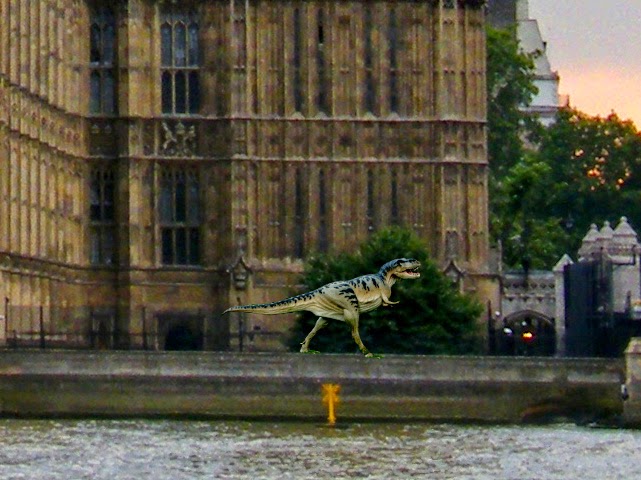
Now, an adult Tyrannosaurus was only about 4 metres tall at the hip, so really, to be in proper scale, it would have to look more like this:


Can’t see it? It’s just about almost as tall as the clump of greenery there at the base of the tower:


So really, a very very long way away from what was depicted on screen!

As a final note, the last time Doctor Who depicted a Tyrannosaurus loose in London was in 1974’s serial “Invasion of the Dinosaurs”. Here’s what it looked like back then:


There’s obviously no contest in realism here (or in accuracy—we know so much more about these animals now than we did forty years ago!)

However—and this is the important point—notice that the 1974 Tyrannosaurus is depicted around about the right size! If anything, it looks very slightly too small for an adult, maybe around 3 metres at the hip. So perhaps this one was a juvenile?


All images from Doctor Who are copyright BBC. I assert that my use here is fair dealing for the purposes of criticism and review.

My composite images of the correctly-scaled Tyrannosaurus against the clock tower are made from an image of the clock tower by Adriano Aurelio (via Wikimedia Commons under a Creative Commons CC-BY 2.0 licence) and an image of a model Tyrannosaurus by User Pibwl (via Wikimedia Commons under a CC-BY-SA 3.0 licence). I release this composite image under a CC-BY-SA 3.0 licence.


Saturday, 23 November 2013

Doctor Who: the latest missing episode recovery rumour

TL;DR version: the Mirror is reporting a rumour that the 1st season Doctor Who story “Marco Polo”, currently missing from the archives, has been recovered. I think there are good grounds to believe the rumour and speculate that the episode has come back from Africa with a locally-produced dubbed soundtrack in a language other than English. Detailed analysis follows:


Today, the Mirror is running the story that the seven episodes missing from the first-season Doctor Who story “Marco Polo” (that is, the entire story) have been recovered and will be announced by the BBC as part of the show’s 50th anniversary celebrations.

Rumours of the return of missing Doctor Who episodes are practically unending in fandom, fuelled by a demonstrably inexhaustible supply of wishful thinking. For anyone who’s been paying attention to these for more than a few years, the reaction is usually “I’ll believe it when I see it”. Maybe I’m feeling especially credulous right now because the Mirror was the first mainstream news source to tip the return of nine 5th season episodes about a week before the BBC made an official announcement last month, but there’s something about this story that has the ring of truth about it for me.

The Mirror’s version of events this time around is that the source of “Marco Polo” is:
“a fan who enthusiastically recorded the episodes ... directly from the television onto a 16mm film camera.... The recording - which is a silent film - came out really clearly so it will be easy to watch.... There are already audio recordings of the episodes so the Beeb have had to match everything up. There are some gaps in the audio so it has been a painstaking process.”
There are significant problems with this version of events:
  1. Domestic home-movie cameras were certainly available in 1964, but their film magazines lasted only a few minutes: a typical 100-foot roll would be finished in a little under 3 minutes of shooting. 
  2. Short clips from early Doctor Who stories have indeed been recovered from a fan who shot these snippets on an 8mm camera. These snippets show heavy distortion and flickering. This is to be expected from the technical limitations of this approach, which include the distortion inherent in early television picture tubes, and a mismatch between the frame rate of the TV signal (50 frames-per-second) and the movie camera (24 frames-per-second). Even if somebody had a home-recording of Marco Polo on the technically superior 16mm format, it would still suffer from the same limitations as the 8mm material previously recovered and be in no way “really clear” and “easy to watch”.
 Against that, it also includes elements of truth:

    1. The BBC does hold audio copies of all seven episodes of “Marco Polo”. At least two fans, David Holman and James Russell, had independently made off-air audio recordings of these episodes. 
    2. Of the two sets of recordings, Holman’s are far higher-quality, but, like the Mirror report states, do contain some gaps. Holman edited out the opening and closing titles of the episodes, and the brief reprises of the action that took place at the start of each episode to recap the action of the previous week’s episode. Additionally, Holman’s recording of episode 7 (“Assassin at Peking”) is missing around ten seconds.
    3. Restoring these vintage, amateur audio recordings is challenging because of technical limitations of the original equipment. For example, the speed at which the tape ran through the recorder might not have been exactly to standard, meaning that the recording was slightly faster or slower than real-time. The speed could also vary within a particular tape, due to the changing tension in a reel of tape when it was empty compared to when it was full, as well as the stretchiness of individual tapes. When remastering these episodes for CD release, the Doctor Who Restoration Team has had to make best guesses about the the tape speed, and the results can be approximations only. Attempting to “match everything up” between this audio with a film print would indeed be challenging and “painstaking”.
    4. 16mm recordings of early Doctor Who were indeed made—not by fans, but by the BBC itself for foreign TV stations. The show was originally produced on 2” videotape, but that equipment wasn’t widely available in the BBC’s export markets, so the episodes were transferred to 16mm instead. It is these film recordings on which all 1960s Doctor Who survives—every single one of the videotape masters was erased (and re-used) a long time ago.
    One missing piece of the puzzle: if we assume that 16mm recordings of “Marco Polo” have been recovered, why would they need to be re-synched to  amateur-made audio recordings?  The BBC telerecordings were all sound film, with the audio tracks present right there optically on the film print itself. One obvious possibility is that the the recovered prints are not of the English originals, but are dubs into another language. Past recovery efforts have yielded prints in at least Arabic and Spanish, but in every one of these previous cases, English-language prints were already known to exist. Admittedly, though, no known dubs were made of Marco Polo, and indeed, the special “sound effects and music only” prints on which foreign TV stations relied to dub programs into a local language were never produced for “Marco Polo”. [Afterthought: actually, on further reflection, it seems to me more likely that the need to re-synch the soundtracks is simply a red herring: a case of confusion of the recovered material with the fan-made off-air audio recordings.]

    Complete prints of “Marco Polo” were sent to no fewer than 23 countries at one time or another, but not every country got a fresh print. It was normal practice for the BBC to send out prints to one country after another country had already screened the material and returned it. Matching up the known movements of these prints suggests that probably 10 sets existed for “Marco Polo”: The Destruction of Time website has a great summary.The last known prints in existence were in Ethiopia, where the story was transmitted in 1971. Each of these 23 countries broadcast the story in English.

    Recent Doctor Who recovery efforts have centred on Africa, and the Mirror specifically (but impossibly) named Ethiopia as the source of the Trougton material recovered last month.

    Putting it all together:


    Speculation:

    • “Marco Polo” has indeed been recovered.  
    • It exists as a professionally made, 16mm telerecording. 
    • The print is a second-generation print made with a locally produced soundtrack in a language other than English. 
      • Revised opinion: the print is in English and (apart from maybe the need to patch up a damaged audio track here-or-there, there's no need to re-sync the print with the existing off-air audio recordings.
    • The print comes from Ethiopia, and the dub is in Amharic.

    As always, time will tell!


    Thursday, 10 October 2013

    Early Doctor Who: What's Missing?

    Just how much early Doctor Who is missing? A lot!
    I'm very much looking forward to this infographic being out of date tomorrow!
    And here it is!
    As I predicted earlier in the week, the find was a batch of season 5 episodes discovered in Nigeria.


    Monday, 7 October 2013

    What are the newly-recovered Doctor Who episodes?

    Updated 8 Oct

    For a few months now, persistent rumours have been circulating among Doctor Who fandom of the return of a huge cache of episodes that are presently not held in the BBC archives (the so-called ‘missing episodes’ or ‘lost episodes’) from somewhere in Africa. How huge? Rumours varied from around a dozen or so up to 90 of the 106 episodes. The rumours reached their peak in June, fuelled by customs evidence of 3 tonnes of archival material being imported into the UK from Nigeria by a noted film and TV archivist, and then diminished again when the archivist released a public statement that the material had no Doctor Who among it.

    Still, the rumours never completely went away, and denials by the BBC and people connected with it tended be to very coy and carefully worded—of the “There are always rumours and speculation about Doctor Who missing episodes being discovered, however we cannot confirm any new finds” variety.

    “There are always rumours and speculation about Doctor Who missing episodes being discovered, however we cannot confirm any new finds,”
    Read more at http://www.thedrum.com/news/2013/06/20/bbc-cannot-confirm-recovery-lost-dr-who-archive#LfHMLVx7K5jjtJTW.99
    “There are always rumours and speculation about Doctor Who missing episodes being discovered, however we cannot confirm any new finds,”
    Read more at http://www.thedrum.com/news/2013/06/20/bbc-cannot-confirm-recovery-lost-dr-who-archive#LfHMLVx7K5jjtJTW.99
    Then, yesterday, The Mirror newspaper ran a story claiming that all 106 episodes had been recovered from Ethiopia, and this morning, the Radio Times reports that the BBC will make two newly-recovered stories available for sale on Wednesday. The Radio Times went on to say that these stories are “believed to be from the Patrick Troughton era” (second Doctor, seasons 4–6) and that “It is understood that other episodes have also been found”.

    Subsequently, The Mirror reports that the announcement of the missing material has been postponed to the end of the week.

    So what might have come back?


    I've put together a spreadsheet to show the countries to which each of the stories that contain one or more missing episodes were sold, based on the amazingly detailed research shared on the BroaDWcast website. I’ve also included a few annotations:
    • cells with grey dates indicate that the print used for that broadcast is recorded as having left the country afterwards (although in at least one case, a print turned up in Australia even after being recorded as returned to the UK).
    • cells with dates struck out indicate that the print used for that broadcast is recorded as specifically having been destroyed. In reality, it’s likely that most of the prints sent to New Zealand were actually destroyed there, even if specific records have not been found for this.
    • cells with dates in square brackets indicate that the story was viewed by TV executives or government censors in that country, but it was not actually broadcast. 
    • cells with dates in bold indicate the last known transmission of that story.
    • columns in green indicate countries in Africa, the continent to which recent rumours consistently point.
    • story titles in blue are those which I feel there is some reasonable possibility that they could be among a hypothetical trove of episodes retrieved from Africa.

    Assessing the rumours


    For a start, it’s simply not credible that all 106 missing episodes have been found anywhere in Africa. In the 1960s, Doctor Who was produced on 2-inch videotape; an expensive resource that had the virtue of being reusable when its contents were no longer needed. The fact that any Doctor Who from the 1960s and early 1970s has survived at all is due to the BBC’s sales of the show to overseas broadcasters. The BBC was one of the world’s early adopters of videotape, a technology that very few of its foreign customers had in the mid 1960s. Therefore, to sell the show abroad, its sales division, BBC Enterprises, had to transfer the videotape masters to film (usually 16mm, but occasionally 35mm) with a process called telecine: a film camera was pointed at a special, flattened television screen, and filmed whatever was played from videotape. At the other end, the foreign TV station would reverse the process: projecting the 16mm film print onto a screen and pointing a television camera at it for live broadcast! Usually, multiple sets of film prints would be made from the one set of negatives so that BBC Enterprises could send prints to multiple customers simultaneously (although some customers would sometimes have to wait until another customer was finished with their set and could send them on).

    Of the 106 episodes not publicly known to be present in the BBC archives today, one episode (“The Feast of Steven”, episode 7 of the serial The Daleks’ Masterplan) was a Christmas novelty episode and was never transferred to film because its foreign sales prospects were deemed non-existent. Therefore, when its master videotape was wiped (as they all were by 1974), we can say that it was gone for good. We’re now down to 105 episodes that could conceivably come back from somewhere in Africa.

    Beyond that, prints of the remaining 11 episodes of The Daleks’ Masterplan plus its “teaser” episode Mission to the Unknown, were only made for one country (Australia). It’s therefore very unlikely that the 9 mising from these 12 would be among any stories recovered from Africa if that’s indeed where any recent finds came from. (Down to 96)

    Similarly, only three foreign countries showed William Hartnell’s last story (The Tenth Planet) and Patrick Troughton’s debut (The Power of the Daleks): Australia (which records returning its prints of these stories to the BBC in 1975), New Zealand (which forwarded its prints to Singapore in 1972), and Singapore. So it’s pretty certain the 7 episodes missing from these 10 can’t be among any hypothetical African treasure trove. (Down to 89)

    The number of prints of The Evil of the Daleks is a little less certain. Four countries showed it. One print went to Australia in early 1969 and is recorded returned to the UK in 1975; this seems to be a separate print from the one that aired in other countries. The story  also aired in Hong Kong and Singapore later in 1969 and in New Zealand in 1970. The New Zealand print is recorded as destroyed in 1974. So there was at least one, probably two, and maybe even three more prints made of this story (Singapore and New Zealand sometimes exchanged prints, as we’ve already seen), but none went anywhere near Africa. (Down to 83).

    By the early 1970s, only two African countries were left buying Doctor Who in black-and-white: Nigeria and Zambia. By that time, Nigeria seems to have been getting its prints from New Zealand: film prints recovered from Nigeria bear cuts made by the New Zealand censorship board, and when New Zealand did not buy and show a particular story, Nigeria did not either. New Zealand did not buy Fury from the Deep (perhaps because its theme of monsters attacking oil rigs was not helpful to a government trying to close a major offshore natural gas deal at the time) and in fact, stopped buying the show after this season (season 5), meaning that the penultimate story of season 5, The Wheel in Space was the last that Nigeria got of the black-and-white years. The circulation of prints into Zambia is less certain, but whatever their source, BBC records indicate that the final batch of Patrick Troughton episodes screened in the country was the first half of season 5 and the second half of season 6. Therefore, Fury from the Deep didn’t screen in Zambia either, and neither did The Invasion, which, coming in season 6 was after New Zealand and Nigeria had stopped buying the show. Therefore, the 8 episodes missing from these 2 stories are unlikely to turn up in Africa, I think. (Down to 75).

    Speculation on what exactly might have been retrieved depends on which individual chunk of the rumour you privilege:

    Episodes found somewhere in Africa

    This part of the rumour is common to all its incarnations, I’m basing all speculation on this part being true. If we remove the Africa constraint, then all kinds of other possibilies open up, but such speculation is completely baseless: “90 missing episodes found in basement of eccentric billionaire film collector in Sussex!” Sure, but there’s really no way to guess what that might include.


    Some huge number of episodes found: most of what's currently missing


    If there really is a huge hoard of these episodes, Zambia is the only realistic source: in fact, of the 75 episodes that could conceivably be found in Africa, prints of all 75 were certainly in that country at some time, and there doesn't seem to be solid records of them having been sent on to other countries, sent back to the UK, or of being destroyed. In fact, it’s the one country in the world in which such a stash might have survived.

    However, Zambia isn’t mentioned in any version of the rumour.

    Episodes found in Nigeria

    Nigerian archives had already been searched for missing episodes in the 1980s. That aside, if a stash of episodes turned up there, they are likely to be the ones missing from Hartnell’s first two seasons, or from season 5 in Patrick Troughton’s time. It seems that Nigeria is the last place on earth to have transmitted the season 5 stories. Furthermore, although the search in the 80s was prompted by a viewer’s remark that Nigerian TV was so far behind the times that it was still showing Patrick Troughton, the only stories recovered then were Hartnell stories.

    Episodes are Troughton stories

    If the stories to be released this week are indeed from Troughton’s time as the Doctor, as the Radio Times suggests, Nigeria and Zambia are both possible sources. The Troughton stories most likely to emerge from Africa are, in their original screening order:
    • The Abominable Snowmen
    • The Ice Warriors
    • The Enemy of the World
    • The Web of Fear
    • The Wheel in Space
    • The Space Pirates
    I can’t see any reason to think that any of these are any more or less likely to emerge from Africa than any of the others. They were all broadcast in Nigeria or Zambia in the early-mid 1970s, and one of those countries was the final known location of each of those episodes.

    Episodes found in Ethiopia

    I think this element of the rumour is so inconsistent with any of the other claims that I’m simply inclined to dismiss it. However, if this piece is true, it implies that: the haul of episodes is relatively small (11 missing episodes) and that the episodes come from the Hartnell era, not Troughton.

    Another possibility, though: the entire first two seasons of the show (81 episodes) have been recovered in Ethiopia, of which the BBC archives already holds copies of 70. Ethopia is the final known location for many of these episodes, and in particular, of all the episodes missing from seasons 1 and 2.

    Episodes found in Sierra Leone

    In The Mirror’s update of the story, Sierra Leone gets a mention. Like Ethiopia, this is inconsistent with Troughton material being recovered, but Sierra Leone would be a good source for Hartnell’s decimated season 3; the country was the last in Africa to broadcast these stories and it’s possible that the prints never left. On the other hand, Sierra Leone’s film and sound archives were destroyed in civil unrest in January 1999.

    Speculation

    Of course, I’m just guessing, but I think that starting on Wednesday and over the weeks leading up to the show’s 50th anniversary extravaganza,  we will learn that a substantial chunk of season 5 has been recovered from Nigeria, probably a mix of episodes that the BBC already has, plus many that it doesn’t.

    I’d like to hope its the “Zambia 75” instead though!


    Saturday, 11 August 2012

    Essential Doctor Who — the classic series

    Ever since I wrote my newcomers’ introduction to Star Trek, I felt I really should do the same for Doctor Who.

    I came to the new, 21st century version of the show as a long-standing fan of the classic 1963–1989 series, but it’s clear that the new series has many viewers who aren’t that familiar with show’s previous incarnation. If you’re among them, and you’re curious, it’s principally to you that I offer this suggested viewing list.

    I have selected:
    • one story from each of the first eight Doctors (in the new series, Christopher Eccleston was the ninth, David Tennant the tenth, and Matt Smith the eleventh Doctors). 
    • stories that pair each of those Doctors with the companions with whom they’re most closely remembered.
    • stories that reflect the typical length of four 25-minute segments (I made one exception).
    • stories that showcase some of the series’ recurring villains, although none more than once each (again,I made one exception).
    Note that the structure of the classic series was significantly different from that of the new one. Although the exact figures changed over the years, for much of the show’s history, a typical season consisted of around five or six individual storylines, each told in around four to six 25-minute episodes. Each episode (up to the last) within a storyline would conclude with a cliffhanger intended to bring the audience back next week. Early seasons of the show included considerably more stories and more individual episodes; later seasons considerably fewer of both.

    Watching these stories now, with the individual episodes back-to-back often seems to produce a little awkwardness; the pacing of the storylines is a little off-kilter. All we can do today to mitigate that is to remind ourselves that they were not constructed to be watched this way, and to extend a little understanding to the show’s writers and producers.

    My recommendations then:

    1. “The Aztecs”
      (4 × 25-minute segments, black & white, season 1, 1964, with William Hartnell as the first Doctor)
    2. “The Tomb of the Cybermen”
      (4 × 25-minute segments, black & white, season 5, 1967, with Patrick Troughton as the second Doctor)
    3. “The Claws of Axos”
      (4 × 25-minute segments, colour, season 8, 1971, with Jon Pertwee as the third Doctor)
    4. “Genesis of the Daleks”
      (6 × 25-minute segments, colour, season 12, 1975, with Tom Baker as the fourth Doctor) 
    5. “Kinda”
      (4 × 25-minute segments, colour, season 19, 1982, with Peter Davison as the fifth Doctor)
    6. “Vengeance on Varos”
      (2 × 45-minute segments, colour, season 22, 1985, with Colin Baker as the sixth Doctor)
    7. “The Curse of Fenric”
      (4 × 25-minute segments, colour, season 26, 1989, with Sylvester McCoy as the seventh Doctor)
    8. “Doctor Who”
      (90-minute TV movie, colour, 1996, with Paul McGann as the eighth Doctor)

    As with my previous Star Trek article, I’d love feedback from anyone who follows this recommendation.

    Update 30 March 2013: Today, The Guardian published an excellent infographic today as a one-page summary of the show’s 50-year history (classic and new eras)—well worth a look.