Showing posts with label computer games. Show all posts

Thursday, 1 January 2015

My favourites and least favourites of 2014

Here’s a round-up of the things I liked and the things I didn’t in 2014:

Books

Per Goodreads, here’s a list of what I read in 2014. I only got through 41 out of the 50 books that I had challenged myself to. Among them were three books that I absolutely loved: Dahlgren, The Fiftieth Gate: A Journey Through Memory, and Colorless Tsukuru Tazaki and His Years of Pilgrimage. Of these, I was amazed by the first two books as much as anything that I’ve ever read, and being so very different, I find it impossible to chose a favourite between them. Dahlgren is a long piece of surrealist paranoia that is experienced as much as it is read. My Goodreads review of it here. I found it to be one of those books that stretched my understanding of what an author could do with a text. The Fiftieth Gate: A Journey Through Memory is a work of memoir that touches one of the darkest chapters of human history, but also explores really complex ideas of memorialisation and of ownership of the past. I haven’t read many books that I have found both emotionally wrenching and intellectually stimulating. This is such a book; my Goodreads review is here.

The book I enjoyed least was Insites: The Book, which I didn’t even finish reading (very rare for me). I found it utterly vapid: my review is here. Other books from which I derived no pleasure this year were David Vann’s Goat Mountain [review] and, astonishingly to me, Stephen King’s The Gunslinger [review].

Live music

I didn’t get out much in 2014, and so I don’t have much to discuss here. I think I only made it to two performances! I enjoyed both of them: The Audreys touring their new album, ’Til My Tears Roll Away, and Early Music Queensland’s programme of late baroque music, Musicalischer Circul. Obviously two very different shows! However, the Audreys performed with a polish absent in the other show, and I enjoyed theirs more.

Albums


I didn't listen to much new music in 2014 either, but I liked ’Til My Tears Roll Away more than anything else I heard. It does fall squarely into the “more of the same” category from The Audreys rather than explore anything new, but because I happen to like the sound of their previous albums so much, I’m perfectly OK with that!

The big disappointment for me was Ella Hooper’s solo debut, In Tongues. This was a surprise, since I liked Killing Heidi and The Verses so much. It was a shock to discover that there wasn’t a single track on this album I could connect with. 

Theatre

I only saw two plays in 2014: Queensland Shakespeare Ensemble’s The Tempest, and La Boite’s production of Kathryn Marquet’s Pale Blue Dot. I find it impossible to choose between these: one is my favourite of Shakespeare’s plays, performed with the tremendous energy and enthusiasm that QSE always brings to their work, and the other was a delightfully nutty yet thoughtful piece superficially about alien abduction, but really more about belief and trust. Both were outstanding.

Movies

The eight movies I watched in 2014 make it perhaps the leanest year for film for me in decades. This was mostly through not having easy access to Apple TV for a large chunk of the year, my main movie- and TV-watching platform these days. Out of what I saw, the highlight was very definitely The Cabin in the Woods, which I enjoyed for its cleverness and Whedon’s evident love of his material. This latter element is something I find lacking in so much mainstream film and is one of the things that draws me to low-budget, amateur film so much. My review is on IMDb.

The film I liked least in 2014 was Interstellar. To explain why, I’ll just recycle the summary I wrote for my IMDb review: I found it to be a film of interesting images, breathtaking visuals, and little consistency or sense.

TV

Early in the year, I heard a lot of buzz around True Detective, and although it very much sounded like not my thing at all, I gave it a try and loved it! Partly, I was drawn to the show’s brooding intensity and bleakness, but there was another element that elevated it to becoming one of my favourite pieces of TV ever. That element is a major spoiler, so I won’t discuss it here, but will instead direct curious readers to my review on IMDb. I'll also mention Broadchurch as another show that defied and grossly exceeded my expectations (and to which I also gave a ten-star rating on IMDb).

In 2014, I continued to sample a wide range of TV in search of new things to enjoy from the last 20 years or so that I’ve been mostly tuned-out to television. Predictably, this turns up a lot more misses than hits. The low-tide mark for my enjoyment of a show during the year was that time I sampled two excruciating episodes of Bob’s Burgers. I have absolutely no idea why so many people find this funny.

Computer games

I played only two computer games in 2014: Papers, Please, and Qwirkle. I really liked the idea and implementation of Papers, Please and could imagine myself getting quite addicted to it, given the opportunity. I haven’t invested the time to discover if that’s actually true though. Qwirkle is a computer implementation of an award-winning boardgame, but I’ll mention it here because I’ve only sampled the computer version. I like it a lot and am definitely addicted. Like most of the board games I enjoy, its mechanics make it appear deceptively simple, but there’s deep strategy to the game that I am very much still learning.

Role-playing games

After a long time, I liked the opportunity of trying out a couple of new games this year. My favourite (of a field of two!) was definitely the new, 5th edition of Dungeons & Dragons. (Note that “editions” of D&D are largely new games with fundamentally different and incompatible sets of rules.) I documented my initial reactions to the game elsewhere in this blog, and I’m glad to report that my positive impressions have persisted as I’ve continued to play it. I like this better than any edition of D&D since 2nd ed in 1989.

I’m less sold on Trail of Cthulhu. This game features a computer-game-like mechanic of ensuring that before leaving a scene in the story, the player-characters always receive the clue that will advance the plot to the next scene. I understand (and relate to!) the problem that this mechanic is designed to address, but the end result feels a bit too much like a “ghost train” to me. That said, I’d still choose to play Trail of Cthulhu ahead of many other games.

Things that I didn’t do in 2014

Things I normally enjoy but didn’t get to do in 2014 include:
  • see a dance performance
  • go to the opera
  • play board games
Hopefully, I’ll get to do more of those in the new year :)


Tuesday, 31 December 2013

My favourites and least favourites of 2013

Shamelessly “inspired” by my friend Lucas Costi’s post on a similar topic, here’s a list of some of the stuff I liked most and least this year. I quite specifically make no representation about the quality or otherwise of any of these things: their inclusion here signifies nothing other than how much or how little I personally enjoyed them.

Books

Per Goodreads, here’s a list of what I read in 2013. I only got through 32 out of the 50 books that I told myself I’d read this year, but there were some wonderful things in there. It’s not a new publication, but the book I enjoyed most was Jeffrey Eugenides’ Middlesex: intelligent, lyrical, and surprising. My review is on Goodreads.

The book I enjoyed least was Intrusion by Ken MacLeod. I felt it was a senseless squandering of some genuinely interesting ideas, that only got worse the longer it went on. My review is here. It narrowly beats out Christopher Gerrib’s The Pirates of Mars, because at least that book stuck to what it set out to do and didn’t change horses in mid-stream.

Dance

I only went to one dance performance this year: Project Rameau by the Sydney Dance Company. I was amazed by how much I enjoyed the juxtaposition of modern dance with the stately elegance of Rameau’s music. “Favourite” is meaningless in a field of one, but I loved this.

Live music

I think the only live music performance I went to this year was the Badinerie Players’ Concert of French- and Italian-Style Baroque Music at the ABC studios. I really love this ensemble, and am very disappointed that while researching the above link I found that they performed twice in November and I never knew about it! I would totally have gone to that!

Theatre

Another single-entry category. My one excursion to the theatre this year was to Queensland Shakespeare Ensemble’s A Midsummer Night’s Dream, which I enjoyed as much as I usually enjoy this company’s work—which is to say, very much indeed!

Movies

I didn’t watch many movies this year. Of that small bunch, Gravity is the one I liked most; my review is on IMDb. In short, I found it incredibly beautiful and moving.

By a long margin, the movie I liked least in 2013 (and one of the films I enjoyed least out of everything I’ve ever sat through including a low-fi, low budget feature film of some Korean teenager SMSing his friends) is J.J.’s Space Adventure II, aka Star Trek Into Darkness. My review is elsewhere here on my blog, but in short, I found it a mediocre (at best) action film, poor science fiction, and practically unrecognisable as Star Trek. Fail.

TV

2013 saw me continue my survey mission to seek out shows I might enjoy out of what has been broadcast in the 20 or so years since Star Trek: The Next Generation ended. The results have been very hit-and-miss, but I was blown away by the one episode of Rome that I trialled. I am just itching to return and watch this series through!

For sheer oh-my-God-stop-this-now hatred, I immediately point to Louie. Not only did I find this horribly unfunny (pretty much a deal-breaker for a comedy for me...)  but the smugness of its central character actually made me angry. Every minute of watching this was unpleasant for me.

Board games

I just realised with horror that I played a grand total of only two new board games this year: Red November and A Game of Thrones. That’s too few to rank a most or least favourite, but I found both games quite fun.

Computer games

I also tried only two computer games in 2013, and really enjoyed both, even if, again, this doesn’t make for a meaningful “most favourite” and “least favourite”. One was XCOM: Enemy Unknown, for which I wrote a long review here on my blog. The other is a relatively recent discovery: Fsim Space Shuttle, which I’m still struggling with, but it feels like a worthy challenge! I’m sure I’ll review it in due course :)


So there it is. Clearly, I need to make more effort to get out more in 2014! Although, that said, I don’t feel like I missed out on anything this year that I knew was on but didn’t get to.


Sunday, 25 August 2013

I liked another computer game!

Screenshots in this article are copyright © 2012 Take-Two Interactive Software Inc. and are used here for the purpose of review.

For the last month or so my reading and blogging activities have fallen way behind schedule. Why? Because I've been addicted to a computer game! This is only the second time this has happened since 1995. The last time was Red Wasp Studio's Call of Chulhu: The Wasted Land in 2012 [my review]. This time, it was XCOM: Enemy Unknown from Firaxis Games: a game so addictive it consumed almost my every free moment until I finished it.

Dealing with the alien threat to Brisbane!

Both Call of Chulhu: The Wasted Land and XCOM: Enemy Unknown are specimens of the turn-based strategy genre, one of my favourite types of computer game and one that has been sadly out of fashion for many years now. Moreover, while I thought that Call of Chulhu: The Wasted Land was based heavily on the 1994 turn-based-strategy classic UFO: Enemy Unknown, XCOM: Enemy Unknown is a straight reboot of that game. Therefore, I'll share a few thoughts on the game itself and also on how I feel it stacks up to its progenitor (and no spoilers until the very end—I'll warn you beforehand anyway.)

The premise of the game is that you command XCOM—a multi-national effort to rid Earth of hostile aliens that are dropping in. You play it on two levels: strategic and tactical. 

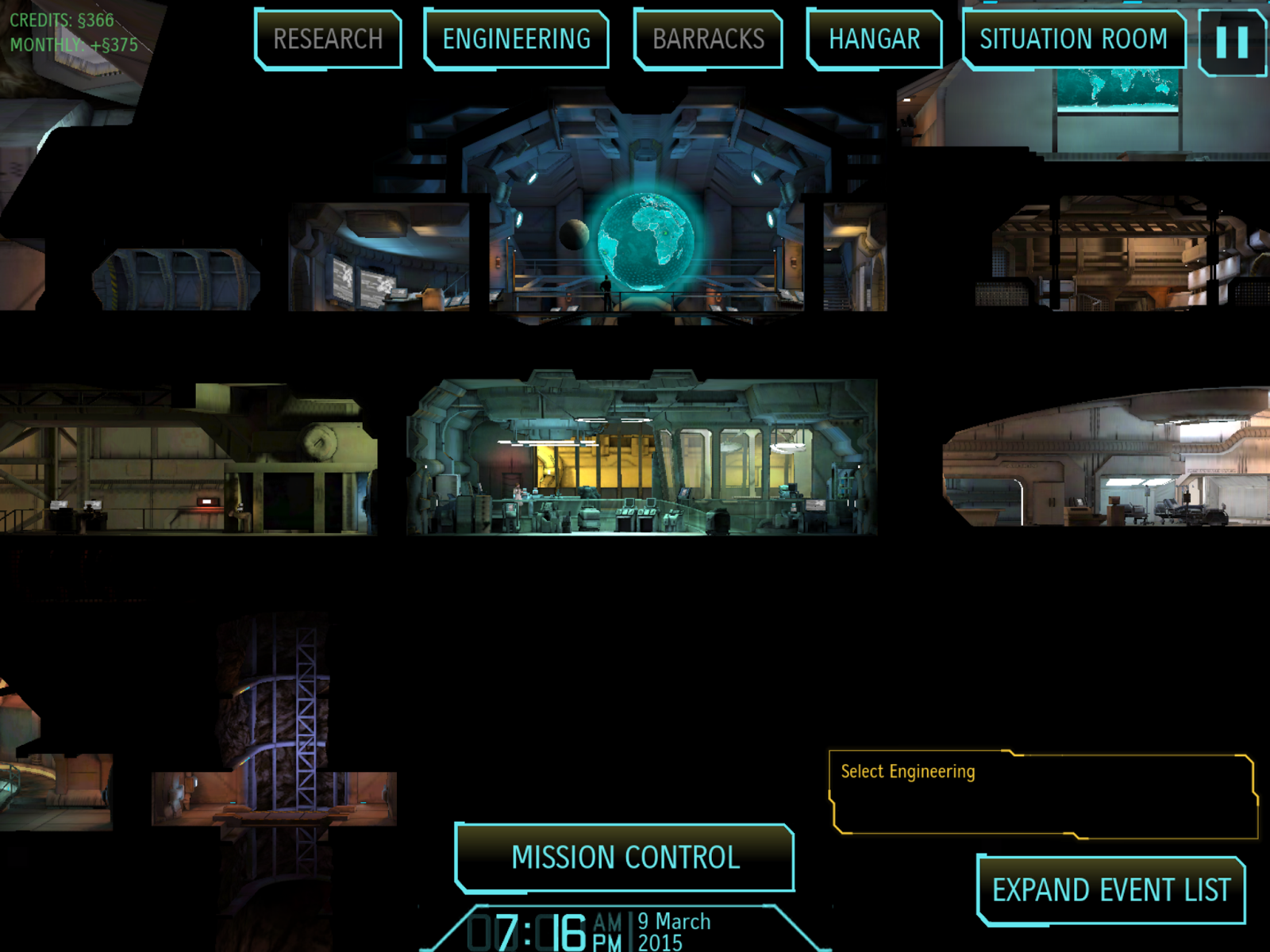
At the strategic level, you are responsible for directing XCOM's research efforts, purchasing or manufacturing equipment to arm the organisation's aircraft and ground troops, and deciding which missions XCOM should take. This is largely a resource-management game, as you slowly build out XCOM's base and expand the organisation's ability to counter ever-more hostile aliens.

The 'antfarm' view of the XCOM base,
showing the various menus

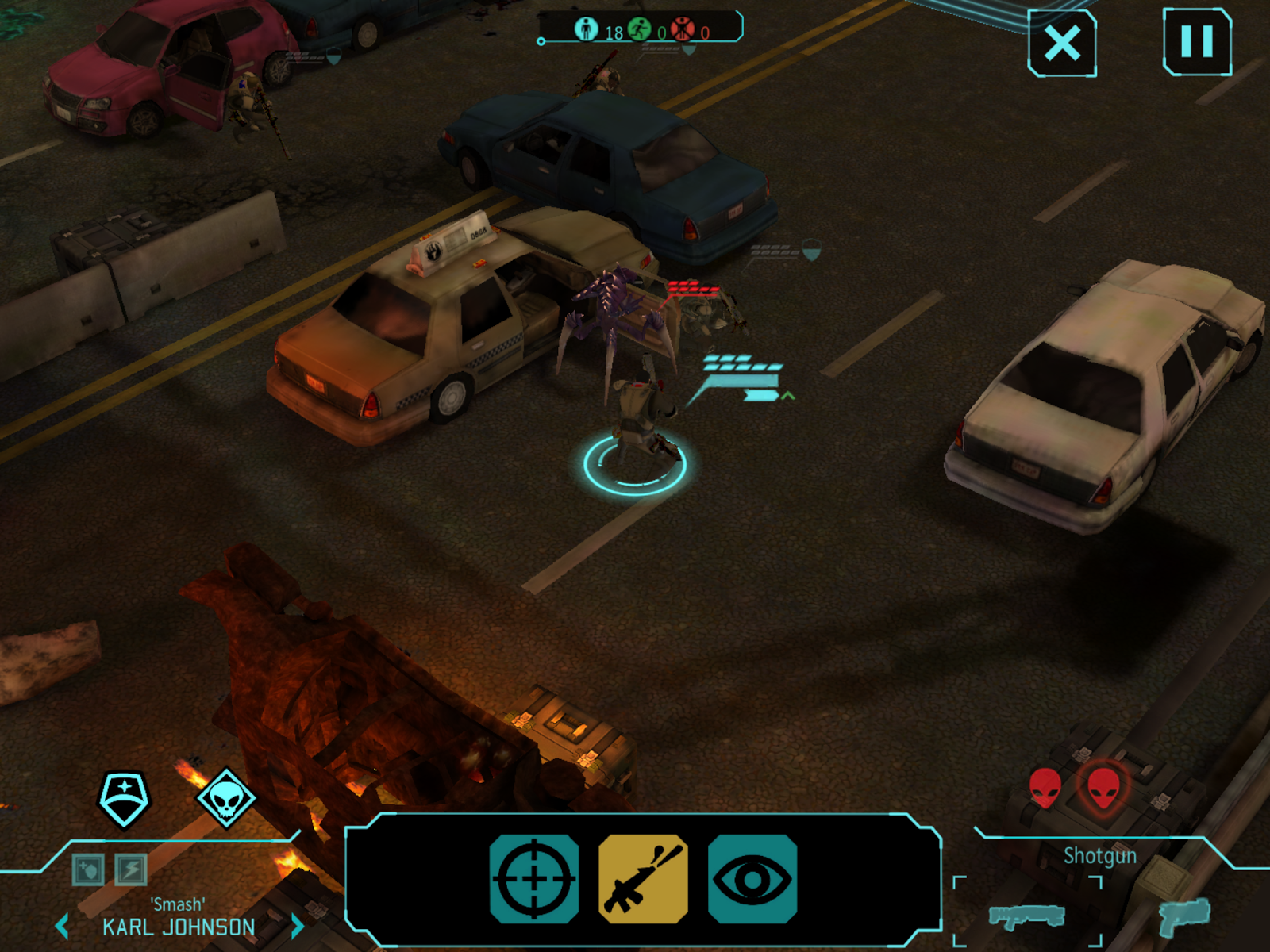
At the tactical level, you regularly lead small squads of soldiers (initially, four) on missions to kill aliens infiltrating Earth's cities or lurking around UFOs that have ended up on the ground in some remote place—either because the aliens landed there or because your interceptors have shot them down. Successful missions get you alien technology and alien beings (dead or alive) to bring back for research.

An XCOM soldier in the midst of
a close encounter. Should be fine.

If you haven't played turn-based strategy before, it would be easy to mistake the screenshot above for a real-time strategy game where your soldier and the alien are fighting it out as you watch. However, in this kind of game, you cycle through your soldiers one at a time, moving them and firing their weapons. Then, the aliens get their turn to move and fight. Think of it like chess. Basically, in the course of a turn, each of your soldiers can:
  • move (dash) the full range of their allowed distance on the battlefield
  • move half their allowed distance, and perform an action (typically, defer shooting until the aliens' turn)
  • fire a weapon
Certain weapons and certain skills available to your soldiers vary this a little, but that's the starting point.
    You can only see a limited amount of the battlefield at a time. As your soldiers move, more and more is revealed, including wherever it is that the aliens are hiding out. The battlefield is also provided with all kinds of obstacles that serve as cover of varying degrees behind which your soldiers and their opponents can shelter.

    Moving slowly and cautiously is essential. Soldiers left standing around out in the open at the end of your turn are just asking to get shot: and one or two shots is usually all it takes to get killed at most stages of the game (yes, you have the opportunity to research better armour for your troops, but as the game progresses, the aliens you encounter tend to be more powerful and better armed).

    As your soldiers gain experience, they specialise into assault troops, heavy troops, support troops, or snipers; each with access to a different set of skills and equipment.

    Successful completion of certain missions along the way advances a storyline that culminates in a final showdown with the aliens and ends the game.

    I love the slow, thoughtful pace of this game. I love that success relies on smart strategy and sound tactics rather than how fast and how accurately you can click a mouse or mash buttons on a controller. Finally, I love the setting and feel of this game: very well realised (although I'd probably fall in love with any turn-based strategy game of this level of quality, regardless of setting!)

    If you've never tried turn-based strategy before, I highly recommend this game as a starting point. No, it's not cheap, but wow, does it deliver bang-for-buck! Really, when a game is the best in its class, you don't mind paying more for it, right?

    For anyone who remembers (or is curious about) how the game stacks up to its forebear, read on.


    How does it compare to the original? Well, obviously, the graphics are better, as you would expect for two games with nearly 20 years between them:

    19942012 (like this comparison
    even needed captions...)

    The gameplay itself is... different. This is by no means a straight remake of the older game. I can probably summarise the entire set of differences by saying that XCOM: Enemy Unknown plays like a slightly more abstracted UFO: Enemy Unknown. By that, I mean that the most obvious differences to me are the way that many, many pieces of micromanagement are absent from the new game:
    • Your squad size starts at four and eventually grows to six, compared to the original's fourteen growing to twenty-six. Turns are therefore much shorter and you don't have to keep the whereabouts of nearly so many soldiers in mind.
    • While in both games, soldiers need to stop and reload most weapons from time-to-time, soldiers in the new game carry an unlimited number of clips for almost all weapons. You don't need to fret about how much ammunition to bring.
    • Soldiers' carrying capacity is far more limited: you only get two weapon slots, an armour slot, and an item slot to play with. In the classic game, soldiers had a variety of differently-shaped spaces in their belts and backpacks to carry a larger number of more varied things. 
      • Moreover, because it was easy to exchange items between soldiers, you could have one soldier carry ammunition for another's exotic weapon. Soldiers cannot exchange equipment in the new game.
    • You only build one base. You don't need to keep track of which soldiers and which equipment is located where. Also, storage space is unlimited and barracks space practically so. It also seems that the aliens never try to invade your base, so layout is mostly irrelevant (although some facilities get bonuses from co-location with similar facilities).
    • The classic game had a few weapons that could fire a variety of ammunition for a variety of effects. This is all but gone in the new game (the rocket launcher can eventually fire a new type of missile as a specific upgrade).
    • Having to complete a mission at night used to be significantly more difficult than during the day. You would therefore try to time your troops' arrival at the site for daylight hours if at all possible, and to see any distance required your troops to carry and throw out flares. While the new game can depict a battlefield at day, night, or dawn/dusk, that depiction seems to have no relationship to local time when you land, or actually have anything but a cosmetic effect: it doesn't affect visibility to any degree.
    • The economics are very different. While various nations might occasionally want to buy some artefact from you, setting up and managing production lines of profitable items is no longer a strategy.
    • The classes of soldiers seem to make a game mechanic out of what many players seemed to do as a micromanagement task in the old game anyway. In UFO: Enemy Unknown, you soon learned who were your best shots, and used them as snipers; you learned who were the strongest and gave them heavy weapons. The game now manages this for you. 
      • Soldiers also differed markedly in their stamina and strength, and pushing them too hard affected them. This subtlety is missing in XCOM: Enemy Unknown.
    • Most aliens don't actually spawn until one of your soldiers crosses a line on the map somewhere and catches sight of them. In almost every case, this assures that you will have at least part of a round of free shots at the alien before it can react. Or you can send soldiers to probe ahead, trigger aliens to spawn, then retreat to safety until the whole squad can open fire next round. You still need to move carefully in  XCOM: Enemy Unknown, but not quite as carefully as when every step could be your soldier's last at the hands of an alien hiding unseen somewhere (or ambushing you as soon as you stepped off the Skyranger's ramp!)
      • For that matter, missions now start with your troops already deployed and with good vision of the battlefield. No more shenanigans of an alien grenade or Chrysalid loose on a still-packed transport!
    • Aiming is much more automated. Friendly fire from aimed weapons seems to never happen (and area-of-effect weapons show you precisely what area they will affect and warn you if there are friendlies inside the zone).  This also means you can't use aimed weapons to deliberately shoot out bits of cover. Now it's just click a weapon, click an icon for any of the aliens in your soldier's line of fire, then click fire...
      • Maybe the single most different-feeling feature is the mechanic of moving your soldiers. In the old game, each soldier had a certain number of time units available per turn, and you could spend them on whatever actions you wanted in whatever order you wanted. And everything cost time units, including changing weapons or getting out an item to ready it for use. The new game's more limited choices of action abstract this considerably.
      That's quite a list! But it would be a mistake to think of this abstraction as just a "dumbing down". Yes, there is far less micromanagement, and you probably won't be keeping sheaves of handwritten notes about which soldier is which on which base, and which base needs to transfer which items to which other until the new storeroom is complete, or which date to expand the laser-cannon production line. Nor will you have the fun surprise of the soldier with low stats who you kept around for opening doors with a live grenade in their hand to see if any aliens were inside the building unexpectedly getting really good by surviving so long through dumb luck. (It's been nearly 20 years, but I still remember my brother's soldier Leon who started his career as a suicide bomber but eventually went all the way to Mars!) However, the game balance is still exquisite, it still rewards brains over reflexes on the part of the player, and it's still creepy yet addictive to play.

      I therefore happily recommend it as a worthy successor to the original game. I'll be honest and say that if the choice was simply between this game and a reimplementation of the old game with new graphics and controls, I would probably still prefer the old game. However, it's not a huge margin, and even having just completed the game, there is definitely a faint nagging at the back of my mind wanting to play it through again straight away!

      I want to make a couple of final observations about the game that contain spoilers, so if you're looking to avoid them, go away for now and come back when you've beaten the game at least once.


      The storyline is quite different from the original game, and contains some interesting notions. That said, there are no real surprises here, and the plot is just as linear as the old game's was.

      One feature that is common to both games is the massively anticlimactic ending! In both, you fought hard to discover the nature of the final mission that you had to undertake, then fight your way through a long and difficult level to confront the 'big bad'... which you would they dispatch with a single volley!

      By this stage of either game, it's probably safe to presume that any troops who make it through to the final showdown will be highly skilled and toting some pretty serious firepower. Just as a single volley of plasma fire from these dudes would kill the alien brain on Cydonia, a single volley of plasma fire dispenses with the Uber Ethereal on the Temple Ship:

      Australian sniper Sarah "Longbow"
      Walker drops the alien leader from
      all the way across the room...


      Frankly, this was a little disappointing, and the fact that it was as lame an ending as the original game was cold comfort.

      Still, that really is a very minor point in a game whose addictive qualities lie more in how tactical missions are executed than in its story as such. I still heartily recommend it!