Saturday, 11 August 2012

Essential Doctor Who — the classic series

Ever since I wrote my newcomers’ introduction to Star Trek, I felt I really should do the same for Doctor Who.

I came to the new, 21st century version of the show as a long-standing fan of the classic 1963–1989 series, but it’s clear that the new series has many viewers who aren’t that familiar with show’s previous incarnation. If you’re among them, and you’re curious, it’s principally to you that I offer this suggested viewing list.

I have selected:
  • one story from each of the first eight Doctors (in the new series, Christopher Eccleston was the ninth, David Tennant the tenth, and Matt Smith the eleventh Doctors). 
  • stories that pair each of those Doctors with the companions with whom they’re most closely remembered.
  • stories that reflect the typical length of four 25-minute segments (I made one exception).
  • stories that showcase some of the series’ recurring villains, although none more than once each (again,I made one exception).
Note that the structure of the classic series was significantly different from that of the new one. Although the exact figures changed over the years, for much of the show’s history, a typical season consisted of around five or six individual storylines, each told in around four to six 25-minute episodes. Each episode (up to the last) within a storyline would conclude with a cliffhanger intended to bring the audience back next week. Early seasons of the show included considerably more stories and more individual episodes; later seasons considerably fewer of both.

Watching these stories now, with the individual episodes back-to-back often seems to produce a little awkwardness; the pacing of the storylines is a little off-kilter. All we can do today to mitigate that is to remind ourselves that they were not constructed to be watched this way, and to extend a little understanding to the show’s writers and producers.

My recommendations then:

  1. “The Aztecs”
    (4 × 25-minute segments, black & white, season 1, 1964, with William Hartnell as the first Doctor)
  2. “The Tomb of the Cybermen”
    (4 × 25-minute segments, black & white, season 5, 1967, with Patrick Troughton as the second Doctor)
  3. “The Claws of Axos”
    (4 × 25-minute segments, colour, season 8, 1971, with Jon Pertwee as the third Doctor)
  4. “Genesis of the Daleks”
    (6 × 25-minute segments, colour, season 12, 1975, with Tom Baker as the fourth Doctor) 
  5. “Kinda”
    (4 × 25-minute segments, colour, season 19, 1982, with Peter Davison as the fifth Doctor)
  6. “Vengeance on Varos”
    (2 × 45-minute segments, colour, season 22, 1985, with Colin Baker as the sixth Doctor)
  7. “The Curse of Fenric”
    (4 × 25-minute segments, colour, season 26, 1989, with Sylvester McCoy as the seventh Doctor)
  8. “Doctor Who”
    (90-minute TV movie, colour, 1996, with Paul McGann as the eighth Doctor)

As with my previous Star Trek article, I’d love feedback from anyone who follows this recommendation.

Update 30 March 2013: Today, The Guardian published an excellent infographic today as a one-page summary of the show’s 50-year history (classic and new eras)—well worth a look.


Saturday, 26 May 2012

What should ebooks cost?

This week, a major publisher released a new novel by a popular and acclaimed science-fiction writer. Although the author is one I admire, and the book is one that I’m certain that I’ll eventually read, the aspect of the release that I found most interesting was the commentary it sparked on social media about the price of its ebook edition. It’s left me with some questions about how people perceive the price of ebooks. I’ll also confine these comments and questions to books as texts, rather than books as collectibles, because I think these are completely different markets. (And yes, I’m a book collector too).

I’m not going to refer to the book in question specifically, because it’s really not important. What’s important here is the price, which was set the same by both Amazon and Barnes & Noble:

hardback (full list price):$25.99
hardback (discount price):$15.63
ebook (for Kindle or Nook):$12.99? $18.14?

There was some uncertainty about the actual price of the Kindle edition, which seemed to display differently to different people on different pages on Amazon. That doesn’t matter. For now, let’s accept that the ebook cost $18.14—that is, $2.51 more expensive than the heavily discounted hardback edition (sans postage, but let’s ignore that too for now).

Two generally supported beliefs seemed to emerge in response to this:
  • $18.00 is unreasonably expensive for an ebook
  • ebooks should never cost more than their equivalent paper editions
Each of these opinions surprised me.

Here in Australia, new-release paperback fiction titles typically retail at between $20 and $30. Clearly, people buy books at these prices (although I don’t know whether anyone participating in the social media discussions is among them). This made me wonder whether there’s something about ebooks specifically that makes them less valuable to some people than paper books.

To me, the reverse is true. An e-ink screen is now my preferred medium for consuming narrative text, and a hard drive is my preferred medium for storing it long-term. So, to me, the ebook is actually more valuable than the paper edition of the book; which in turn means that I’m prepared to pay the same for the ebook, and if anything, even more. 

What I’d like to know:

  • If you think that $18 is too expensive for an ebook, would you pay that amount for the paper edition of the same title? 
  • If so: what’s the biggest gap that you would tolerate between the ebook and paper book? 
  • And what makes the paper edition more valuable to you than the ebook edition?
I suspect that these opinions must be, to some extent, based on the belief that the ebook must cost considerably less to produce and that the publisher is somehow obliged to pass these savings on to the consumer. However, the best figures I’ve been able to find so far suggest that for an American hardback with a list price of around $30, printing, binding and distribution costs account for only something like $3.50.1 In other words, the ebook is only slightly cheaper to produce and distribute, and with gross retail margins in the vicinity of 50%, a hardcover discounted by Amazon from $25.99 to $15.63 looks like a loss leader to me. Is the price structure for this title so surprising then?

Finally, the most disquieting thing about the discussion of this book’s price were the various suggestions that the perceived high price somehow made pirating the title acceptable if you wanted to read it.  

Really? I get that if someone is selling something—anything—at a price greater than you’re willing or able to pay for it, you’re going to walk away and not buy that thing. What I don’t get is how it then becomes acceptable to just help yourself to something to which you’re in no way entitled. Maybe someone can explain that to me.

Comments on any or all of the above are most welcome.


1Levine, Robert. (2011). Free Ride: How Digital Parasites are Destroying the Culture Business, and How the Culture Business Can Fight Back. New York; Doubleday. p.166. I also found a secondary reference to an article in Money magazine from around March 2009 with a breakdown of the publishing costs of a then-current bestseller, with figures that agree well with Levine’s. I haven’t succeeded in tracking down the original article though, so I can't be sure that the sources are independent of each other.


    Saturday, 5 May 2012

    Jupiter-ho!


    ...to explore strange, new worlds; to seek out new life...

    I think that the most exciting news of this week was the European Space Agency (ESA) announcing a new robotic mission to explore three of Jupiter’s largest moons: Ganymede, Callisto, and Europa. Named JUICE (for Jupiter Icy Moon Explorer), the probe is scheduled to launch in 2022, and after a 7½-year journey, will spend 3½ years studying these distant worlds.

    Artist’s impression of JUICE.
    The design of the probe is not
    yet finalised.
    Image copyright: ESA, used
    here for educational and
    informational purposes, in
    agreement with their terms.


    In particular, JUICE will examine Jupiter’s moons from the perspective of determining whether such worlds are capable of supporting life—or perhaps already do. Data returned by previous space probes that visited Jupiter (the two Voyager probes, and Galileo) suggests that these moons have large amounts of liquid water under their frozen surfaces: vast subterranean oceans. Although they are far from the Sun’s light and heat, Jupiter’s immense gravity and radiation belts provide energy for these worldlets.

    Could life exist in such places? Might it already? A better understanding of these three moons will help us answer these questions: questions that are more compelling today than ever, for two reasons.

    First, the discovery of deep-sea ecosystems in 1977 has forced us to think more broadly about what conditions might support life. Clustered around volcanic vents on the ocean floor, intricate communities of life forms exist in a completely sunless realm. It turns out that forms of energy other than sunlight can power even complex organisms.

    Second, in 1988, the only planets that we knew to exist were those of our own solar system. Since then, nearly 800 worlds have been discovered around other stars, many of them “gas giants” like Jupiter. So far, we know for absolutely certain that life might exist on rocky worlds with large amounts of liquid water on their surfaces. Knowing whether the conditions are right for life on Jupiter’s icy moons would provide us with another environment in which to search for life around other stars.

    If the recent probe into Lake Vostok—3.7 km under Antarctica—reveals life there too, the questions become more compelling still. Lake Vostok is perhaps the environment on Earth most like these moons of Jupiter.

    When the Voyager probes departed, the existence of deep-sea ecologies was brand-new knowledge. When Galileo departed, the existence of planets around other stars was brand-new knowledge. Human understanding of life is deepening and broadening significantly, even within our own lifetimes. Learning is building on learning.

    In the meantime, science-fiction authors have wasted no time in speculating about what kinds of life might inhabit these moons. Arthur C. Clarke’s 2010: Odyssey Two portrays primitive life on Europa, and I recently enjoyed a novella called “The Frozen Sky” by Jeff Carlson with quite a different portrayal. Such tales only make me more excited to learn what the truth might eventually be determined to be.

    Wonder awaits us!


    Author’s note:
    I wrote this piece in part as a reply to a comment I read on Twitter this week:
    The European Space Agency has approved a mission to Jupiter's moons to check for fish there. Which will give us something else to kill.
    I find this kind of cynicism and pessimism really disappointing and frustrating. We are living in one of the most exciting periods of human history: the generation in which we have learned that our solar system is far from unique in the cosmos. The best is truly yet to come, and don’t let anyone tell you otherwise!

    If you feel the same way, you might enjoy Annalee Newitz’s article about Neal Stephenson’s Heiroglyph project, “Dear Science Fiction Writers: Stop Being So Pessimistic!” in the April 2012 edition of the Smithsonian magazine. 


    Sunday, 26 February 2012

    Essential Star Trek — the original series

    From time to time, people who know me as a devoted Star Trek fan ask me to put together a viewing list to help newcomers get a taste of the series. I’ve always found such requests really difficult, because different people like different things in a TV show. Furthermore, my own lists of what I consider to be the “best” and the “most significant” episodes of the series don’t entirely overlap, so I’m faced with the problem of which of those to privilege. And attempts I’ve made to list every episode that I consider a “must-see” end up being nearly half the series. ;)

    Presented with another such request recently, I’ve decided to make a somewhat different recommendation: if you’re interested in delving into the original Star Trek and getting an insight into what has kept some of us addicted for decades to these 80 episodes of late-1960s programming, I suggest watching a run of six consecutive episodes from close to the end of the first season. Before I list them, though, a couple of things to note:

    • Episodes of Star Trek are almost entirely “stand-alone”. Twenty-first century television is dominated by season-long and series-long story arcs. Outside the soap opera genre, this is a relatively new phenomenon. Star Trek, like most of its contemporaries, is almost purely episodic. The total number of times that any episode refers back to anything else that has occurred previously in the series can be counted on your fingers. The upshot is: don't worry about diving straight into the middle of a season, or watching an episode that someone recommends to you. There’s no back story that you need to have already absorbed.
    • The series was remastered in HD with new special effects between 2006 and 2008. Star Trek’s effects were state-of-the-art for its time, but of course appear very crude and stagey by today’s standards. Unless you’re already quite sure that the antiquated effects won’t bother you, I strongly recommend that you find and view the remastered versions of the episodes rather than the originals.
    With those things in mind, I suggest that the newcomer to Star Trek find and watch:

    1. “A Taste of Armageddon”
    2. “Space Seed”
    3. “This Side of Paradise”
    4. “The Devil in the Dark”
    5. “Errand of Mercy”
    6. “The City on the Edge of Forever”
    I think these episodes are a good showcase for the series’ idealism and thoughtfulness, include strong material for the main characters, and explore the setting. I also consider most of them to be excellent TV storytelling.

    I’d love to hear thoughts and reactions from any newcomer to the show who follows this recommendation.

    Update, 11 August 2012: I’ve just written a companion recommendation for the classic series of Doctor Who.

      Wednesday, 15 February 2012

      A computer game I actually liked!

      Screenshots in this article are copyright © 2011 Red Wasp Design Ltd and are used here for the purpose of review.

      Games have always been a big part of my life, but for whatever reason, I haven't generally warmed to computer games very often or very much. The last two that I really enjoyed both came out in 1994 — UFO: Enemy Unknown and Star Wars: TIE Fighter. These two games also typify the two game genres I like the most: turn-based strategy, and flight simulators. Unfortunately for me, neither of these genres have been in vogue for some time now.

      Last week, I was interested to learn that a British indie game studio, Red Wasp Design had released a game for iOS based on one of my favourite (table-top) role-playing games, Call of Cthulhu. My love of that game was itself enough reason to give the computer version of it—Call of Cthulhu: The Wasted Land—a try.

      I am very, very glad that I did! Not only was it a credible attempt to bring Call of Cthulhu to a new medium, but it was turn-based strategy! Hooray!

      There are, however, some important differences with the role-playing game. While the actual mechanics seem to be a largely faithful implementation of the RPG mechanics, giving and taking damage are vastly different. Within the group with which I've played Call of Cthulhu for the last twenty years or so, we have our three golden rules:
      1. Never split up the party
      2. Always carry a light
      3. If it comes to guns, you've done something wrong.
      This final point reflects the fact that the supernatural horrors that player characters investigate are routinely invulnerable to normal weapons. It usually takes some kind of magic to defeat these creatures. Conversely, guns are deadly when used on ordinary humans, like the player characters. Getting shot even once can easily put a character out of the story, and even if they survive, healing routinely takes weeks of in-game time.

      Call of Cthulhu: The Wasted Land is set in the trenches of World War I. The characters that you control routinely shoot their way from one point in the story to the next, and all the monsters they encounter eventually go down when you pump enough gunfire into them. When the characters take damage, first-aid kits are available to boost them back to maximum hit points immediately. The ubiquity of guns as the solution to all problems is reflected in the unlimited ammunition the characters seem to carry.

      Enemy German soldiers: gun battles are to be expected.
      Call of Cthulhu's signature mechanic—sanity points—are handled similarly. These points represent the mental equivalent of hit points; confront enough horror and characters lose their ability to function, perhaps even becoming permanently insane. Recovering from these mental scars again takes weeks of in-game time. Characters in Call of Cthulhu: The Wasted Land lose sanity too, but a nearby character with a book on psychotherapy can restore sanity points to maximum in a single turn!

      Call of Cthulhu therefore differs from other role-playing games in that in other games, characters gain experience and become stronger, more capable, and more heroic. In Call of Cthulhu, characters are inexorably driven towards madness, incapacitation, and death. Red Wasp Design evidently decided that this concept doesn't lend itself especially well to computer games, and they're probably right.
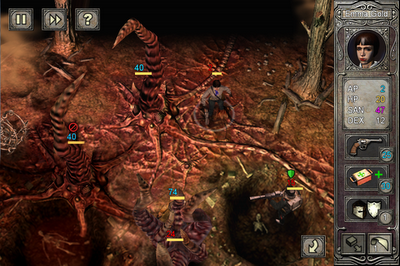
      You knew that tentacles had to come into this eventually, right? Guns work fine here too though...

      Call of Cthulhu: The Wasted Land plays very much like UFO: Enemy Unknown, and I feel quite sure that Red Wasp referred to that earlier game. That said, a few very useful features of its interface are missing and kept me hunting for them! Each character has a certain number of points with which to perform actions during a turn, such as moving or firing a weapon. In UFO: Enemy Unknown, you can set aside points for combat while moving characters. Without being able to reserve points this way, moving characters while retaining enough points to perform useful actions with them becomes much more tedious. I also missed the ability to make characters kneel down for increased protection from enemy attacks. At the end of your turn in Call of Cthulhu: The Wasted Land, characters are frequently left standing around unprotected when no terrain is available to hide in or behind.

      All up, however, Call of Cthulhu: The Wasted Land was a very pleasing and addictive game. It plays out like a highly compressed role-playing campaign in which the monsters are unusually susceptible to lead poisoning :) It also helps that it's gorgeous to look at.

      My biggest grievance is that it was only too short! I sincerely hope that Red Wasp will publish further adventures for this game or release other Call of Cthulhu-based games in future.

      Incidentally, "Never split up the party" is sound advice in this game too!

      Saturday, 31 July 2010

      First impressions of social media

      I have to keep this short because I've had too much to drink and I'm typing under difficulty. But I wanted to get this down while it's all still so new:

      Twitter is basically IRC in super-slow motion AMIRITE?

      And the way that Facebook lets you see the friends of people whom you look up is more than just a bit creepy. RL points out to me that by using this identity the whole experiment is flawed. He's right of course -- it's a real positive skew on the exercise.

      Friday, 30 July 2010

      iPhone4: no luck

      So we thought we'd try our luck at the Telstra shop in the city that was opening at midnight. We weren't keen enough to start lining up way ahead of time; we just thought we'd get there at midnight and see what the line was like.

      [The scene might appear blurry, but this is an accurate
      representation of how it looked to my eyes at midnight]

      At first we were quite encouraged, because it didn't really seem all that long -- I'm crap at estimating distances, so I won't try, but the Telstra guy who wandered down the line to talk to us gave us a form and told us we were 92 in the queue. He also told us that there were already more people in the queue than they had phones, but that if we waited, they could at least get all the paperwork out of the way and we would be early in the queue for the next batch. At that point, he said he thought it would be about an hour.

      This seemed like a reasonable suggestion, but when 45 minutes later he came down to report excitedly that they were getting though the "30s" in the queue, and that we would be served in "about an hour" we called it quits; we'll try again next week.

      In the meantime, I've signed up for Twitter and Facebook. What else do I need?